FactCheckTool is good at what it does. Paste a YouTube video, a TikTok, a news URL, or a PDF. It hands back a credibility score with sources, and flags deepfakes and scams too. If you are a reader trying to judge whether something you found online is trustworthy, it works well.
TrueStandard is built for the other moment. The question is not whether the thing you are reading is fake, but whether the thing you are about to publish is true. Picking between them comes down to one thing. Which side of publish are you on?
Two different jobs
FactCheckTool works on the reading side. Its inputs are finished media someone else made: videos, social posts, articles. Its output is a verdict for the reader. The job is media skepticism: it spots fake news, deepfakes, and scams in content you did not write.
TrueStandard works on the writing side, and its input is your own draft, before it ships. Its output flags the claims you should check first, and you get them before your readers do. The job is pre-publish verification. The two tools rarely compete, because they sit on opposite sides of the publish button. Most teams that need one do not need the other.
Side by side
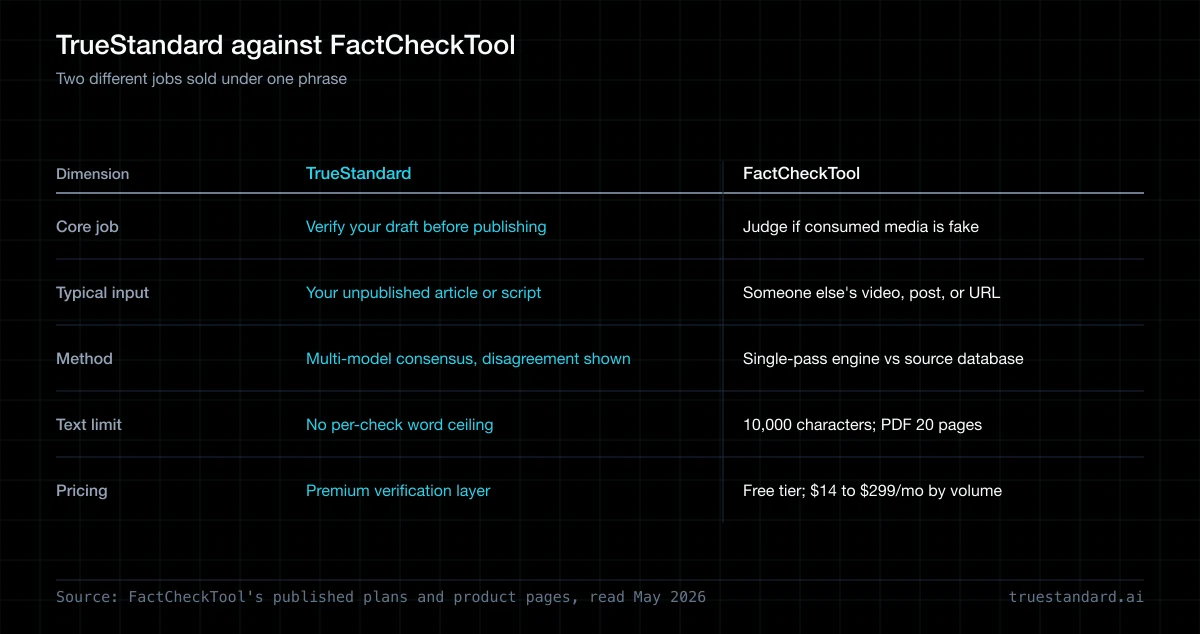
They look alike, but the jobs are not the same.
| Dimension | TrueStandard | FactCheckTool |
|---|---|---|
| Core job | Verify your draft before publishing | Judge if consumed media is fake |
| Typical input | Your unpublished article or script | Someone else's video, post, or URL |
| Method | Four models, and it shows where they split | One pass, checked against a source list |
| Extras | It checks claims, and nothing else | Deepfake, scam, and bias detection |
| Text limit | No per-check word ceiling | Text mode: 10,000 characters; PDF: 20 pages |
| Pricing | A premium layer for people who publish | Free tier; $14–$299/mo by scan volume |
What each one checks
FactCheckTool's strength is the range of what it takes. It reads YouTube, TikTok, Instagram, X, Facebook, Reddit, Vimeo, news articles, and PDFs. It turns audio and video into text, and runs deepfake and scam checks. If your question is whether you can trust a thing you found, that range is exactly right.
TrueStandard does none of that, on purpose: it does not score videos. It does not spot deepfakes or rate other people's articles. It checks the factual claims in a draft you are writing. It uses a panel of models, not one. Publishing a wrong claim under your own name has one cost, and getting someone else's video wrong has another.
Pricing compared
FactCheckTool's published plans, as of May 2026:
| Free | 2 scans, no card required |
| Starter — $14/mo | 30 credits/mo, so 1 credit is 1 scan, any format |
| Pro / Business — $29 / $59/mo | 80 / 150 credits/mo, priority support |
| Enterprise — $299/mo | 680 credits/mo, plus your own account manager |
FactCheckTool is the cheaper tool, and for the odd media check, the free tier may be all you need. TrueStandard is priced as a layer for people who publish for a living. For them, one error caught is worth more than a year of the plan. The two are not really competing on price, because they are not doing the same job.
Who each is best for
Use FactCheckTool if
- — You want to check whether a video, post, or article you found is real
- — You need to spot deepfakes or scams across many kinds of media
- — You are a reader, or a researcher, judging what other people made
Use TrueStandard if
- — You are the author, and the draft has to be right before it ships
- — You want a panel of models on your own claims, and you want to see where they split
- — You publish long-form and need the whole piece checked, not a 10,000-character slice
Common questions
Do TrueStandard and FactCheckTool compete?
Mostly no. FactCheckTool judges whether media you are reading is fake, while TrueStandard checks a draft you are about to publish. They sit on opposite sides of the publish button. Some people do need both, for different reasons.
Can FactCheckTool check my unpublished draft?
You can paste text into its Text mode, up to 10,000 characters, and it will hand back a credibility score. But it is built to score finished media against a source list, in one pass. It is not built to show you where several models disagree on your own claims before you publish.
Is FactCheckTool cheaper than TrueStandard?
Yes. FactCheckTool has a free tier and paid plans from $14/month. TrueStandard is a premium verification layer, priced for people who publish for a living. If you only check a video now and then, FactCheckTool's free tier is the right call.
Does TrueStandard detect deepfakes?
No. Deepfakes, scams, and media formats are what FactCheckTool is good at. TrueStandard only checks the factual claims in text you write.
Keep reading
AI Detector vs Fact Checker
One asks who wrote this. The other asks is this true. Before you publish, only one of those questions protects your name, and most teams are watching the wrong one.
Does Claude Watermark My Writing?
Claude marks the words it chooses, and if you wrote them, there is almost nothing to mark.
AI Detectors Ask the Wrong Question
They flag honest writers. They mark famous human documents as AI, and OpenAI quietly killed its own detector. But the deeper problem is not that detection is unreliable. It is that 'was this written by AI?' was never the question that protects you.
GPTZero's Hallucination Detector, Explained
It catches citations that don't exist. By GPTZero's own admission, it does not check whether what you wrote is true. Here is exactly what its hallucination and source tools do. Here is where the gap is, and what closes it.
TrueStandard vs Omniscient AI
Both run several models, and both show where those models agree. The difference is the moment each one is built for. Omniscient checks what you are reading. TrueStandard checks what you are about to publish.
Check your draft before readers do
You are the one publishing. The real question is not whether someone else's video is fake, but whether your own claims hold up. Run them past a panel of models.
Verify a draft