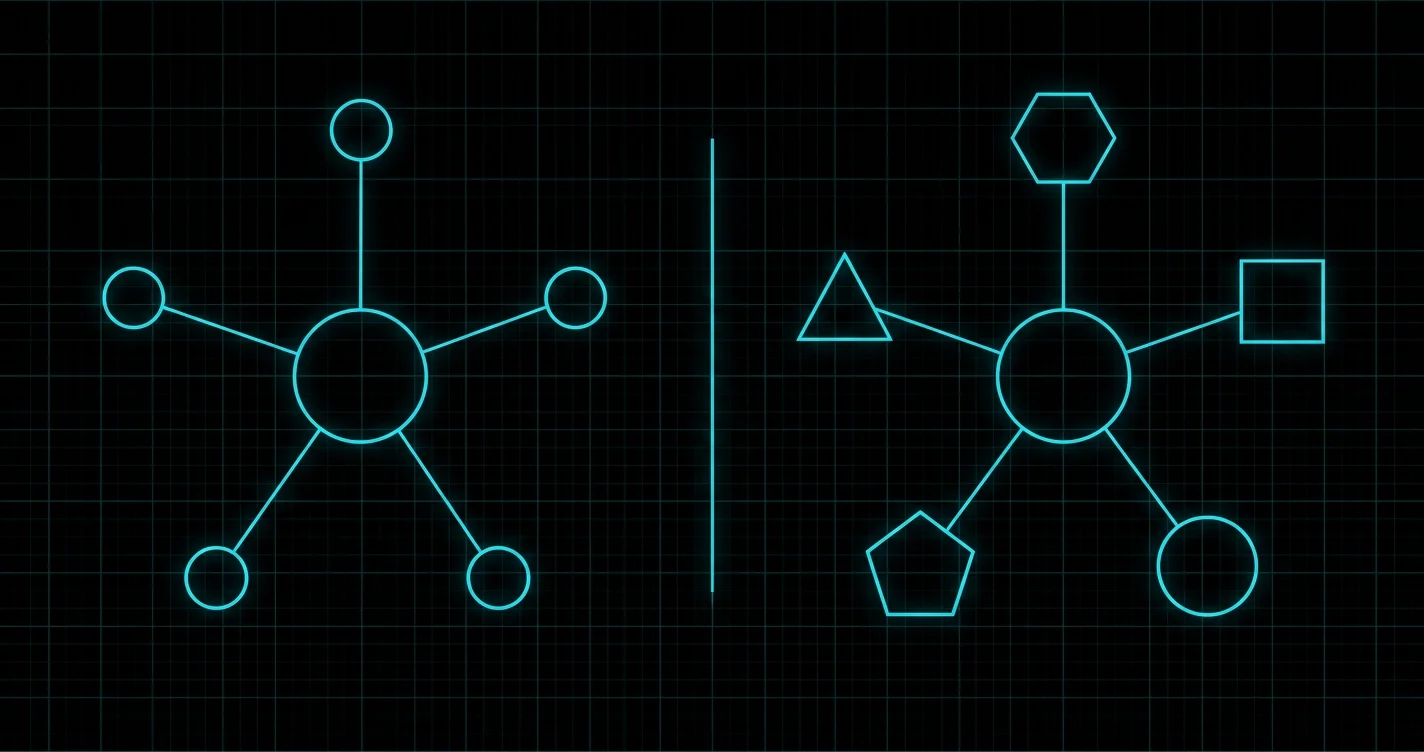
Spend any time on AI Twitter or YouTube and you have seen it. The words 'multi-agent' and 'multi-model' get used as if they meant the same thing. They do not. They describe two completely different architectures, built to solve different problems. And the difference matters most for the job no AI demo ever sells: catching the moments when your AI is confidently wrong.
This guide draws a clean line between the two. It explains what builder Nate Herk actually demos when he shows off Claude's new agent teams feature. It explains what TrueStandard does when it runs your draft through four to five different models at once. And it explains why one architecture is the right tool for production work and the other is the right tool for checking. Swap one for the other and you have made a category error that will eventually publish a wrong answer in your name.
Why these terms get confused
Both terms include the word 'multi.' Both involve more than one AI working in parallel. Both produce impressive demos. The casual reader sees 'I have five agents working together' or 'I have five models checking my work.' They conclude they have heard the same idea twice. This mix-up is nobody's fault. Two technical ideas got marketed in the same week to the same audience. But the mechanics underneath differ. That difference decides whether you can trust the output. It is worth knowing before you bet a piece of published content on the result.
What multi-agent actually is
A multi-agent system is several AI agents given different roles. They usually all run on the same model underneath. They are asked to coordinate on a complex task. Take Nate Herk's April 2026 demo of Claude's new agent teams feature. He spawned three agents: a front-end developer, a backend developer, and a QA agent. He asked them to build a working full-stack web app together. All three agents ran on Claude Sonnet 4.6 (here is why Sonnet is the right default for most Claude workloads). What set them apart was their role descriptions and the files they could edit, not any difference in the model behind them.
How agent teams work in practice
A team lead or main session creates the team. It gives each agent a specialist role and its own files to own. The agents share a task list. They can message each other directly rather than going through the team lead. They work in parallel, so the front-end dev does not wait for the backend dev to finish. And they react to each other in real time. In Nate's demo, the QA agent flagged three issues with the first build. It sent the work back to the developers. The team iterated until QA passed. The output was a polished landing page from a single short prompt.
What multi-agent is good for
- Parallel construction work where different specialists can make progress at the same time
- Tasks that gain from real-time coordination, like front-end and back-end devs checking in while they build
- Workflows with clear dependencies, where one role hands off to the next in a set order
- Production work where you can afford the extra tokens to have one agent QA the work of another
What multi-agent costs
Token use scales linearly with the number of agents. A team of three agents uses roughly three times the tokens of a single agent on the same task. Add the coordination cost between them on top. Nate plainly recommends staying between two and five agents per team. Past that, token cost rises faster than quality does. The team starts to spend more time coordinating than working. Multi-agent is a parallel-execution architecture, not a checking one.
What multi-model actually is
A multi-model system is several different LLMs from different labs. Each was trained on different data with different goals. Each gets the same input and produces its own answer. In TrueStandard's case, the same content goes to Claude, GPT, Gemini, and one or two others at once. Then the answers get compared, and the places they disagree get surfaced. What sets these models apart is structural: different training data, different model architectures, different fine-tuning priorities. That is a deeper difference than role descriptions alone.
How multi-model verification works in practice
You paste your draft or your question into the system. The system fans the input out to four or five different models at once. Each model produces its own answer from its own training. The system then compares the answers. Claims where the models agree are high confidence and likely correct. Claims where they disagree are uncertain, and worth checking on your own before you publish. The whole process takes about 60 seconds. There is no orchestration, no role assignment, no agent-to-agent messaging. Just parallel queries with the answers laid side by side.
The same fan-out works on a judgment call. We asked one question: does a builder learning to sell beat a marketer learning to build? We sent it to ten frontier models as raw calls. The answers split by lab, not by tier. A single app would have hidden that behind one confident reply.
What multi-model is good for
- Fact-checking specific claims in a draft
- Catching the moments when one confident model is wrong. You set its answer beside four others trained on other data
- Generating evidence trails. Five model answers to the same question are a much better record than one
- Publication-grade quality control on AI-assisted content, where being wrong has a real cost
What multi-model costs
A multi-model check costs roughly the same as one query to each model in the panel, run in parallel. The models do not coordinate or iterate. So there is no overhead beyond the raw inference cost, the price of each model working out its answer. For most published content, that is a few cents per draft and 60 seconds of wall time. The expensive part is not the inference. It is the editor or writer time you save by knowing exactly which claims to spot-check.
The critical difference: shared blind spots vs independent views
Here is the difference that decides whether either architecture can check AI output. A multi-agent system runs every agent on the same model underneath. So it has shared blind spots. Say Claude Sonnet 4.6 was trained on data that contains a wrong fact. Then every agent in the team draws on that same training data. That covers the developer, the QA agent and the team lead. The QA agent is not going to flag a wrong fact the model was trained to believe. It will faithfully confirm the fact and move on. This is the design. Agent teams are built to coordinate work, not to bring in a dissenting view.
A multi-model system draws each model from a different lab with different training data. So its blind spots are independent. Claude might confidently confirm a wrong fact. GPT or Gemini may flag it as suspicious, because their training covered the area differently. GPT might hallucinate a citation. Claude may correctly spot it as fake. The architecture is not magic: it just gives you four or five different priors on the same question. The moments when those priors disagree are the moments worth your attention.
This is why TrueStandard uses multi-model and not multi-agent for verification. We did not pick the architecture because it sounded better. We picked it for what it catches. Single-model self-checking will always miss one kind of error, no matter how many agents you wrap around it. Multi-model is the only architecture in 2026 that catches it by design. Multi-agent is the right tool for building things. Multi-model is the right tool for checking that what you built is actually true.
A real example: when agent teams miss what multi-model catches
Imagine you ask a Claude agent team for a B2B blog post. The topic is AI adoption rates in financial services. The team lead spawns a research agent, a writer agent, and a fact-checker agent. The research agent cites a statistic: 'According to a 2025 Gartner survey, 73 percent of mid-market financial services firms have deployed AI in production.' The writer uses it. The fact-checker agent reviews the draft and approves it. The team ships you the finished draft.
Here is the problem. That Gartner statistic is a hallucination: there is no such survey. In this hypothetical, Claude Sonnet 4.6 has a confident but wrong prior about a survey that does not exist. That is why the research agent produced the citation. The fact-checker agent also runs on Claude Sonnet 4.6, so it has the same prior. It looks at the citation and knows the format. Nothing inside it flags the statistic as wrong. So it confirms it. The writer agent never had reason to question it. Three agents, three approvals, one fake statistic now sitting in your published draft.
Now imagine you run the same draft through a multi-model verification step before publishing. The system sends the post to Claude, GPT, Gemini, and two other models. Claude confirms the statistic. Its training matches the original agent team's training. GPT was trained on different data, and it flags the statistic as one it cannot find a source for. Gemini does the same. Two of the five models disagree on this specific claim. The system surfaces the disagreement to you. You spend 30 seconds on the original Gartner site. You confirm the citation does not exist. You edit the draft before publishing. Time saved against manual fact-checking: about 30 minutes per article. Plus you did not publish a fake statistic to your audience.
This is not a rare edge case. Independent benchmarks put hallucination rates for frontier models in the 17 to 34 percent range on factual claims. Then look at the claims B2B writers and journalists care about: statistics, quotes, citations, dates, attributions. The rate there is high. Publish AI-assisted work without multi-model verification and you are accepting a steady drip of errors.
When to use each architecture
They are tools for different jobs, so use them together where each one fits.
Reach for multi-agent when...
- You need to coordinate parallel work. Think building software, drafting and reviewing in turns, or working a queue of tasks
- Different parts of the job need truly different skills, and the cost of role coordination is worth paying
- The bottleneck is speed, not accuracy checking
- You are building something, like a website, a workflow or a pipeline. You are not checking it for correctness
Reach for multi-model when...
- You need to check whether AI output is actually correct
- You are about to publish AI-assisted content. Being wrong costs more than checking does
- Your work depends on factual claims, statistics, quotes, attributions, or dates
- You want an evidence trail: which claims several independent models confirm, and which need a human spot-check
What writers, journalists, and B2B teams should actually do
Use both architectures where each one fits: build with multi-agent, verify with multi-model. Do not try to swap one for the other.
Drafting and producing content
Use a single AI model directly. Or use a multi-agent setup if your workflow gains from parallel specialist roles, say a researcher feeding a writer feeding an editor. Most content work does not need multi-agent at all. Single-model drafting is faster and simpler, and the quality difference is small for typical writing tasks.
Fact-checking and verification
Use multi-model verification, not multi-agent. Fact-checking exists to bring in a view the original draft did not contain. A multi-agent system built on one model cannot do that by design. TrueStandard runs your draft through four to five different models from different labs in parallel. In 60 seconds it surfaces each claim where the models disagree.
Pre-publish quality control
Combine both. Do the production work with whatever single-model or multi-agent setup you prefer. Then add a multi-model check before any AI-assisted content reaches an audience. The check does not replace editorial judgment. It tells you exactly where to apply that judgment, instead of forcing you to spot-check every sentence.
Decision framework: which architecture for which job
If you remember nothing else from this guide, remember this table.
| If your job is... | Use... | Because... |
|---|---|---|
| Building software, websites, or pipelines | Multi-agent (agent teams) | Parallel specialized execution beats sequential single-agent work |
| Drafting articles, emails, posts | Single model (Sonnet 4.6 default) | Multi-agent is overkill for most writing tasks |
| Coordinating parallel work across roles | Multi-agent (agent teams) | Direct messaging and shared task lists are the value prop |
| Fact-checking AI-generated claims | Multi-model verification (TrueStandard) | Different training data is the only structural defense against shared blind spots |
| Pre-publish QA on AI-assisted content | Multi-model verification (TrueStandard) | Single-model self-verification has known ceilings around 60-70% recall |
| Original analysis on contested topics | Multi-model verification on the result | Reasoning differences between models surface contested claims faster than any single model can |
Notice the pattern. Multi-agent owns construction, multi-model owns checking. Using one for the other is a common architecture mistake in 2026. It is the mistake that quietly publishes wrong answers in production. Four rows in this table say 'multi-model verification.' We built TrueStandard for those. Paste your draft. Four to five models from different labs check the claims in parallel, every disagreement surfaced in 60 seconds.
Frequently Asked Questions
What is the difference between multi-agent and multi-model AI?
Multi-agent means several AI agents given different roles and asked to coordinate on a complex task. They usually all run on the same model underneath. Think of a frontend developer agent, a backend developer agent, and a QA agent, all running on Claude Sonnet 4.6. Multi-model means several different LLMs from different labs. Each was trained on different data with different goals, and each gets the same input and gives its own answer. In practice, that means sending the same draft to Claude, GPT, and Gemini in parallel and comparing the answers. Multi-agent is built for parallel execution. Multi-model is built for checking through independent views.
What are Claude's agent teams and what do they do?
Agent teams are an experimental Claude feature released in early 2026. You spawn several specialist AI agents that share a task list. They message each other directly and work in parallel on different parts of a complex job. Builder Nate Herk's most-cited demo uses three agents. They build a complete web app from a single prompt. The three are a front-end developer, a backend developer, and QA. All three usually run on the same model, Claude Sonnet 4.6 in his demos. What sets them apart is their role descriptions and the files they own, not any difference in the model itself.
Can a multi-agent system fact-check itself?
Not reliably. In the standard setup, every agent in the team runs on the same underlying model. So every agent shares the same training data, the same blind spots, and the same wrong priors. A QA agent built on Claude Sonnet 4.6 will faithfully confirm a wrong fact that Claude Sonnet 4.6 was trained to believe. The QA agent holds no view the original agent lacked. This is called homophily. It is the structural reason single-model self-checking plateaus around 60 to 70 percent recall on factual errors. Multi-model verification breaks the failure mode by bringing in models trained on different data.
When should I use multi-model verification instead of multi-agent?
Use multi-model checking any time you need to know whether AI output is really correct. That goes double before you publish AI-assisted content. A model checking its own work will miss certain errors every time. Multi-model is the only setup in 2026 that catches them by design. The value comes from independent views: other training data, other goals, other blind spots. Use multi-agent for parallel build work, where the goal is speed and quality coordination, not catching errors. The two are not rivals. They solve different problems.
Can I combine multi-agent and multi-model?
Yes, and you should if your workflow involves both production and checking. Have a multi-agent team produce the work. A writing team, for instance, might spawn research, drafting, and editing agents. Then add a multi-model check at the end, before publishing. It catches the errors the single-model agent team will not catch on its own. The pair is much stronger than either architecture alone. TrueStandard handles the multi-model layer, and tools like Claude's agent teams handle the multi-agent production layer.
Does multi-agent or multi-model cost more in tokens?
Multi-agent usually costs more per task than a multi-model check. A team of three agents working in parallel uses roughly three times the tokens of a single agent on the same task. Coordination cost between agents comes on top. A multi-model check costs roughly the same as one query to each model in the panel. For a four to five model setup, that is like running the first query four or five times in parallel. For published content, it usually costs a few cents per draft, and saves the better part of an hour of manual fact-checking.
What is the most common mistake AI builders make with these architectures?
Treating multi-agent as a stand-in for a multi-model check. Builders see a QA agent in their team, assume it is fact-checking the work, and ship the output with no independent check. The QA agent is reviewing structure, completeness, and obvious bugs. It is not catching factual hallucinations the model underneath was trained to believe. The fix is to add a multi-model check before publishing, not to add more agents to the team.
Do writers and content teams need multi-agent setups?
Most content workflows do not need multi-agent. A single high-quality model like Claude Sonnet 4.6 handles most drafting, editing, and summary work. The quality is hard to tell apart from a multi-agent team. Multi-agent does earn its place in parallel research-and-writing pipelines, say a research agent and a writing agent sharing notes. Even there, the gain over single-model drafting is small for most uses. What content teams need is a multi-model check at the publish step, whatever produced the draft.
Keep reading
Long Context vs RAG in 2026
Under about 100 pages, put your documents in a long context window. From 100 to 500 pages, Karpathy's wiki method works, and past 500, graph RAG wins. Better retrieval still does not make the answer true.
AI Agent Workflow Patterns: When Each One Works (and When It Fails)
Six patterns cover almost every agent you'll build. Five are routine. The sixth, verification, breaks when you wire it with a single model, and most teams wire it that way.
Every Type of AI, Explained
From large language models to coding agents: what each type of AI does, which tools lead each group, and how to pick the right one for your work.
Karpathy's 3 AI Methods, and What They Don't Fix
Andrej Karpathy's three 2026 methods are autoresearch, the LLM Wiki and brevity constraints. Autoresearch tunes metrics, the wiki organizes memory, and brevity cuts reasoning loops. None of them checks whether a writer's claims are true.
3 AI Stress Tests from Q2 2026
In April 2026, top AI builders ran real experiments instead of demos. The results were more interesting than the demos. Here is what each test reveals, and why none of them fully answers the question writers care about.
Build With Multi-Agent. Verify With Multi-Model.
These are different tools for different jobs. Use multi-agent for parallel construction, and multi-model to catch the errors single-model agent teams cannot catch by design. TrueStandard runs your draft through four to five different models from different labs in 60 seconds. It surfaces every disagreement before your readers see it.
TrueStandard is for writers who publish AI-assisted drafts. Paid plans check every claim and citation across four AI models before you hit publish.
Free: one check a day, no signup. Pro is $20 a month for 250 drafts.
Start Verifying →