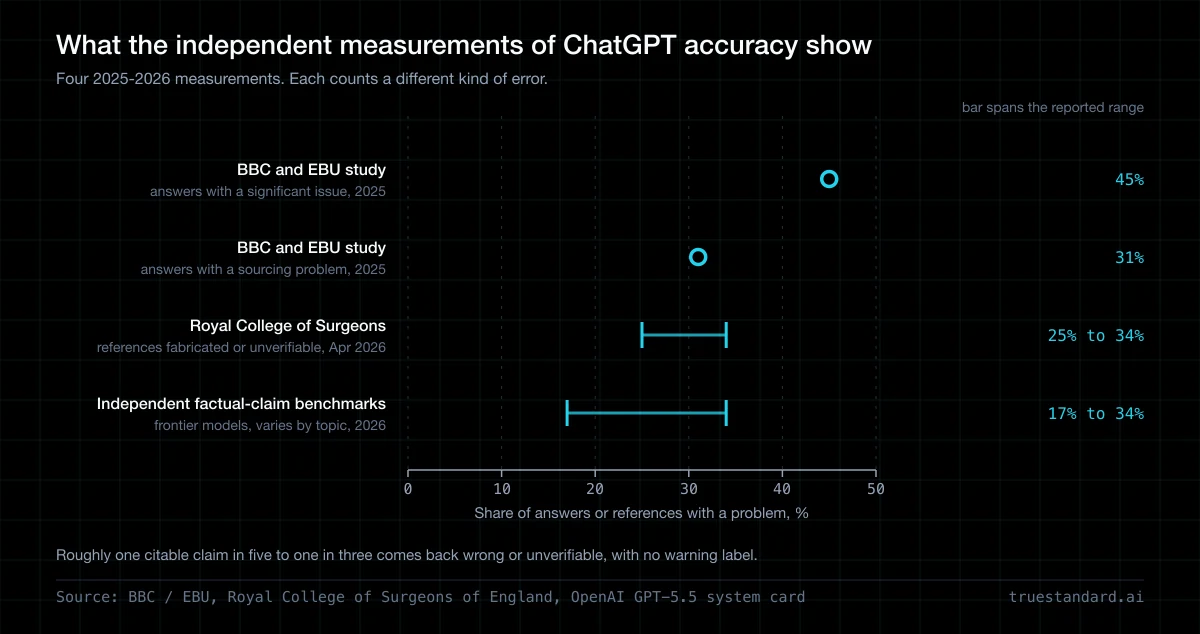
ChatGPT is accurate for well-documented, everyday questions, and unreliable on specifics. Independent benchmarks put hallucination rates for frontier models at 17 to 34 percent on factual claims. That includes ChatGPT. A 2025 BBC and EBU study found 45 percent of AI answers carried at least one significant issue. Verify before you publish.
That range is the whole story. It is why a simple yes or no misleads people. Ask ChatGPT to explain photosynthesis and it will nail it. Now ask it for the exact figure in a niche market report, a case citation, or a quote from a named source. The same confident voice will sometimes hand you something that does not exist. This guide puts real numbers on ChatGPT's accuracy. It shows where it is trustworthy and where it invents. It walks through what that has already cost people. And it gives you a practical way to catch the errors before your name is on them.
How accurate is ChatGPT, in numbers
There is no single accuracy percentage for ChatGPT, because accuracy depends on the question. But the independent measurements that do exist point the same way. Good on average. Unreliable on the specific claims that matter most when you publish.
The most useful way to read the data is as a floor and a ceiling. On broad, well-documented topics ChatGPT is right most of the time. Then take a factual claim that needs a precise figure, a real source, or a named quote. There the error rate climbs fast. It climbs highest on the niche subjects that make your work worth reading. Here is what the recent measurements show.
What the measurements actually show
| Study or benchmark | What it found | When |
|---|---|---|
| BBC and EBU study | 45% of AI assistant answers had at least one significant issue; 31% had sourcing problems | 2025 |
| Independent factual-claim benchmarks | 17-34% hallucination rate for frontier models, depending on topic | 2026 |
| Royal College of Surgeons of England | 25-34% of references from some LLMs were fabricated or unverifiable | Apr 2026 |
| OpenAI GPT-5.5 system card | Increased fabricated-facts incidence versus GPT-5.4 on representative prompts | Apr 2026 |
Sources: the BBC and EBU multi-newsroom study, the Royal College of Surgeons of England test, and OpenAI's own GPT-5.5 system card. Treat the 17-34% band as directional. The exact number moves with the topic and the model version. The full sourced picture, benchmark by benchmark, is in AI hallucination rates in 2026.
Put those together and a fair summary is this. ChatGPT answers most everyday questions correctly. But take the kind of factual claim you would actually cite: a statistic, a study, a quote, a date. Roughly one in five to one in three comes back wrong or unverifiable. That is not a rounding error. In a newsletter with a dozen claims, at least one is almost certainly off. And no warning label tells you which one.
The error rate is not what catches people. A wrong ChatGPT answer looks exactly like a right one. Same fluent, confident prose. That is why the fix is not reading more carefully. It is checking the specific claim against something independent. TrueStandard runs your draft through four to five frontier models at once. It surfaces every claim they do not all agree on, in about 60 seconds.
Where ChatGPT is accurate, and where it breaks
The most useful thing to know about ChatGPT's accuracy is that it is uneven in a predictable way. It is not randomly wrong. It fails hardest in specific, nameable categories. Once you know them, you know exactly which parts of a draft to distrust.
The pattern comes down to two things. How much well-structured training data exists for a claim, and how specific the claim is. Broad, heavily documented facts are anchored by millions of consistent examples. So ChatGPT reproduces them reliably. Precise, sparse, or recent facts have thin support. So the model fills the gap with something plausible instead of admitting it does not know. The more your work leans on specifics, the more it leans on the part of ChatGPT that is least reliable.
Reliable vs invented
| Type of claim | How reliable | Why |
|---|---|---|
| General explanations and definitions | High | Densely documented in training data |
| Step-by-step reasoning on common problems | Medium-high | Well-represented patterns, but errors compound |
| Specific statistics and figures | Low | Precise numbers are sparse and easy to approximate wrongly |
| Academic or legal citations | Very low | Format is easy to fake; the underlying source often does not exist |
| Quotes attributed to named people | Low | Plausible wording gets invented and misattributed |
| Recent or niche events | Low | Thin or missing from training data, so it guesses |
Notice which rows are low-reliability. They are exactly the claims that carry the most weight in published work. The stat that anchors your argument. The citation that proves you did the reading. The quote that gives a piece authority. This is the same failure shape behind why AI citations are wrong. It is why a draft can read flawlessly and still rest on three claims that will not survive a fact-check.
What it costs when nobody checks
ChatGPT's error rate is abstract until it lands on someone. The best-documented cases come from professionals who had every reason to check. They did not, because the output looked right.
The original example is Mata v. Avianca. Two attorneys filed a brief built on court cases ChatGPT invented, complete with realistic citations. They were sanctioned and fined. It was not a one-off. In April 2026, Sullivan and Cromwell, an elite Wall Street firm, apologized to a federal bankruptcy judge for AI-introduced errors in a filing (Reuters, April 21 2026). And these are not a handful of headline cases. A 2026 Stanford-led benchmark catalogued more than 1,000 court filings with fabricated citations, a count still rising year over year (Who Checks the Citations?). Sullivan and Cromwell's review processes are the envy of BigLaw. When a firm like that ships hallucinated citations, the lesson is not that they were careless. It is that normal review does not catch this specific failure.
The same thing is happening in science. A May 2026 letter in The Lancet audited 2.5 million open-access papers in PubMed Central. It found nearly 3,000 published papers with references that cannot be traced (Nature · STAT). These are peer-reviewed papers. They cleared human review with invented sources inside them.
You are not filing federal briefs or publishing in The Lancet. But the mechanism that burned them is the same one at work in your drafts. A confident model. A plausible-looking claim. A human who trusted the fluency. And no independent check between the draft and the audience. The stakes scale down. The failure does not change shape. For a newsletter it is a wrong stat screenshotted and shared before you can send a correction. For a client deliverable it is your credibility.
Every one of these cases shares a thread. A single model produced the error, and nobody had an independent second opinion before it shipped. That is the gap TrueStandard is built to close. It checks the claims in your draft across models from different vendors. Then it flags the ones they cannot agree on, before your readers or your editor find them first.
Why a smarter ChatGPT will not fix it
The natural hope is that the next version solves this. The evidence says otherwise, and the reason is structural rather than temporary.
An April 2026 Purdue preprint proves a no-free-lunch result. Removing hallucination from training data alone is statistically impossible, no matter how clean the corpus. The one exception is if fact-aligned structure is built into the model itself (Purdue). Worse, the trend does not move in one direction. OpenAI's own GPT-5.5 system card reports an increase in fabricated-facts incidence versus GPT-5.4 on representative prompts. The pattern shows up in hard numbers, too. A 2026 benchmark of legal citations found GPT-5.1 fabricated references at 6.57 percent. That is up from 1.23 percent for the GPT-4o release a year earlier (Who Checks the Citations?). Newer reasoning models run long chains of thought. Some have started to hallucinate more on some tasks, because more generation steps mean more chances to invent.
So the honest read is this. ChatGPT will keep getting better on average. It will also keep hallucinating on the specific claims you publish. Rising average accuracy makes the errors that remain more dangerous, because people check less as the tool feels more reliable. There is a deeper reason. ChatGPT is fluent whether or not it is right. So confidence tells you nothing about accuracy. That is the trap we unpack in why AI is confidently wrong and trace to its root in the structural cause of AI hallucination. If the problem is structural, the fix has to be structural too. Waiting for a better model is not a plan.
Is ChatGPT accurate enough for research?
This is the question behind most searches for ChatGPT's accuracy. It deserves a direct answer. ChatGPT is a good research starting point and a bad research endpoint.
Use it to get oriented, to sum up a topic, or to surface directions to explore. There it is genuinely useful, and mostly accurate on the shape of a subject. The failure comes when you treat its output as a finished citation rather than a lead. A reference from ChatGPT is a hypothesis to check against the primary source, not a confirmed fact. The citation-shaped rows are exactly where its accuracy is lowest. The same caution applies to the newer deep-research modes, which we look at in is AI deep research reliable. A longer, more confident report is still built on claims that need checking. Length can disguise how many of them were never verified.
The practical rule: use ChatGPT to find things, and use an independent check to confirm them. Every statistic, source, and quote in your published work should trace back to something that is not ChatGPT. Do that before it ships. That is how you use a fast, fallible research assistant responsibly.
How to check whether ChatGPT is right
Most people reach for the same instinct: ask ChatGPT to double-check its own work. It does not work, and understanding why points at what does.
A model asked to check its own output runs the same probability distribution that produced the claim. Say it invented a citation because the pattern looked right. Asking is this citation real returns the same confident yes. Nothing independent has entered the loop. This is also why re-pasting into a fresh ChatGPT window is weaker than it feels. It is the same model architecture, prone to the same blind spots. Real verification needs independence. It needs a source of judgment that was trained differently and does not share the original error.
Ways to check a ChatGPT claim, compared
| Method | What it catches | Time cost |
|---|---|---|
| Ask ChatGPT to double-check itself | Little; shares the original blind spot | Seconds |
| Trace each claim to its primary source by hand | Nearly everything, if you have time | High, per claim |
| Re-paste into a different single chatbot | Some, but still one model's view | Low |
| Run the claim across multiple independent models | Disagreement flags exactly what to verify | About 60 seconds |
Manual lateral reading is the gold standard. For a single high-stakes claim it is worth doing. The problem is that it does not scale to every claim in every draft under a deadline. That is why most people skip it and hope. The efficient version keeps the independence and drops the tab-switching. Ask several models trained by different labs the same question. Then read where they disagree. When independent models land on the same answer, that agreement is a real signal the claim is probably sound. When they split, they have pointed you straight at the sentence that needs a human. You are not left re-reading ten paragraphs hunting for an error you cannot see.
That is exactly what TrueStandard does, and why it exists. Paste your ChatGPT draft. Four to five frontier models from different vendors check every claim in parallel. In about 60 seconds you get back the specific claims they disagree on, ranked by how far apart they are. It is the difference between hoping ChatGPT got it right and knowing which three sentences to look at. Want the manual version first? Our guide to checking whether AI citations are fake walks through it. And is there a most accurate AI model explains why picking a different single model is not the answer either.
Frequently Asked Questions
How accurate is ChatGPT?
ChatGPT is accurate for well-documented, everyday questions, and unreliable on specifics. Independent benchmarks put hallucination rates for frontier models in the 17 to 34 percent range on factual claims. That includes ChatGPT. A 2025 BBC and EBU study found 45 percent of AI assistant answers had at least one significant issue. It is reliable enough to draft with. It is not reliable enough to publish from without checking the specific claims.
Is ChatGPT reliable for research?
It is a good research starting point and a poor endpoint. ChatGPT is useful for getting oriented and surfacing directions. It is mostly accurate on the broad shape of a subject. It is unreliable on the specific citations, statistics, and quotes that research depends on. So treat anything it produces as a lead to verify against the primary source, not a confirmed fact.
How often is ChatGPT wrong?
On factual claims, independent benchmarks put the error rate for frontier models at roughly 17 to 34 percent, depending on topic. A large 2025 news-industry study found 45 percent of AI answers carried at least one significant issue. The rate is much lower for general knowledge. It is much higher for niche subjects, precise figures, citations, and recent events. There is no reliable warning when it is wrong. That is the core problem.
Is ChatGPT accurate for medical or legal questions?
Not accurate enough to rely on unverified. Testing by the Royal College of Surgeons of England found 25 to 34 percent of references from some models were fabricated or unverifiable. Courts have sanctioned lawyers for filing briefs built on cases ChatGPT invented. For any medical or legal claim, ChatGPT can help you find leads. But every claim must be confirmed against an authoritative primary source before you act on it.
Is ChatGPT getting more accurate over time?
On average yes, but not in a way that removes the risk. A Purdue impossibility result shows hallucination cannot be removed from training data alone. OpenAI's own GPT-5.5 system card reported more fabricated-facts incidents than the prior version on representative prompts. Reasoning models that generate longer answers can hallucinate more, not less. Rising average accuracy also makes people check less. So the errors that remain slip through more easily.
How do I check if ChatGPT is right?
Do not ask ChatGPT to check itself. It shares the blind spot that produced the error. Verify the specific claim against something independent. Trace it to a primary source by hand. Or run the exact claim across several models trained by different labs and look for disagreement. When independent models agree, the claim is probably sound. When they disagree, they have flagged exactly what a human needs to confirm before you publish.
Is GPT-5 more accurate than earlier versions of ChatGPT?
It is stronger on most benchmarks. More capable does not mean safe to trust unverified. OpenAI's GPT-5.5 system card actually reported an increase in fabricated-facts incidence versus GPT-5.4 on representative prompts. Each version improves the average. It still hallucinates on the specific, high-stakes claims that matter when you publish. So the checking step stays necessary, whichever version you use.
Can I trust ChatGPT for facts?
Trust it to draft and to explain, not to be your final source of truth. For a fact that will appear in published or high-stakes work, confirm it independently before it ships. ChatGPT states false claims with the same confidence it uses for true ones. It gives no signal about which is which. The reliable pattern is to use it to move fast, then check the specifics separately.
Keep reading
Is There a Most Accurate AI Model?
The honest answer is no. The ranking changes with the task, the benchmark, and the month, and even the leader still hallucinates.
Should You Stop Using ChatGPT?
Researchers found AI made experts measurably worse on hard tasks. Here is when to trust ChatGPT, and when it is just telling you what you want to hear.
AI Hallucination Rates in 2026: What the Data Actually Shows
A sourced reference of the 2026 hallucination-rate numbers. What each benchmark measured. Which models did best and worst. And where the widely quoted figures get misread. Built to be linked and kept current as new data lands.
Which AI Fabricates Citations? We Tested Four Models
We asked four frontier models for peer-reviewed sources on 30 claims. Then we resolved every DOI they gave us against Crossref and DataCite, and 21 of 146 did not exist. The fabrication rate varies three and a half times between vendors. And every single fake landed on a claim that has real literature behind it.
TrueStandard vs Parafact
Both verify claims before you publish. The real difference is what one model can miss, and whether your long-form draft fits inside the check at all.
Is AI accurate for your field?
The failure modes change by profession. These break down what AI gets wrong in specific fields, with the incidents and the checks that catch them.
What we measured on this model
Each release page carries our own fabrication data for one model version, measured against the model it replaced in the same vendor's line.
Know Which ChatGPT Claims to Trust.
ChatGPT is right most of the time. It is wrong exactly when it costs you most, with no warning either way. Paste your draft into TrueStandard. Four to five frontier models check every claim in about 60 seconds, flagging the ones they disagree on before your readers do.
Check Your Draft →