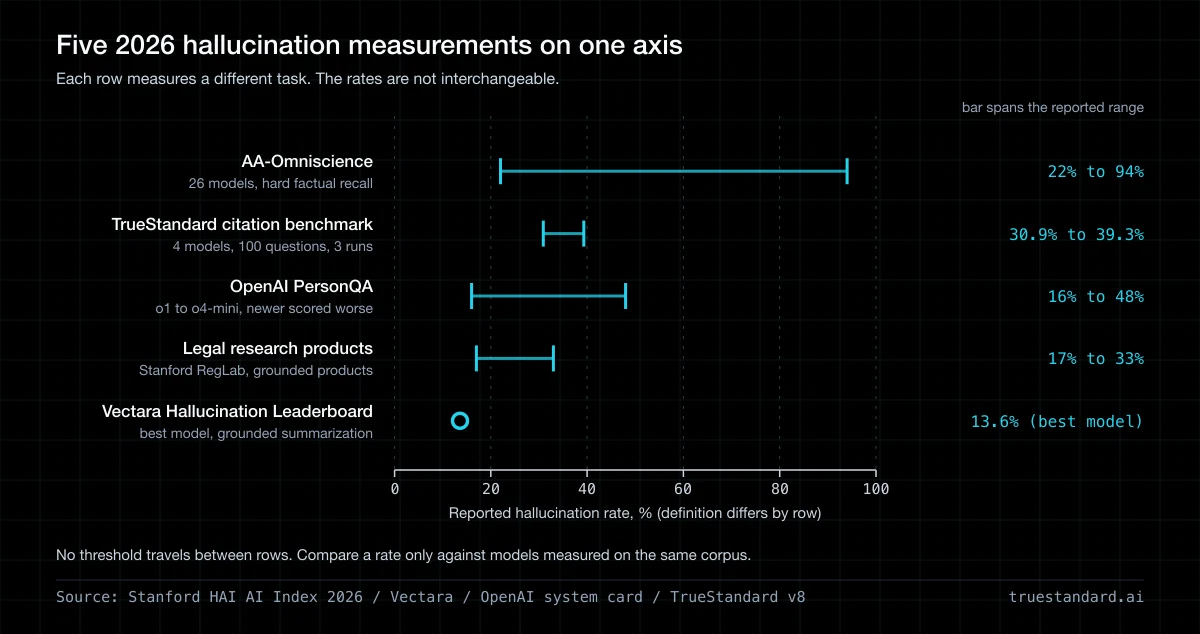
How often does AI hallucinate? It depends on what you ask it to do. Take purposely hard factual questions. Rates across 26 top models run from 22 to 94 percent, per the Stanford AI Index 2026. Hand the model the source text and ask it to sum that up, and the best one still makes things up in 13.6 percent of answers. In real tools, grounded legal research products hallucinated on 17 to 33 percent of queries in Stanford's testing. So there is no single hallucination rate. Anyone quoting one number without naming the benchmark is telling you less than they appear to.
This page collects the 2026 numbers that hold up. Each comes with the benchmark it came from, and what that benchmark measured. We run our own measurement too: five frontier models, every DOI resolved against the registry that issues them, updated on each release. See which AI hallucinates the least, and each model's own numbers on our model release pages. Rates are high where models must recall facts unaided, and lower, but not low, when the model is handed sources. And they are worst on the very stuff published work depends on: specific statistics, citations, and niche detail. For the mechanism behind the failure, see why AI hallucinates. This is the data.
The headline number, read correctly
The most quoted hallucination number of 2026 comes from the Stanford AI Index. Most people quoting it have not read what it measures.
The Stanford HAI 2026 AI Index reports this in its Responsible AI chapter. Hallucination rates across 26 top models range from 22 to 94 percent on a new accuracy benchmark (Stanford HAI). The benchmark behind that sentence is AA-Omniscience, from the testing firm Artificial Analysis. It runs 6,000 questions across 42 topics in six fields, among them law, health and software engineering. The paper calls it a measure of factual recall and knowledge calibration, meaning whether a model's confidence matches reality. It reports lasting weakness on both (arXiv).
The definition is the part that matters. On AA-Omniscience, the hallucination rate is the share of questions a model got wrong. That share is taken out of the questions it could not answer correctly. It measures how often the model guessed instead of saying it did not know. A rate of 94 percent does not mean the model is wrong 94 percent of the time you use it. It means something else: when the model lacks the knowledge, it makes up an answer 94 times out of 100 rather than owning the gap. That is a calibration failure, and for anyone who publishes it is the dangerous one. A model that never says I don't know is just as smooth when it makes things up as when it has the facts. We unpack that trap in why AI is confidently wrong.
The finding underneath the range is starker than the range itself. When Artificial Analysis launched the benchmark, it tested 36 models. On these hard questions, 33 of them were more likely to hallucinate than to answer correctly. Only three scored above zero on the paired Omniscience Index, which rewards right answers, docks wrong ones, and lets a model decline for free. GPT-5 (high) posted a rate of 81 percent. The best rate in the field was Claude 4.5 Haiku's, and it was still 26 percent. That is roughly one confident invention for each four gaps in its knowledge.
The benchmarks behind the numbers
Four 2026 measurements come up again and again, and they test different things. That is why their numbers differ, and why quoting one without its context misleads. The fifth row is ours, included so you can see what an open benchmark looks like. The people publishing it also publish the corpus, the run count and the scorer.
The 2026 hallucination benchmarks
| Benchmark | What it measures | Headline finding | Source |
|---|---|---|---|
| AA-Omniscience | Guessing vs. abstaining on 6,000 hard factual questions | Rates of 22-94% across 26 top models; 33 of 36 more likely to hallucinate than answer correctly | Artificial Analysis / Stanford AI Index, 2026 |
| Vectara Hallucination Leaderboard | Fabrication when summarizing a document the model is handed | Best model (Gemini-3-Pro) at 13.6%; GPT-5, Claude Sonnet 4.5, and Grok-4 all above 10% | Vectara, 2026 |
| KaBLE | Whether models can tell a user's false belief from a fact, 13,000 questions, 24 models | GPT-4o fell from 98.2% to 64.4% accuracy on false first-person beliefs; DeepSeek R1 from over 90% to 14.4% | Suzgun et al., Nature Machine Intelligence, 2025 |
| OpenAI PersonQA | OpenAI's own hallucination eval on questions about people | o1: 16% → o3: 33% → o4-mini: 48%, newer reasoning models hallucinated more | OpenAI o3/o4-mini system card, 2025 |
| TrueStandard citation benchmark | Fabricated sources when a model is asked for peer-reviewed citations, every DOI resolved against Crossref and DataCite | 30.9-39.3% of offered DOIs did not resolve, four models on 100 questions, three runs each | TrueStandard, August 2026 |
Sources: Stanford HAI 2026 AI Index; AA-Omniscience; Vectara Hallucination Leaderboard; Suzgun et al., Nature Machine Intelligence; OpenAI system card.
Notice what changes between rows. AA-Omniscience tests unaided recall under pressure, so its numbers are the ceiling of the problem. Vectara hands the model the source and asks only for a faithful summary. That is about the easiest factual task there is, and the field still cannot get under 10 percent. KaBLE is different in kind: each model tested had the knowledge to answer. Accuracy collapsed anyway the moment a false claim arrived framed as the user's own belief. That is how false claims really do arrive in drafts, briefs, and newsletters. And PersonQA is OpenAI grading itself, which is what makes its direction worth noting. Each new reasoning model hallucinated more than the last, not less.
The one we run ourselves
Each other row in that table is someone else's work. This one is ours. We publish it the way we wish the others did: named corpus, counted runs, and a scorer you can check without trusting us.
We ask frontier models for peer-reviewed sources on a fixed set of claims. Then we resolve every DOI they return against Crossref and DataCite. A DOI either resolves or it does not, so nothing here depends on a model grading another model. In the August 2026 arm, four models answered 100 questions three times each, sampled from the public AA-Omniscience corpus. That gave 1,200 answers and 2,429 offered DOIs.
Made-up DOIs by model, August 2026, all three runs
| Model | Questions answered | Made-up DOIs | 95% range |
|---|---|---|---|
| Grok 4.3 | 68% | 30.9% | 27.3–34.8% |
| Gemini 3.7 Flash | 98% | 37.5% | 34.2–41.0% |
| Claude Sonnet 5 | 69% | 39.3% | 35.0–43.7% |
| GPT-5.6 Luna | 98% | 32.8% | 29.0–36.8% |
Each row is one model on 100 questions, asked three times. Questions answered is the share of questions that got an answer. Made-up DOIs is the share of its DOIs that neither Crossref nor DataCite knows. The 95% range shows where the true rate most likely falls.
Read the two columns together or neither one means much. Grok 4.3 has the lowest fabrication rate here, and it answered the fewest questions. Rank by questions answered with a citation that resolves and it comes third. Grok 4.3 against GPT-5.6 Luna is statistically indistinguishable. So is Gemini against Sonnet 5, and no ordering can be claimed for those pairs. Corrected 3 September 2026: this row ran at 54.2% until we found a defect in our DOI extractor. It read the asterisks of markdown bold as part of the identifier. Luna is the only model here that bolds its citations, so the scorer turned 179 real papers into inventions. The other three rows are unchanged.
These numbers are not comparable to the four rows above. That is the point of the section. Our own control arm changed nothing but the question set, holding the model, the prompt and the scorer still. The rate went from 10.9 to 30.9 percent. Benchmark difficulty moves a rate further than the choice of model does. That is the single most useful thing to know before quoting any figure on this page.
The full experiment is in why hallucination benchmarks disagree.
One more result worth carrying. Across 855 dead DOIs in that arm, 832 were distinct, and only 2 were invented by more than one model. Models mostly invent their own identifiers rather than landing on a shared fake. That is what makes cross-model agreement a usable signal at all.
What do the hallucination leaderboards measure?
Each public leaderboard counts a different failure, so one model can top one board and trail another. Claude Fable 5.1 shows it. Of five models we also test, it has the worst Artificial Analysis rate and the fewest made-up citations on ours. Artificial Analysis counts wrong guesses on questions a model cannot answer. Vectara counts made-up details in a summary of a document the model was given. We count citations that point at no paper.
The Artificial Analysis board shows three numbers
The AA-Omniscience page gives each model three scores on 6,000 questions. Accuracy is the share of all the questions it got right. The hallucination rate looks only at the questions it did not get right. It is the share of those where the model gave a wrong answer instead of declining. The Omniscience Index runs from -100 to 100. Right answers add to it, wrong ones take away, and declining costs nothing (Artificial Analysis, read September 26, 2026).
So the rate says nothing about how much a model knows. The lowest rate on the board is 1 percent. It belongs to MiniCPM5-1B, a small model with one billion parameters. A rate that low means almost none of its misses were wrong guesses. To see how much a model knows, read accuracy.
The Stanford AI Index 2026 quotes this same count. Its line reads: "hallucination rates across 26 top models range from 22% to 94%" (Stanford HAI, read September 26, 2026). The benchmark behind it is AA-Omniscience, as the section above explains. So the 94 percent is a share of the questions that model missed.
The AI hallucination index is two different things
Search for an AI hallucination index and you find two. One is the Omniscience Index above, the score from -100 to 100. The other is Galileo's Hallucination Index, published in November 2023. It tested 11 models on three tasks. The tasks were questions without sources, questions with sources, and long-form writing (Galileo, read September 26, 2026). Its model list dates from 2023. Vectara's board is a third one with the word in its name. It scores summaries only, as row two of the benchmark table shows.
Five models on the AA board and on ours
Five models appear on both the AA board and our release pages. Here they are side by side. Where AA lists a model at more than one effort setting, the cell shows the range across those settings.
Five models on the Artificial Analysis board and on our test
| Model | AA hallucination rate | AA accuracy | AA questions tried | Made-up DOIs, our test | 95% range | Our run |
|---|---|---|---|---|---|---|
| Grok 4.7 | 29.3% | 47.4% | 63.8% | 4.7% | 2.1–9.8% | Sep 22 |
| Grok 4.6 | 34.3% | 48.2% | 66.8% | 6.2% | 3.2–11.7% | Aug 21 |
| GPT-6 Astra | 44.8–51.3% | 61.1–62.6% | 80.3–83.4% | 3.0% | 1.0–8.4% | Sep 7 |
| Gemini 3.8 Flash | 55.2% | 54.6% | 81.7% | 20.0% | 14.1–27.5% | Sep 3 |
| Claude Fable 5.1 | 70.5–72.6% | 66.2–67.2% | 92.5–93.4% | 1.4% | 0.4–4.9% | Sep 3 |
AA means Artificial Analysis, and each row is one model. The AA hallucination rate is the share of missed questions where the model gave a wrong answer. AA columns come from 6,000 questions on the AA-Omniscience page, read on September 26, 2026, and a range spans the effort levels AA lists. Our columns use the same 30 claims, three runs per model, on the date shown in 2026. A made-up DOI is a paper ID that neither Crossref nor DataCite, the two DOI registries, knows. The 95% range shows where the true rate most likely falls.
The two boards do not agree on the order. Claude Fable 5.1 has the worst AA rate of the five. It also has the best AA accuracy. On our test it made up 2 of the 144 DOIs it gave, the fewest here. Grok 4.7 has the best AA rate, and it tried the fewest questions.
The two boards count different failures. Fable 5.1 tries about 93 percent of the AA questions, so most of its misses turn into guesses. But when it names a paper, the paper almost always exists. A model that declines more gets a lower AA rate without knowing any more.
Our column cannot rank these five either. Each model ran on its own day, against the model it replaced. The same test can move a model ten points a week apart. Grok 4.6 made up 6.2 percent of its DOIs on August 21. On September 22, with the same claims and the same prompt, it made up 12.5 percent. Only Gemini 3.8 Flash has a range that does not overlap the other four. Even it overlaps that second Grok 4.6 run.
So quote a leaderboard number with its board and its axis, or not at all. The full method and each model's own numbers are on our model release pages.
Which AI hallucinates the least?
On 2026 data there is no single safest model. Claude 4.5 Haiku posted the lowest hallucination rate on hard factual recall (26 percent on AA-Omniscience). Gemini-3-Pro leads grounded summary work (13.6 percent on Vectara's harder benchmark). And Claude 4.1 Opus topped the Omniscience Index, largely by declining to guess when it did not know. The leader changes with the benchmark. And each leader still invents at rates no publisher would accept from a human researcher.
The Opus result is worth sitting with, because it shows what a low rate actually costs. The Omniscience Index does not dock a model for saying I don't know. Opus won it by declining, trading answers for reliability. That is the right trade for a careful assistant. It is a useless one for anyone hoping a low rate means the output can ship unchecked. The rate is low because the model answered less, not because its answers became true. Why the model-ranking question is the wrong question is covered in is there a most accurate AI model, and the ChatGPT-specific numbers live in how accurate is ChatGPT. What reliability means once ranking stops helping is set out in AI reliability.
There is a practical use for the fact that models fail differently. They are trained by different labs on different data, so they rarely invent the same fact the same way. Where several independent models agree, the claim is usually sound. Where they disagree, you have found exactly what needs a human check. That disagreement signal is the mechanism TrueStandard runs on: a draft goes through four to five frontier models at once. The claims they cannot all back up come back flagged, in about 60 seconds.
Hallucination rates in the wild, by field
Benchmarks are controlled conditions. The recorded rates from real work show what those benchmarks predict.
Recorded rates by field, 2023-2026
| Field | Documented rate | Source |
|---|---|---|
| Legal research | Grounded legal AI tools hallucinated on 17-33% of queries; GPT-5.1 fabricated 6.57% of legal citations, up from 1.23% for GPT-4o | Stanford RegLab; Who Checks the Citations? (2026) |
| Medical & academic citations | 47% of ChatGPT-generated medical references fully fabricated; 4,046 fake citations found across 2,810 published papers | Cureus (2023); Columbia / The Lancet audit (2026) |
| News & current events | 45% of AI answers about news carried at least one significant issue; 8 AI search engines misattributed sources on 60%+ of queries | BBC / EBU (2025); CJR Tow Center (2025) |
| Software packages | 19.7% of AI-suggested package names did not exist; 43% of the fabrications recurred in every one of ten repeated runs | USENIX Security (2025) |
| Personal finance | 7 major AI platforms gave inconsistent advice to identical prompts, with recommendations varying by the hypothetical user's race or gender | Journal of Financial Planning (June 2026) |
Sources: Stanford RegLab; Who Checks the Citations?; Cureus; Columbia Nursing; BBC / EBU study; CJR Tow Center; USENIX Security; CNBC on the JFP study.
The rates land highest on exactly the stuff that carries the most weight. The citation that proves the claim. The number that anchors the argument. The niche detail that makes a piece worth reading. And the failures are no longer near-misses caught in review; they are reaching the permanent record. By mid-2026, researcher Damien Charlotin's public database had logged more than 1,600 court cases worldwide involving AI-hallucinated content. The Columbia audit found fake sources sitting uncorrected in peer-reviewed journals. The full list of recorded cases, from Mata v. Avianca to CNET's corrections, is in our fake-citation disasters reference.
Five ways these numbers get misread
Hallucination numbers travel badly. The same five misreadings turn up almost everywhere they are quoted.
Reading 94% as "AI is wrong 94% of the time"
The AA-Omniscience figures count guesses on questions the model could not answer. Those questions were written to be hard. On common, well-covered topics, frontier models are right far more often than not. The honest statement is narrower and more useful: when a model does not know, it usually makes something up rather than admitting it. And nothing in the output tells you which mode you are in.
Quoting the best benchmark number as if it transfers
Gemini-3-Pro's 13.6 percent on Vectara measures one task: summing up a document it was handed. That number says nothing about open factual recall, where the same generation of models posts rates from 22 to 94 percent. A rate only means something attached to the task it was measured on. And vendors, fairly enough, quote the task they score best at.
Assuming newer models hallucinate less
The trend does not move in one direction. OpenAI's own tests are the cleanest evidence. On PersonQA, o3 hallucinated at double the rate of o1, and o4-mini reached 48 percent. A 2026 legal-citation benchmark found GPT-5.1 inventing sources at five times the rate of the year-older GPT-4o. Each release is better at many things. Being finished with hallucination has not been one of them.
Comparing rates across different definitions
One study counts fully made-up citations. Another counts any significant issue. A third counts guesses on questions with no answer. The BBC study's 45 percent, AA-Omniscience's 94 percent and Vectara's 13.6 percent are not points on one scale. Before comparing two rates, check whether they count the same failure. Most quoted comparisons do not survive that check.
Reading a higher hallucination rate as a less accurate model
Claude Fable 5.1's hallucination rate on AA-Omniscience rose to 72.6 percent from Fable 5's 63.6. It was one of the most quoted numbers at its launch. Over the same test the model tried more questions, 93.4 percent against 87.8. It also got more of them right, 67.2 percent against 65.4. The rate counts only the questions a model gets wrong, so a model that answers more often can push the rate up while becoming more accurate. Read it next to the accuracy and attempt rates.
The Fable 5.1 figures, and a cost figure that reverses the same way, are in our Fable 5.1 review.
The first four share a cause, and we ran the experiment that shows it. We held the model, the prompt and the scorer still. Changing only the question set moved one model from 10.9 to 30.9 percent: why hallucination benchmarks disagree.
What the rates mean if you publish
Do you ship work with your name on it? Then the practical readings of this data hold across each benchmark and field.
First, the floor is not zero anywhere. The best model on the friendliest task still invents in more than one answer in ten. So verify before you publish is not caution; it is what the data says. Second, confidence carries no signal: the same fluency wraps the facts and the inventions. And a model reviewing its own output shares the blind spots that produced it. That is why AI can't reliably check its own work. Third, the errors cluster in specifics: numbers, names, citations, quotes. So your checking should cluster there too. The step-by-step workflow is in how to fact-check AI writing before publishing.
That blind spot reaches checking citations too. We gave four AI judges the same answer with two working DOIs, then with two dead ones, and they scored the two versions about the same. Most of their written reasons described the dead sources as if they had read them. So checking a citation means resolving it. The free AI citation checker does that: it resolves each DOI and reads the source it points to.
One thing in this data works in a publisher's favor. Independent models almost never share an invention. TrueStandard turns that into a check. Paste a draft, and four to five frontier models from different labs check each claim at once. In about 60 seconds you get back the exact claims they disagree on. Those are the ones worth your attention before anyone else reads them. Try a single claim free with the claim checker, or see the full AI hallucination checker.
Frequently Asked Questions
How often does AI hallucinate?
It depends on the task. Take hard factual questions answered from memory. Rates across 26 top models ranged from 22 to 94 percent there, in the Stanford AI Index 2026 data. When summing up a document the model is given, the best 2026 models still invent in 10 to 14 percent of answers. In real use, grounded legal research tools hallucinated on 17 to 33 percent of queries in Stanford's testing. On easy, well-covered topics the rate is far lower. But it reliably rises on specifics. Think numbers, citations, quotes, and niche subjects.
What is ChatGPT's hallucination rate?
There is no single number, and the spread is the story. GPT-5 (high) posted an 81 percent hallucination rate on AA-Omniscience's hard factual questions. It guessed rather than owned up four times out of five when it lacked the answer. On Vectara's grounded summary benchmark, GPT-5 went above 10 percent. OpenAI's own PersonQA test measured o3 at 33 percent and o4-mini at 48 percent. A 2026 benchmark found GPT-5.1 inventing 6.57 percent of legal citations. The rate depends on the task. None of these rates is safe to publish unchecked.
Which AI model hallucinates the least?
The leader depends on the benchmark. Claude 4.5 Haiku had the lowest hallucination rate on AA-Omniscience's hard factual questions at 26 percent. Gemini-3-Pro led Vectara's document-grounded benchmark at 13.6 percent. Claude 4.1 Opus topped the overall Omniscience Index. It did so mostly by declining to answer when unsure, not by knowing more. No 2026 model posts a rate a publisher would accept from a human researcher. So the practical question is not which model to trust. It is how to check whichever one you use.
Are AI hallucination rates going down?
Not reliably. OpenAI's own tests showed o3 hallucinating at twice the rate of the earlier o1, with o4-mini higher still. And a 2026 benchmark found GPT-5.1 inventing legal citations at five times the rate of GPT-4o a year earlier. Average accuracy on easy questions keeps improving. That is a different thing. The errors that remain get more dangerous as the output feels safer and people check less.
What does the Stanford 22-94% hallucination figure actually mean?
It comes from the AA-Omniscience benchmark. That is 6,000 purposely hard questions. They span law, health, software engineering, and three other fields. The hallucination rate is the share of questions a model answered wrongly. That share comes out of the ones it could not answer correctly. It measures how often the model guessed instead of saying it did not know. A 94 percent rate means that model made up an answer 94 times out of 100 when it lacked the knowledge. It does not mean the model is wrong 94 percent of the time in normal use.
What is the Artificial Analysis hallucination rate?
It is a score on AA-Omniscience, a test of 6,000 hard questions run by Artificial Analysis. The rate looks only at the questions a model did not get right. It is the share of those where the model gave a wrong answer instead of declining. So it measures how often a model guesses when it does not know. On September 26, 2026, Claude Fable 5.1 had one of the higher rates, 70.5 to 72.6 percent, and one of the best accuracy scores. Read the rate next to accuracy.
What is the AI hallucination index?
The name covers two different boards. The AA-Omniscience Index from Artificial Analysis scores models from -100 to 100. Right answers add, wrong answers take away, and declining costs nothing. Galileo's Hallucination Index, from November 2023, tested 11 models on questions with and without sources and on long-form writing. Check which one a number comes from before you compare it with anything.
Can AI catch its own hallucinated citations?
Not by reading them. In a September 2026 test, four AI models with no browsing read two answers. One carried two dead DOIs, the other two real ones. They scored the two about the same, 0.10 points apart on a 10-point scale. That is no better than chance. The reliable check is to resolve each DOI and confirm the paper matches the claim.
How do I protect my work from AI hallucinations?
Treat each specific claim in an AI-assisted draft as unproven until checked. That means statistics, citations, quotes, names, and dates. It is where the recorded failures cluster. Trace high-stakes claims to a primary source by hand. For a full draft, use independence. Run the claims across several models from different labs and check what they disagree on. Independent models rarely invent the same fact the same way. Agreement is not proof. But disagreement is a reliable pointer to what needs a human eye.
Keep reading
Is There a Most Accurate AI Model?
The honest answer is no. The ranking changes with the task, the benchmark, and the month, and even the leader still hallucinates.
Is AI Deep Research Reliable?
Deep research tools are fast, fluent, and wrong about their sources more often than not. Here is what the audits found, and the two-part fix.
Which Is the Best Claude Model? Fable, Opus, Sonnet, Haiku
There is no single best Claude model. Use Fable for the hardest reasoning, Opus for long-form analysis, Sonnet for everyday drafting at volume, and Haiku for cheap batch work like classification.
Why the Best AI Systems Use Multiple Models
In 2026, the strongest AI systems stopped trusting one model. They send each task to a different one. That choice has a plain lesson for anyone who publishes AI-assisted work.
An Originality.AI Alternative
If the job is checking claims before you publish, TrueStandard is an Originality.AI alternative built only for that. It runs each claim past four models from different labs. Originality.AI's fact check is one of five bundled checks, on one model.
What we measured on this model
Each release page carries our own fabrication data for one model version, measured against the model it replaced in the same vendor's line.
The rates say verify. This is the fast way.
Each benchmark on this page points the same way. No 2026 model is safe to publish unchecked. Paste your draft into TrueStandard. Four to five frontier models check each claim at once, flagging the ones they can't back up in about 60 seconds.
TrueStandard is for writers who publish AI-assisted drafts. Paid plans check every claim and citation across four AI models before you hit publish.
Free: one check a day, no signup. Pro is $20 a month for 250 drafts.
Check Your Draft →