There is no single most accurate AI model. There probably never will be a stable one. The ranking changes depending on the task you give it, the benchmark you trust, and the month you ask. Even the model sitting at the top of a given list will state a wrong fact. It uses the same calm confidence it uses for a right one.
That second part should worry anyone who publishes. You may be picking a model so you can stop checking its work, which is solving the wrong problem. The question for a publisher is not which model is most accurate. It is whether this specific claim is true, and no single model answers that reliably. This guide walks through why the accuracy crown keeps moving, and what to do instead of chasing it.
Why people keep asking
The question gets asked constantly, and it sounds like it should have an answer. Phones have a fastest chip, cars have a top speed. It feels reasonable that one AI model should be the most accurate. And that picking it once would settle things for good. The appeal is obvious: choose the single best tool and you never have to think about the choice again. You can spend your subscription on the model everyone agrees is on top.
It does not work that way, for a simple reason: accuracy is not one skill. A model writing a clean client email is doing one job. A model researching a market or generating a photorealistic image is doing another. Lump those together and most accurate stops meaning anything. Pull them apart and you get a different winner in almost every category. So the search for a single accuracy crown is really a search for an average that flattens every task you care about into one number. The number hides more than it reveals.
There is a second reason the question never resolves. The models do not sit still. Each of the three major tools, ChatGPT, Gemini, and Claude, ships new versions every few weeks or months. They leapfrog each other constantly, so any answer you settle on is accurate for the week you settled it. A month later the order has shifted, a new model has launched, and the tool you crowned has been quietly passed. Asking which model is most accurate is a bit like asking which runner is fastest mid-race. The honest answer keeps moving.
Why most accurate depends on the task
A useful way to see this is to watch the same three tools compete on real work. That means ChatGPT, Gemini, and Claude, on real work rather than a single staged demo. One creator did exactly that across eight rounds. Each tool got the same brief with tight constraints, and constraints are where the gaps actually show up. A vague LinkedIn-post prompt makes every model look the same, while a precise prompt with rules to follow separates them fast. The creator landed on a line worth keeping. There is no best tool right now. But there is a best tool for you.
How the eight rounds split
Writing went to Claude. It followed the constraints in the brief, dropped the filler, and read like a person wrote it. Across independent comparisons in 2025 and 2026, it was the one people kept naming for long-form.
Research went to Gemini, mostly on integration. Deep research pulls from your Gmail, Drive, and Docs, then hands the result to NotebookLM for an audio overview. That is hard to beat if you already live in Google's tools.
Voice went to ChatGPT, whose advanced voice mode felt the most natural, real-time and interruptible. It picked up on tone better than the other two.
Images went to ChatGPT, with Gemini a close second. Its 2026 image model produced strong, watermark-free photography across every test. Gemini stamped its symbol on every output.
Video went to Gemini, largely by default. ChatGPT retired Sora in April 2026, and Claude does not generate video. So Gemini's Veo output had the field to itself.
Coding went to Claude, helped by Claude Code. The benchmark picture underneath is messier than that single result suggests. More on that below.
Workspace was a split: Gemini wins if you live in Google Workspace. Claude wins inside Microsoft 365, where it now works in Word, Excel, PowerPoint, and Outlook. ChatGPT fits mixed stacks with broad app connectors.
Agentic tasks were also a split. Claude co-work handles file-based work on your desktop, ChatGPT agent mode runs web tasks in a cloud browser, and Gemini automates routines inside Google Workspace.
No single tool swept. The winner inverted from round to round, which is the whole point. A leaderboard that crowns one model is averaging across tasks you may never do. Say you write long-form and rarely touch video. The model that wins video generation is irrelevant to you, but it still pulls weight in any combined ranking. The honest framing is the creator's: no best tool, a best tool for you. Your job is to find which round matters most for your work. Then pick the winner of that round, not the winner of an average you do not live in.
Price barely settles the question either. All three tools offer a free tier you can do real work on. All three sit at roughly twenty dollars a month for the plan most people choose after the free one. There are higher tiers around a hundred and fifty to two hundred dollars, a usage play worth it only if you are hitting limits on the standard plan. The fit matters more than the cost. So the deciding factor is which tool suits how you actually work, not which one tops a chart.
How the ranking flips by benchmark
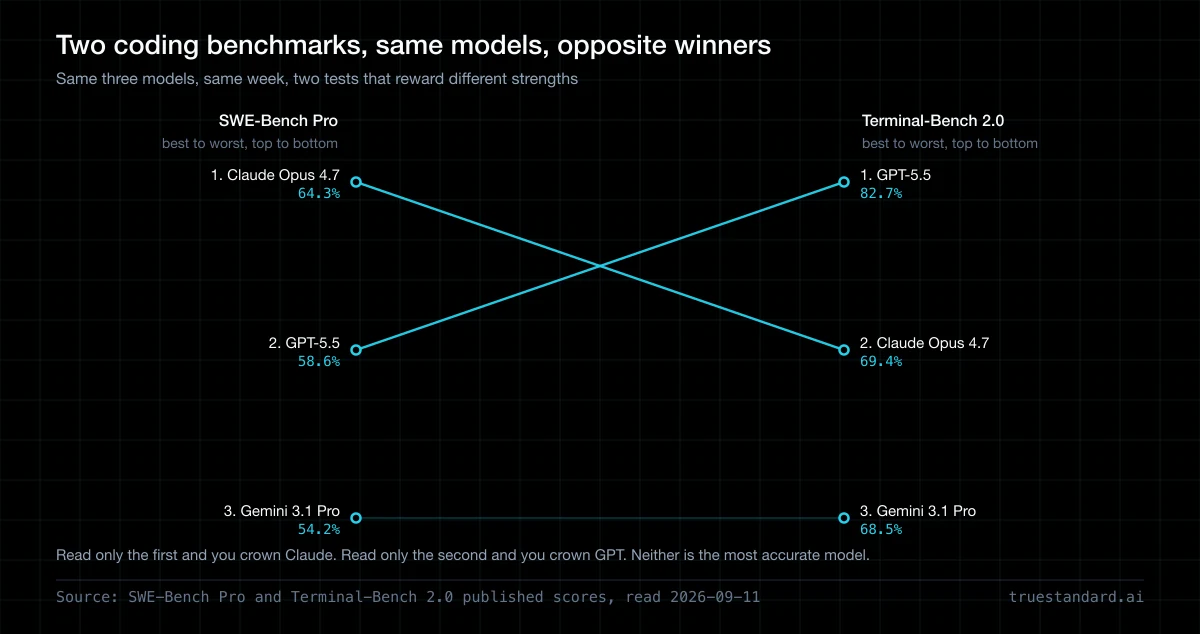
Even inside one category, the ranking is unstable. Coding is the cleanest example: the benchmarks openly disagree with each other. Here is the same set of models scored two different ways in the same window.
Two coding benchmarks, same models, opposite winners
| Benchmark | 1st | 2nd | 3rd |
|---|---|---|---|
| SWE-Bench Pro | Claude Opus 4.7 — 64.3% | GPT-5.5 — 58.6% | Gemini 3.1 Pro — 54.2% |
| Terminal-Bench 2.0 | GPT-5.5 — 82.7% | Claude Opus 4.7 — 69.4% | Gemini 3.1 Pro — 68.5% |
Same three models, same week, two tests. Claude leads one, and GPT leads the other by a wide margin. If you had read only the first benchmark you would call Claude the most accurate coder. Read only the second and you would say GPT. Both readings are wrong. The question they answer is too narrow to crown anything. SWE-Bench Pro and Terminal-Bench 2.0 measure different things, so they reward different strengths. A model tuned to do well on one will not automatically top the other. The practical takeaway from the people who actually run these tests is softer than any single number. Claude tends to have an edge on real coding work right now, helped by tooling like Claude Code. GPT and Gemini stay close enough that the lead depends on the task. Pick the leader of the benchmark that matches your work, and remember the next model release can reshuffle it.
Treat these numbers as directional. They come from independent 2026 benchmarks cited in the source video. The reason the caveat matters is real: benchmark contamination is possible on frontier models, and the scores shift on a schedule measured in weeks. We track how unstable these results get across the major model families in our Q2 2026 stress tests. The short version is that any leaderboard is a photo of a moving target. For the current hallucination numbers with their benchmarks attached, see AI hallucination rates in 2026.
The gap in definitive rankings
Some publications do present a single definitive ranking with no hedging. OfficeChai's Top 10 Most Factually Accurate AI Models lists a clean first-to-tenth order. There is no no-single-winner caveat anywhere in it.
That missing caveat is exactly the gap. A ranked list reads as authoritative, and it hides the part where the order depends on what you measured. A reader looking for a quick answer takes the number-one slot at face value, and never sees the asterisks that should sit beside it. The domain you ask about changes the math too. In one neuroradiology evaluation, ChatGPT 4.0 answered roughly 64.9% of questions correctly, while Gemini landed near 55.7%. That gap is large enough to flip the winner the moment you move from general questions into a specialty. The most accurate model for a marketing email is not automatically the most accurate elsewhere. Not for a medical claim, a legal clause, or a financial figure. Narrow the domain and the leaderboard you trusted can invert on you. That is why a definitive top-ten list is most dangerous in exactly the high-stakes situations where people reach for it.
Why most accurate is the wrong question for publishers
Here is the deeper issue, and it holds even if you accept one model as today's leader. Accuracy benchmarks measure averages, not your specific claim.
A model can post the best average score on a test. It can still hallucinate the one statistic, citation, or date in the paragraph you are about to publish. Benchmarks tell you a model is right more often than the others on a fixed set of questions. They tell you nothing about whether it is right on yours. And when it is wrong, it gives no warning: a confident fabrication looks identical to a confident truth. That is the trap we unpack in why AI is confidently wrong.
So even the perfect model-selection decision leaves a gap on the page. You picked the strongest tool for the job, and the strongest tool still fabricates. It fabricates often enough that publishing on its single word is a liability. Choosing better does not close that gap. Checking does. Think about how you actually use these tools day to day. You ask a model a question, it answers in clean confident prose, and you move on. There was no moment where it flagged a shaky line for you. The fluency is the whole problem: it reads as certainty whether or not the underlying fact is real. So the burden of telling true from false-but-fluent lands entirely on you. A more accurate model raises the odds it got your claim right. It does not tell you which claim it got wrong.
What the pattern tells you
Step back and the shape of the problem is clear. Two facts keep showing up across every comparison. First, no single model is reliably right: the accuracy crown moves by task, by benchmark, and by domain. Second, even the model that holds the crown this month will still hallucinate your specific claim without warning. Put those together. The usual instinct is to find the best model and trust it. That is the one move guaranteed to leave errors on the page.
Notice the pattern. No single model is reliably right, and the rankings reshuffle almost monthly. So the move is not picking the best one and trusting it, but checking the specific claim across several models at once. That is exactly what TrueStandard does. Paste your draft. Four to five frontier models from different vendors evaluate it in parallel. In about 60 seconds every point they disagree on is surfaced for you.
A best-for decision framework
You may want a defensible single choice for a specific job, and the eight rounds give you a clear starting map. The table below pairs each task with the tool that tends to win it, and the verification step that still applies. Read it as two columns of advice, not one: the middle column tells you where to start your draft. The right column tells you what to do before that draft carries your name. Pick the strongest tool for the task, then verify the output anyway. Both halves matter. Skipping the second is where most published AI errors come from.
| If your task is... | Strongest tool | But you still... |
|---|---|---|
| Long-form writing | Claude | Verify every claim before publishing |
| Research inside Google's tools | Gemini | Check the citations it returns |
| Voice and brainstorming | ChatGPT | Treat spoken output as a draft |
| Photorealistic images | ChatGPT | Confirm no unwanted artifacts |
| Native video generation | Gemini | Review for fabricated detail |
| Serious coding work | Claude | Test and read the code yourself |
| Workspace integration | Gemini or Claude | Verify pulled context is current |
| Multi-step agentic tasks | Depends on the stack | Scope the instructions tightly |
Every row ends in but you still verify. Picking the right tool decides how good your first draft is. It does not decide whether the claims are true. That second job is the one single-model output cannot do alone, and the one TrueStandard automates. Four to five models run the same check in parallel: 60 seconds, every disagreement flagged for you.
What to do instead
Stop shopping for the most accurate model and start verifying the claim. The shift is small, and it changes everything about how reliable your published work is.
For anything that carries your name, cross-check the exact sentence or citation across more than one model. Agreement across independent models is a real signal that the claim is probably solid. Models are trained on different data, by different labs, with different priorities. They are unlikely to invent the same wrong fact in the same way. When they converge, that convergence means something. Disagreement is the more useful result, though, and it points you straight at the line that needs a human to dig in. You do not re-read the whole draft hoping to feel the error. You stop scanning ten paragraphs for a mistake you cannot see. You start with the two sentences the models could not agree on. That is a much smaller, much more honest job.
This also fits how careful people already work. The same creator who ran the eight rounds likes to use all three tools together. He runs a research report through more than one, then pulls the results into a single place to understand them. That instinct is right. The mistake is doing it by hand, tab by tab. That is slow enough that most people skip it under deadline. The fix is to make the cross-check automatic, so it happens on every draft, not just the ones you have time for.
This is why the conversation has moved from best single model to having several models check each other. We cover the distinction in multi-agent vs multi-model. You may still want a defensible single choice for a specific job, like long-form writing or coding. Then our guide to picking the right Claude model walks through it. And once you have a draft, the pre-publish process lives in how to fact-check AI writing before publishing.
And if you are picking a model off a tier list, look at what those rankings actually score. The usual six categories — design, speed, cost, one-shot ability, subscription value, overall — measure a model against your intent. They never measure it against the world. See what AI model rankings do not measure.
That the ranking flips is not only an argument. We held the model, the prompt and the scorer still, and changed only the questions we asked. One model went from 10.9 to 30.9 percent fabrication: why hallucination benchmarks disagree.
Notice the pattern one more time. The model you choose decides how good your first draft is, but it does not decide whether the claims are true. That is exactly what TrueStandard does. Paste your draft. Four to five models from different vendors check it in parallel. In about 60 seconds every claim they disagree on is surfaced, before your readers see it.
Frequently Asked Questions
Which AI model is most accurate in 2026?
None of them, consistently. The most accurate model changes by task, by benchmark, and by domain. Claude tends to lead long-form writing and some coding tests, Gemini leads research and video, and ChatGPT leads voice and images. Even those orderings shift every few weeks. There is no single accuracy crown to hand out. So the more useful move is verifying the specific claim, rather than trusting whichever model produced it.
Is Gemini more accurate than ChatGPT?
It depends entirely on the task: Gemini tends to win research and video work, especially inside Google's own tools. ChatGPT tends to win voice and image generation. On factual accuracy in a specific domain the gap can flip. One neuroradiology evaluation put ChatGPT 4.0 ahead of Gemini, around 64.9% to 55.7%. Neither is universally more accurate.
Is Claude more accurate than GPT?
On some benchmarks yes, on others no: per independent 2026 benchmarks, Claude Opus 4.7 led GPT-5.5 on SWE-Bench Pro at 64.3% to 58.6%. GPT-5.5 led Claude on Terminal-Bench 2.0 at 82.7% to 69.4%. Same models, same week, opposite results. Treat both as directional, and verify the actual claim rather than trusting the ranking.
Does the most accurate AI still hallucinate?
Yes. A top-ranked model will still state a false fact, citation, or date with full confidence, and gives no warning when it does. Accuracy benchmarks measure averages across a fixed test, not whether the specific claim in your draft is true. This is why even the strongest model needs a second opinion before its output is published.
How do I check if an AI answer is accurate?
Verify the specific claim rather than trusting the model that produced it. The reliable method is to run the exact sentence or citation across several independent models. Then look for disagreement, which flags the claims a human needs to check. Agreement across models is a signal the claim is probably solid. Disagreement points you straight at what to verify.
What is the best AI model for writing?
Across independent comparisons in 2025 and 2026, Claude was the model people kept naming for long-form writing. It follows brief constraints, drops filler, and matches a sample voice well, which makes it a strong default for drafting. The draft still needs claim-level verification before it carries your name. Being the best writer does not make a model the most factually reliable.
Should I pay for more than one AI tool?
For most people one roughly twenty dollar plan covers the work. The right one depends on where your work lives and what you do most. Heavy users sometimes run two or three subscriptions to cover writing, research, and images separately. Either way, all three tools have free tiers and real rate limits. So try the free version against your actual tasks before you commit to paying.
Is there a single best AI tool?
No. There is no best AI tool right now. But there is a best tool for you. It depends on the work you do most and the tools you already use. Pick the strongest tool for your main task, then verify its output across multiple models for anything you publish. The tool choice sets your draft quality. Verification decides whether the claims are true.
Keep reading
How Accurate Is ChatGPT?
Accurate enough to trust for everyday questions. Wrong often enough to get you sued if you publish it unchecked. Here is what the measurements actually say, and what to do about it.
Why AI Is Confidently Wrong
Models sound certain every time, even when wrong, and the confident tone you trust in people is worthless here. Here is the fix.
Should You Stop Using ChatGPT?
Researchers found AI made experts measurably worse on hard tasks. Here is when to trust ChatGPT, and when it is just telling you what you want to hear.
AI Hallucination Rates in 2026: What the Data Actually Shows
A sourced reference of the 2026 hallucination-rate numbers. What each benchmark measured. Which models did best and worst. And where the widely quoted figures get misread. Built to be linked and kept current as new data lands.
TrueStandard vs FactCheckTool
These two tools look alike, but they solve opposite problems. One tells you if the media you read is fake. The other tells you if the draft you are about to publish is true.
What we measured on this model
Each release page carries our own fabrication data for one model version, measured against the model it replaced in the same vendor's line.
Stop Chasing the Most Accurate Model.
The accuracy crown keeps moving by task, benchmark, and domain, and even the leader fabricates with confidence. Pasting your draft into one model and hoping it caught everything is the same mistake at a smaller scale. TrueStandard runs your content through four to five models in 60 seconds, and flags every claim where they disagree.
Start Verifying →