Parafact is a capable, well-positioned fact-checker. It checks human or AI-written text in real time, returns a citation for every claim, and reports around 93% accuracy. Say you write short pieces and want fast, sourced checks. It does the job.
TrueStandard takes a different position on purpose. It does not hand your draft to one model. It runs the same claims through several frontier models, then shows you where they agree, where they disagree, and what still needs a human look. And there is no limit on how long your draft can be.
At a glance
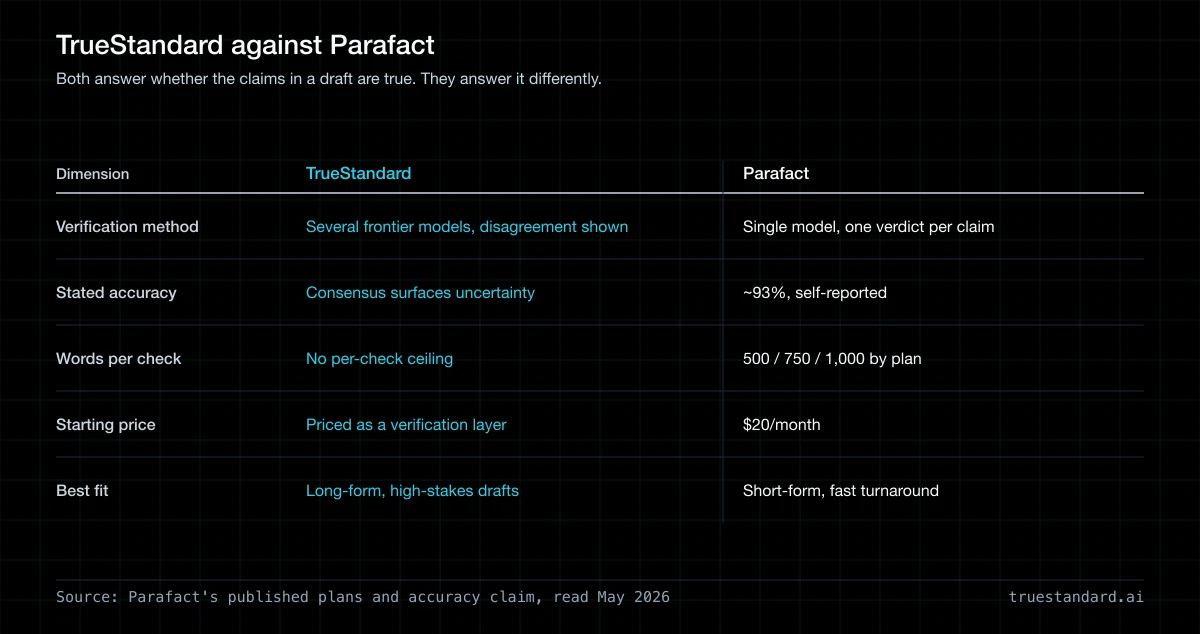
Both tools answer 'are the claims in this draft true?' They answer it differently.
TrueStandard and Parafact at a glance
| Dimension | TrueStandard | Parafact |
|---|---|---|
| Verification method | Multi-model consensus — several frontier models, disagreement shown | Single model, one verdict per claim |
| Stated accuracy | Consensus surfaces uncertainty instead of a single score | ~93% (self-reported) |
| Words per check | No per-check word ceiling | 500, 750 or 1,000, by plan |
| Citations | Per-claim, plus flags for what to verify by hand | Per-claim citation |
| Starting price | $20/month (Pro, 250 drafts); one check a day free | $20/month |
| Best fit | Long-form, high-stakes drafts | Short-form, fast turnaround |
Each row compares one feature of the two tools. The Parafact figures come from its own published plans and claims.
One model vs. a panel
Parafact passes your claims to a single AI model and returns that model's judgment. This is fast, and much of the time it is right. The problem is built in: one model has no way to tell you when it is confidently wrong. There is no second opinion to disagree with the first.
TrueStandard runs the same claims through several frontier models and reports where they line up and where they split. Agreement raises your confidence. Disagreement is the alarm, and it points you straight at the claims worth checking yourself. One accuracy number cannot give you that, because it averages away the exact places a model is unsure.
The word-count ceiling
This is the difference most buyers miss until they hit it. Parafact's plans cap each check at 500 words (Essential), 750 (Pro), or 1,000 (Enterprise). A typical 2,000-word newsletter or blog post does not fit in one pass. You split it, check the parts one at a time, and lose the context across paragraphs, where contradictions often hide.
TrueStandard does not impose a per-check word ceiling. You verify the whole piece as one document, the way your reader will actually read it. Think of a solo publisher, or a content team shipping long-form on a deadline: for them the line is simple. One tool fits the workflow, the other fights it.
Pricing compared
Parafact's published plans, as of May 2026:
Parafact plans
| Plan | Price | Words per month | Max words per check | Also included |
|---|---|---|---|---|
| Essential | $20/mo | 30,000 | 500 | Source citations |
| Pro | $49/mo | 60,000 | 750 | Developer API |
| Enterprise | Custom | Unlimited | 1,000 | Priority support |
Each row is one Parafact plan. Words per month is the monthly limit. Max words per check is the most text that one check takes.
Both start at $20 a month. Parafact Essential buys 30,000 words a month, at up to 500 words per check. TrueStandard Pro buys 250 drafts a month with no per-check word cap, each checked by four models, and one single-model check a day is free with no signup. On a long draft, the word cap is the bigger difference.
Who each is best for
Parafact is the better choice if
- — Most of your work is short — social posts, abstracts, single sections under 500–750 words
- — You want fast turnaround on short pieces
- — A single sourced verdict per claim is enough for your risk level
TrueStandard is the better choice if
- — You publish long-form — newsletters, articles, scripts — and need the whole draft checked at once
- — A missed claim damages your reputation or revenue. Shown doubt beats a confident guess
- — You want to see where models disagree, not just one answer
Switching from Parafact
There is nothing to migrate: verification tools hold no data you need to move. Take your next finished draft, the one you would split into 500-word chunks for Parafact, and paste it into TrueStandard whole instead. Then compare the two reports on the same piece. The honest test is simple. On the full document, does model disagreement catch something the single-model verdict did not?
Common questions
Is TrueStandard a replacement for Parafact?
Say your work is short-form and single-model checking suits you. Parafact is a reasonable tool. TrueStandard is the better fit when drafts run long, when a missed claim is expensive, or when you want to see model disagreement rather than one confident verdict.
Does Parafact really cap checks at 500–1,000 words?
Per Parafact's published plans (as of May 2026): Essential allows up to 500 words per check, Pro up to 750, and Enterprise up to 1,000. A 2,000-word newsletter has to be split across several checks. TrueStandard does not impose a per-check word ceiling.
Why does multi-model consensus matter for fact-checking?
A single model can be confidently wrong, and it has no way to flag its own blind spots. Run the claims through several models and disagreement shows up. That is exactly the signal you want: it tells you which claims to check by hand before you publish.
Is TrueStandard more expensive than Parafact?
No. Both start at $20 a month. Parafact Essential gives you 30,000 words a month in checks of up to 500 words, and its Pro plan is $49 for 60,000 words at up to 750. TrueStandard Pro gives you 250 drafts a month with no per-check word cap, each checked by four models.
Keep reading
AI Detector vs Fact Checker
One asks who wrote this. The other asks is this true. Before you publish, only one of those questions protects your name, and most teams are watching the wrong one.
Does Claude Watermark My Writing?
Claude marks the words it chooses, and if you wrote them, there is almost nothing to mark.
Are AI Detectors Accurate? They Ask the Wrong Question
They flag honest writers. They mark famous human documents as AI, and OpenAI quietly killed its own detector. But the deeper problem is not that detection is unreliable. It is that 'was this written by AI?' was never the question that protects you.
GPTZero Hallucination Detector, Explained
It catches citations that don't exist. By GPTZero's own admission, it does not check whether what you wrote is true. Here is exactly what its hallucination and source tools do. Here is where the gap is, and what closes it.
TrueStandard vs Omniscient AI
Both run several models, and both show where those models agree. The difference is the moment each one is built for. Omniscient checks what you are reading. TrueStandard checks what you are about to publish.
Check the whole draft, not 500 words of it
Run your next piece through multi-model consensus. There is no per-check word ceiling, and disagreement is shown as a feature, not hidden behind one confident answer.
TrueStandard is for writers who publish AI-assisted drafts. Paid plans check every claim and citation across four AI models before you hit publish.
Free: one check a day, no signup. Pro is $20 a month for 250 drafts.
Verify a draft