Omniscient AI and TrueStandard are easy to mix up. They share the same core idea: run a claim past several independent models, then show where they agree rather than trusting one. That idea is the right one. Where they part ways is what they point it at.
Omniscient is built to fact-check what you read on the web, while TrueStandard is built to verify what you are about to publish. Both are multi-model, so the choice is not about method. It is about which side of the publish button you stand on.
Read-side vs write-side
Omniscient AI is a browser extension with an API, and it fact-checks what you are reading. Select a sentence on a page, or run a full-page analysis on an article. It runs three models over the claim, then hands back a consensus verdict with live citations. Its headline is 'fact-check anything on the web,' and it lists what you can feed it: news articles, social posts, political speeches, YouTube transcripts, and PDFs. Say you read or research for a living and need to know if a thing holds up. This is a genuinely useful tool.
TrueStandard is built for the other side of the publish button. Its input is your own unpublished draft, and its output flags which of your specific claims to verify. You get that list before your readers see the piece. Omniscient answers 'can I trust this thing I am reading?' TrueStandard answers 'is this thing I am about to publish accurate?' The two rarely compete. They sit on opposite sides of publish, and some people genuinely want both.
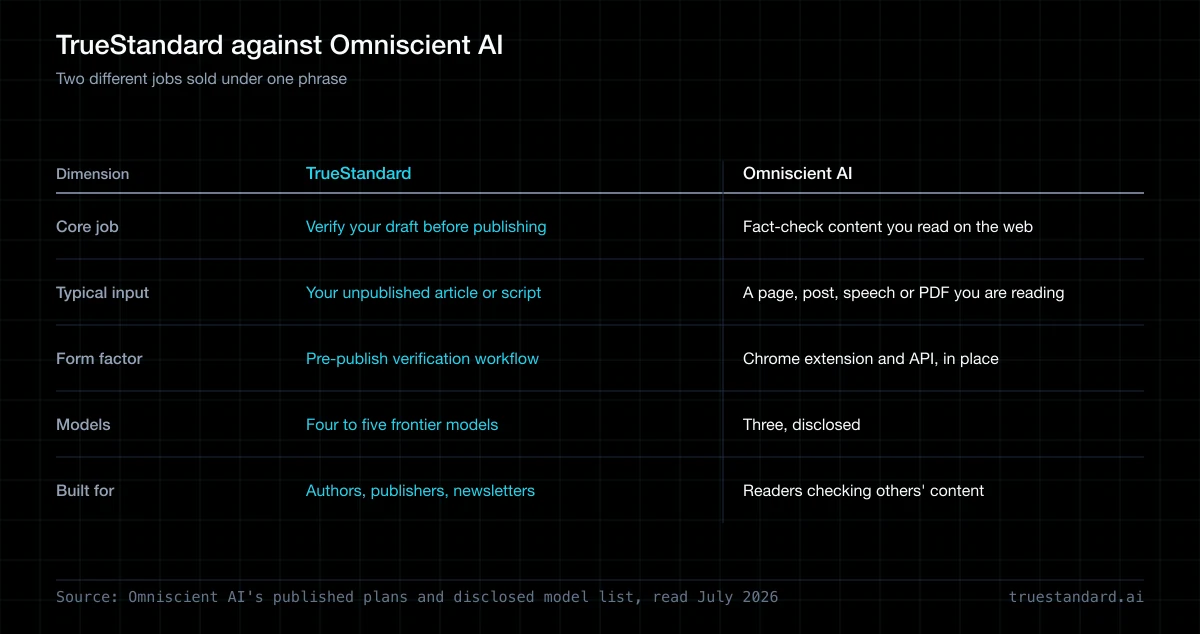
Side by side
Same multi-model idea, aimed at different moments.
| Dimension | TrueStandard | Omniscient AI |
|---|---|---|
| Core job | Verify your draft before publishing | Fact-check content you read on the web |
| Typical input | Your unpublished article or script | A page, article, post, speech, or PDF you are reading |
| Form factor | Pre-publish verification workflow | Chrome extension and API, in place on the page |
| Models | Four to five frontier models | Three: GPT-4o Mini, Perplexity Sonar, Gemini Flash (disclosed) |
| Output | The specific claims in your draft to verify | Per-claim verdict plus a 0-100 page score for the reader |
| Built for | Authors, publishers, newsletters | Readers, researchers, checking others' content |
What each one is pointed at
Omniscient's strength is checking in place, across the formats you read. It takes in articles, social posts, speeches, YouTube transcripts, and PDFs. It runs three models with a consensus score, gives a verdict on each claim with citations, and adds a whole-page score from 0 to 100. If your question is 'can I trust what I am reading,' that shape fits well. And it lives right in the browser where you read.
TrueStandard deliberately does none of that. It does not score web pages or rate other people's articles. It checks the factual claims in a draft you are writing, running a panel of frontier models over them. A wrong claim under your own byline costs you more than a page you misjudge as a reader. Same multi-model idea, aimed at the moment before you publish, not the moment you read.
Pricing compared
Omniscient's published plans, as of July 2026 and marked introductory, so confirm on its site:
| Free | 10 checks on signup, no card required |
| Pay-as-you-go | About $0.11 per check |
| Pro | $34.99/mo, introductory; unlimited source verification |
| Enterprise | Custom |
The tools are not really priced against each other, because they are not doing the same job. Omniscient charges per check for reading-side fact-checking. TrueStandard is a verification layer, priced for people who publish for a living, where one error caught is worth more than the plan. Pick on the job, not the price.
Who each is best for
Use Omniscient AI if
- — You are a reader or researcher fact-checking content you found online
- — You want in-browser, in-place checks across news, social, video, and PDFs
- — You are judging claims in content other people made
Use TrueStandard if
- — You are the author, and the draft has to be right before it ships
- — You want multi-model consensus on your own claims, with disagreement shown
- — You publish long-form and need the whole piece checked before readers see it
Common questions
Do TrueStandard and Omniscient AI compete?
Mostly no. Omniscient fact-checks content you are reading on the web, while TrueStandard verifies a draft you are about to publish. Both run several models, and both show where those models agree. But they sit on opposite sides of the publish button, and some people want both, for different reasons.
Is Omniscient AI multi-model like TrueStandard?
Yes. Omniscient discloses that it runs three models: ChatGPT (GPT-4o Mini), Perplexity Sonar Pro, and Gemini 2.5 Flash. It shows a consensus score across them, so the main difference is not the number of models. Omniscient is built for content you read. TrueStandard is built for the draft you are about to publish, running a panel of frontier models over it.
Can Omniscient AI check my unpublished draft?
Its form factor is a browser extension, and it checks pages and claims you meet while reading. You could paste text in to check it. But it is built around in-place, reading-side fact-checking, not a pre-publish authoring workflow the way TrueStandard is.
Which one should I use?
Say you read or research, and you want to check what you read. Omniscient's in-browser checking is a strong fit. Say you are the author instead, and the real risk is a wrong claim under your own name. TrueStandard is built for that moment: it checks your draft before it ships.
Keep reading
AI Detector vs Fact Checker
One asks who wrote this. The other asks is this true. Before you publish, only one of those questions protects your name, and most teams are watching the wrong one.
TrueStandard vs Parafact
Both verify claims before you publish. The real difference is what one model can miss, and whether your long-form draft fits inside the check at all.
TrueStandard vs FactCheckTool
These two tools look alike, but they solve opposite problems. One tells you if the media you read is fake. The other tells you if the draft you are about to publish is true.
Does Claude Watermark My Writing?
Claude marks the words it chooses, and if you wrote them, there is almost nothing to mark.
AI Detectors Ask the Wrong Question
They flag honest writers. They mark famous human documents as AI, and OpenAI quietly killed its own detector. But the deeper problem is not that detection is unreliable. It is that 'was this written by AI?' was never the question that protects you.
Check your draft before readers do
Fact-checking what you read is a good habit. Verifying what you publish protects your name. Run the claims in your draft through multi-model consensus before you hit send.
Verify a draft