Originality.AI earned its name: it is the best-known brand in AI content integrity. The press has covered it, and it holds a 4.5-star Trustpilot record across hundreds of reviews. Its AI detector scores well in tests run by other people. All of it checks out, and none of what follows is a knock on the tool.
But many people come to it for one job: they want to know if the claims in a draft are actually true. Then they meet the fifth item in a bundle built around detection, and that fifth item is the fact-check. So here is the honest question: when does a tool built for one job do that job better?
Why look past the suite
The heart of the tool is AI detection and plagiarism, and the fact-check sits next to grammar and readability. All five share one credit pool, where one credit covers 100 words. The result is a good all-rounder: broad, well sold, and thin on any one check, by design. Say what you need is depth on the claims, and a bundle built for detection is the wrong shape of tool. It is not a bad tool; it is the wrong one for that job.
The other limit is method: the fact-check gives you one model's call. Every one-model checker has the same blind spot, because it cannot tell you when it is sure and wrong. There is no second view to argue with the first, so a wrong answer looks just like a right one.
TrueStandard as the alternative
TrueStandard does one thing: it checks claims before you publish. It runs the claims in your draft past several frontier models, then shows where they agree, where they split, and what still needs a human check. A split is treated as a feature, not a flaw: it is the sign that tells you which specific claims to check by hand.
It is not an AI detector, and it does not check plagiarism. If you need those, Originality.AI is better at them. TrueStandard is the other choice for one job, the claims, and it is built around that job rather than bundling it with four more. It suits writers whose risk is a wrong claim, not an AI-detection score.
Side by side
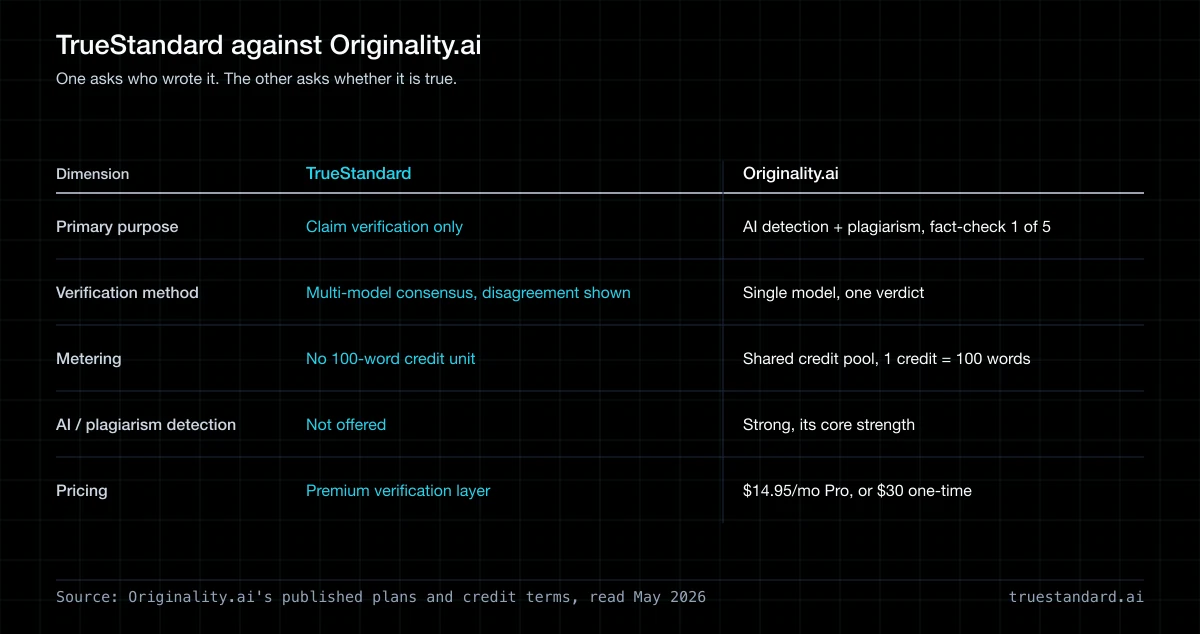
Same question — are these claims true — and two different tools for it.
| Dimension | TrueStandard | Originality.AI |
|---|---|---|
| Primary purpose | Claim verification only | AI detection + plagiarism (fact-check is 1 of 5) |
| Verification method | Multi-model consensus, disagreement shown | Single model, one verdict |
| Metering | No 100-word credit unit on verification | Credit pool shared across 5 checks (1 credit = 100 words) |
| AI / plagiarism detection | Not offered | Strong — its core strength |
| Brand & proof | Newer, focused | Established — press, Trustpilot 4.5 (720) |
| Pricing | One check a day free; Pro $20/mo for 250 drafts | $14.95/mo Pro, or $30 one-time PAYG |
Bundled check vs. dedicated layer
A suite has to spread its work across five checks: detection, plagiarism, grammar, readability, and the fact-check. A tool built for one job spends all of it on one question, and you see the split on a shaky claim. A bundled checker tends to hand back a verdict and move on. A consensus layer shows you where the models split, so you know not to trust that claim on its own.
This is the same idea as a second opinion from a doctor. The value is not a faster answer, but catching the one case where the first sure answer was wrong. Some writers stake their name on being right, and for them, that is the difference worth paying for.
Who should switch — and who shouldn't
Stay with Originality.AI if
- — Your main need is AI detection or plagiarism — it leads the market on both
- — You want one cheap tool that covers five checks at once
- — Single-model fact-checking is enough for your risk level
Switch to TrueStandard if
- — The claims are the actual job, and detection is a side note
- — You want several models, with the doubt shown, not one verdict
- — You publish long-form and don't want a 100-word credit unit shared across five tools
Moving over
There is nothing to move, because these tools store no data you need. Keep Originality.AI for detection and plagiarism if you use them. Run your next finished draft through TrueStandard for the fact-check, spending no suite credits on it, then read the two reports on the same piece. The test is simple: do the models split on a claim the one-model verdict waved through?
Common questions
Is TrueStandard a full replacement for Originality.AI?
No, and it does not try to be. Originality.AI is a detection and plagiarism suite that fact-checks too, where TrueStandard only checks claims. Say you lean on AI detection or a plagiarism score: keep Originality.AI for those, and use TrueStandard when the claims are the job that counts.
Why is Originality.AI's fact-checking described as shallow?
Not as an insult: it follows from the design. The fact-check is one of five checks that share a credit pool, sitting behind a product built for detection, and it runs on a single model. A tool built for one job can go deeper on that job, and show you where the models split.
Is Originality.AI cheaper than TrueStandard?
Its monthly price is lower. Originality.AI Pro is $14.95 a month for 2,000 credits, and there is a $30 one-time pay-as-you-go option, but its pricing page does not say how many credits a fact check uses. TrueStandard Pro is $20 a month for 250 drafts, each checked by four models, and one check a day is free with no signup.
Does TrueStandard detect AI-written or plagiarized text?
No. That is Originality.AI's strength, not ours. TrueStandard checks whether claims are true, and it does not matter who or what wrote them.
Keep reading
AI Detector vs Fact Checker
One asks who wrote this. The other asks is this true. Before you publish, only one of those questions protects your name, and most teams are watching the wrong one.
TrueStandard vs FactCheckTool
These two tools look alike, but they solve opposite problems. One tells you if the media you read is fake. The other tells you if the draft you are about to publish is true.
Does Claude Watermark My Writing?
Claude marks the words it chooses, and if you wrote them, there is almost nothing to mark.
Are AI Detectors Accurate? They Ask the Wrong Question
They flag honest writers. They mark famous human documents as AI, and OpenAI quietly killed its own detector. But the deeper problem is not that detection is unreliable. It is that 'was this written by AI?' was never the question that protects you.
GPTZero Hallucination Detector, Explained
It catches citations that don't exist. By GPTZero's own admission, it does not check whether what you wrote is true. Here is exactly what its hallucination and source tools do. Here is where the gap is, and what closes it.
Verify the claims, not the byline
Say the job is making sure your draft is true before it ships. Run it through multi-model consensus built only for that.
TrueStandard is for writers who publish AI-assisted drafts. Paid plans check every claim and citation across four AI models before you hit publish.
Free: one check a day, no signup. Pro is $20 a month for 250 drafts.
Verify a draft