GPTZero added a Hallucination Detector, and it does something real. It flags citations that look real but do not exist. To catch sources an AI invented, it searches more than 220 million scholarly articles. If your problem is a made-up reference, it helps. But GPTZero is careful about what it is not. That line is the whole story here.
GPTZero can tell you a citation exists. It cannot tell you the sentence it supports is correct. Its founder has called the related Sources feature 'explicitly not a fact-checker.' This guide maps that line exactly. It also shows what covers the other side of it. GPTZero's own FAQ states the tool 'does not take a stance on whether your claims or the claims in the sources cited are true.'
What GPTZero's hallucination tool actually checks
GPTZero started as an AI-content detector. At heart it still is one. It estimates the odds that text was written by a machine. Around that it has built citation tools. The Hallucination Detector highlights sentences likely to carry fake or wrong citations. It then points you to real academic sources instead. The related Sources feature finds factual claims. It matches them to online and academic sources. It marks whether the evidence supports, contradicts, or debates a claim. It even runs AI-detection on the cited sources, to catch second-hand hallucinations.
That is genuinely useful for one failure: a citation that does not exist. What it is not built to do is judge truth. It checks that a reference is real and roughly on-topic. It does not check that your number is right. It does not check that your quote is accurate or your conclusion sound. Catching an invented citation and checking a claim are different jobs. GPTZero signs up only for the first. In GPTZero's own words, the tool 'does not take a stance on whether your claims or the claims in the sources cited are true.'
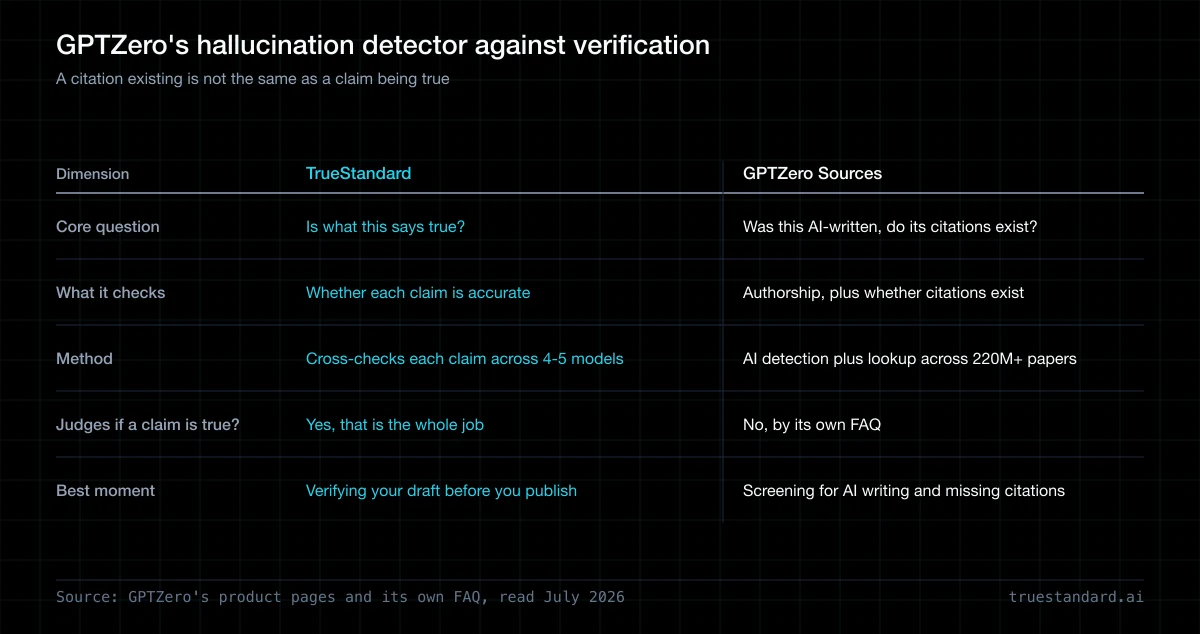
GPTZero vs verification, side by side
Both touch citations. Only one is about whether you are right.
| Dimension | TrueStandard | GPTZero |
|---|---|---|
| Core question | Is what this says true? | Was this AI-written, and do its citations exist? |
| What it checks | Whether each claim is accurate | Authorship, plus whether citations exist and are on-topic |
| Method | Cross-checks each claim across 4-5 frontier models | AI-detection plus citation lookup across 220M+ papers |
| Judges if a claim is true? | Yes, that is the whole job | No, by its own FAQ |
| Best moment | Verifying your draft before you publish | Screening for AI writing and missing citations |
| Owned by | Independent verification tool | Superhuman (acquisition announced June 2026) |
The gap: a citation existing is not a claim being true
Take a sentence that reads: 'A 2024 study found remote workers were 22 percent more productive.' A citation checker confirms the study exists and is about remote work. It passes it. But the study might have said 12 percent. It might have measured something else entirely, or reached the opposite conclusion. The reference is real. The claim built on it is wrong. That is most of what really damages published work. And it is exactly the layer GPTZero's tools do not cover, as we detail in when AI cites studies that don't exist.
There is a second reason not to lean on GPTZero as a truth signal. It is a detector, and detectors carry documented false-positive risk. GPTZero flagged the US Constitution as AI-written. A Stanford study found detectors wrongly flagged 61 percent of essays by non-native English speakers. That comes with guessing the author from style. Style is one question. Whether a claim is accurate is another, a split we unpack in why AI detectors ask the wrong question. As of June 2026, GPTZero is being folded into Superhuman Go. It becomes an authenticity layer for a writing suite. That is further from a standalone truth-checking workflow, not closer.
Checking truth is a different move. Spotting who wrote it is not the same. Nor is confirming that a link opens. TrueStandard runs the claims in your draft across four to five frontier models from different labs. It shows you where they disagree. Say several independent models cannot back a claim. That is the one to check before you publish. It answers the question GPTZero explicitly declines to.
Pricing and where it's headed
GPTZero is schools first, priced for classrooms and writing teams. Exact rates change and vary by source. So treat these as approximate, and check its pricing page:
| Free | Signup required; roughly 10,000 words/month |
| Premium (individual) | Reported around $15-24/mo depending on billing |
| Professional / Team | Reported around $46/mo |
| Enterprise / Classroom | Custom, seat- or volume-based |
GPTZero is priced as a detection and integrity suite for schools. Its citation tools ride along with that. TrueStandard is priced as a checking layer for people who publish for a living. There, catching one false claim is worth more than the plan costs. They price differently because they answer different questions. And one of them is now an authenticity feature inside a bigger writing product.
Which one you need
Use GPTZero if
- — You need to detect whether text was written by AI
- — You are a teacher screening student work for fake or missing citations
- — You want plagiarism and author checks next to AI detection
Use TrueStandard if
- — You need to know whether your claims are actually true before you publish
- — You want several models to agree on accuracy, not a guess about who wrote it
- — Your risk is a wrong statistic or misused source, not just a citation that doesn't exist
Common questions
Does GPTZero detect hallucinations?
It has a Hallucination Detector. It flags citations that look real but do not exist. To catch sources an AI invented, it searches over 220 million scholarly articles. But it checks whether citations exist and are on-topic, not whether your claims are true. GPTZero's own FAQ says the tool does not take a stance on whether claims are true or false.
Is GPTZero a fact-checker?
No, by its own description. GPTZero is an AI-content detector with citation-checking features. It answers whether text was AI-written and whether its citations exist. It does not answer whether a claim is accurate. Its founder has called the Sources feature 'explicitly not a fact-checker.'
Can GPTZero tell me if my statistic or claim is correct?
No. Its tools check that a citation exists and roughly backs the point. They do not check factual truth. A real citation can still sit next to a wrong number or a misread finding. To confirm a claim is actually correct, you need verification. One way is cross-checking it across several independent models. That is a different job from detection.
Did Superhuman acquire GPTZero?
Yes. On June 23, 2026, Superhuman announced it was buying GPTZero. This is the Grammarly-descended firm that now uses that name, not the standalone email app. GPTZero folds into its AI assistant, Superhuman Go, as an authenticity layer. Terms were not disclosed.
Is GPTZero accurate?
As a detector, it has a documented false-positive risk. It flagged the US Constitution as AI-written. A Stanford study found detectors wrongly flagged 61 percent of non-native English essays. That is another reason. Spotting the author is no substitute for checking whether a claim is true.
Keep reading
AI Detector vs Fact Checker
One asks who wrote this. The other asks is this true. Before you publish, only one of those questions protects your name, and most teams are watching the wrong one.
An Originality.AI Alternative
Originality.AI is a strong AI-detection suite. But say the job you care about is verifying claims before you publish. Fact-checking is only one of its five bundled checks, and it runs on a single model.
TrueStandard vs Parafact
Both verify claims before you publish. The real difference is what one model can miss, and whether your long-form draft fits inside the check at all.
TrueStandard vs FactCheckTool
These two tools look alike, but they solve opposite problems. One tells you if the media you read is fake. The other tells you if the draft you are about to publish is true.
Does Claude Watermark My Writing?
Claude marks the words it chooses, and if you wrote them, there is almost nothing to mark.
Check whether it's true, not just whether it's cited
GPTZero can tell you a citation exists. It will not tell you the claim is right. Paste your draft into TrueStandard. Four to five frontier models check whether each claim actually holds up, in about 60 seconds.
Verify a draft