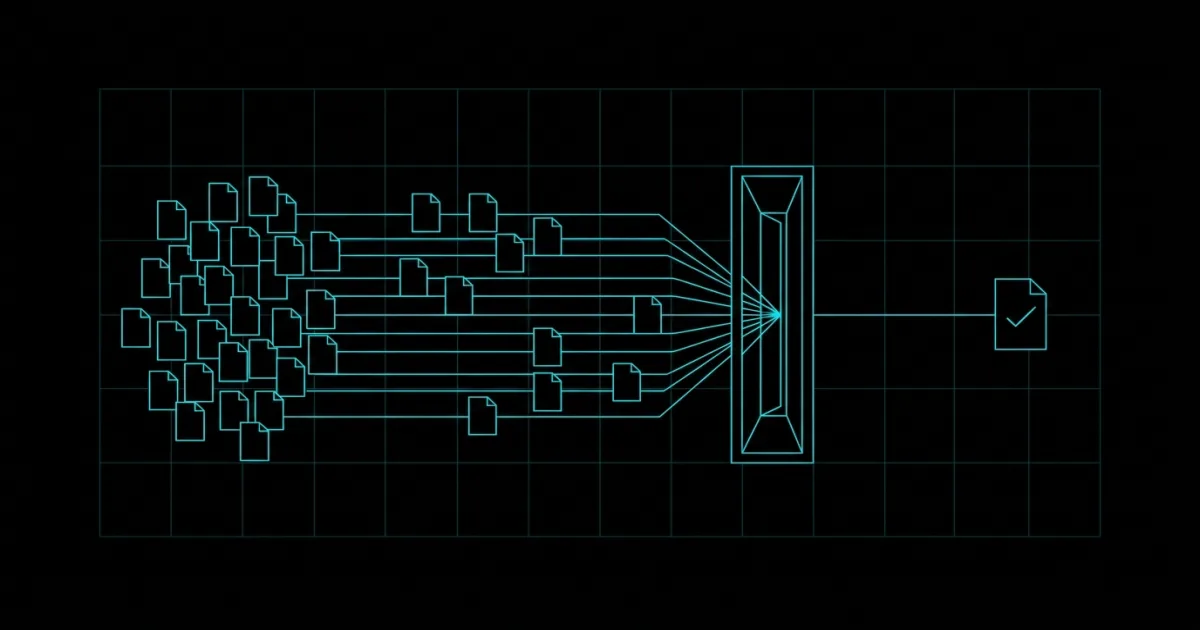
AI slop is mass-produced, low-effort content generated with little regard for whether it is accurate. The phrase spread so fast that in 2025 it was named Word of the Year by both Merriam-Webster and the American Dialect Society, which tells you how quickly it went from a niche complaint to a term ordinary readers reach for. If you write with AI, the term should make you uneasy for one specific reason.
AI slop and AI-assisted work can look identical on the page. Same clean sentences, same confident tone, same right-shaped paragraphs. The thing that separates them is not whether you used a model. It is whether you verified the output and can prove you did. This guide breaks down what slop actually is, why it is everywhere, and the short discipline that keeps your work on the right side of the line.
What AI slop actually is
Strip away the disgust the word carries and AI slop has a specific shape. It is low-to-mid quality AI output, produced in high volume, with little concern for accuracy. The volume is the point. Slop is not one bad article. It is the strategy of generating a hundred passable ones and shipping them all.
Wikipedia's entry on AI slop, citing Cody Kommers and colleagues, lists three prototypical properties:
Superficial competence
It reads fine at a glance. Clean sentences, confident tone, the right shape for the format. That fluency is exactly what makes it pass a skim, and a skim is all most readers give it.
Asymmetric effort
Almost nothing went into making it, and the reader has to spend real attention figuring out whether it holds up. The cost was quietly pushed onto the audience.
Mass producibility
It can be generated endlessly and near-instantly, which is why it floods a feed rather than arriving one piece at a time. The supply is effectively unlimited.
That second property is the one that connects slop to verification. The effort the creator skipped, checking the claims, is the exact effort that would have turned slop into real work.
Why it is flooding feeds
The flood is not an accident. It is an incentive. Platforms pay for attention, and AI lets anyone produce attention-shaped content faster than the cost of producing it. When you can generate fifty posts in the time it used to take to write one, and each carries a small chance of monetizing, the math pushes hard toward volume over care.
The casualties are already visible. As The Conversation's explainer notes, the science-fiction magazine Clarkesworld had to close submissions entirely after being buried under an avalanche of AI-generated stories. A respected publication shut its front door because it could not separate the real submissions from the slop fast enough.
That is the second-order cost most coverage misses. Slop does not just clutter a feed. It makes the legitimate work around it harder to find and harder to trust, because every reader now has to assume some fraction of what they are reading was never checked by a human at all. The Clarkesworld episode is the visible version of a quieter tax that every honest publisher now pays. When the baseline assumption shifts to maybe a machine wrote this and nobody looked, the burden of proof lands on you. You no longer get the benefit of the doubt that came with a byline, because the byline itself is cheap to fake. That is the environment a solo publisher is now competing in, and it is the reason verification stopped being optional.
The creator-risk continuum
Creator and entrepreneur Alex Hormozi has a useful frame for who slop threatens first. He argues that AI will not disrupt all creators equally. Instead, creators sit on a continuum from low risk to high risk, where risk is measured by what the content asks of the audience.
A meme or a stand-up clip is self-contained. You watch it, you laugh, the value is already delivered, and the only thing you risked was the time you spent. As you move along the continuum, the stakes climb. Acting on diet advice carries more risk than watching a joke. Acting on money advice carries more than that. Acting on how to scale a company carries the most. The higher the stakes, the more proof a reader demands before they will listen, which is exactly the proof an AI cannot yet manufacture.
Where AI disrupts first, by Hormozi's continuum
| Tier | Example creator | AI disruption risk |
|---|---|---|
| Entertainer | Meme page, stand-up clip | Highest |
| B2C educator | Makeup, fitness, or diet tutorials | High |
| B2C prosumer | Savings and investing creators | Medium |
| B2B | Operators sharing playbooks | Low |
| B2B creator | Hormozi-style content with public track record | Lowest |
Hormozi's point is that AI eats the low-risk end first. An AI avatar giving hair tips works fine, because the cost of being wrong is small and the audience will try it anyway. The moment the advice could lose you money or a year of your business, readers stop trusting a faceless source. That is where credibility becomes the moat. For a solo newsletter publisher, the practical read is twofold. If your content lives at the low-risk end, AI competition is already here and your only durable edge is being demonstrably real. If you write something readers act on with real stakes, you have more runway, but only as long as you keep showing the proof that an AI cannot yet fabricate. Either way the defense is the same: be the source whose claims hold up when someone checks them.
The real risk for a publisher
Here is where it gets personal. The risk to your reputation is not that you used AI. Plenty of careful writers use AI well. The risk is shipping AI output that is confidently wrong and that you never checked.
A model will hand you a fabricated statistic or a citation to a paper that does not exist, and it will do it in the same fluent, assured voice it uses for true things. Publish one of those and the cost is not abstract. It is your credibility, gone in the time it takes a reader to click a broken citation. This is the same trap newsletter writers keep walking into, which we cover in newsletter AI hallucinations. The draft felt finished, so the checking step got skipped, and the error went out to the whole list.
One fake citation is enough. A reader who catches a single broken reference does not assume the rest of your work is sound. They assume the opposite, and they are right to, because they have no way of knowing which claims you actually checked. Verification is the only thing that earns back the benefit of the doubt. The asymmetry is brutal for a solo publisher. You might verify ninety-nine claims by hand and miss the hundredth, and the one you missed is the one that defines you. A reader does not grade on a curve. The fabricated quote, the statistic that traces to nothing, the study that was never published, any one of them reads to your audience as evidence that you did not look. Worse, the failure is silent until it is public. The draft felt finished, the model sounded sure, and the gap only surfaces when someone with more time than you decides to click through.
Notice the pattern. The error you ship is almost never the one you would have caught yourself, because the same model that wrote it is the one you would ask to check it. That is exactly what TrueStandard does: paste your draft, four to five models from different vendors check it in parallel, and in about 60 seconds every claim they disagree on is surfaced. The model that hallucinated the citation rarely fools the other four.
What AI can replicate, and what it cannot
There is a sharper way to think about the line, and it comes back to Hormozi's frame about proof. (source)
AI can replicate content. It can produce the same six tips, the same explainer, the same confident paragraph a credible expert would write. What it cannot replicate is demonstrable proof that the person behind the content actually knows the thing.
Hormozi puts it as a head-to-head. Picture two creators publishing identical advice on scaling a sales team. One has built ten sales teams. The other has never sold anything and asked a chatbot for the list. Same words on the page. The creator with real, demonstrable credibility wins, in his phrasing, not just by a little bit, by a lot. We treat proof as a signal that lowers our own risk in acting on the advice. Strip the proof away and the words are just words.
That is the moat. AI can fake the content. It cannot yet fake the receipts. Until an AI has built a real company, run a real sales team, or shipped a real product on its own, the proof you can show is the one asset a model cannot copy out from under you. For a writer, that proof comes in two forms, and both are worth building deliberately. The first is first-hand experience that you can demonstrate, the thing you actually did and can show. The second is verification, the record that the claims in your work were checked against real sources. The first proves you know the subject. The second proves you respect the reader enough to confirm what you told them. Slop fails on both counts at once, and that is precisely why it is so easy to spot once you know to look.
Where the line actually falls
Notice where the line actually falls. The difference between AI-assisted work and AI slop is verification: if you can show the claims were checked, you are on the right side of it. That is exactly what TrueStandard does: paste your draft, four to five models from different vendors check it in parallel, and in about 60 seconds every claim they disagree on is surfaced, plus a log you can keep.
How to keep your work out of the slop pile
Using AI is fine. Shipping it unchecked is what makes it slop. A short discipline keeps you on the right side of the line.
Start by finding out where your draft actually stands. Our free check on whether your writing looks AI-generated scores it against the documented patterns below and quotes the line each one sits on, which is faster than reading for them by hand.
Verify every claim and every citation
Statistics, dates, attributions, and references all get checked against a primary source, not against the model's own confidence. A citation that resolves to a real-looking page is not the same as one that supports your sentence.
Cross-check across models
A single model cannot reliably catch its own errors. Running the claim past independent models surfaces where they disagree, and disagreement is where the risk is hiding.
Keep receipts you can show
A record of what was checked, and what the models flagged, is what lets an editor or a reader trust the work without re-checking it from scratch. Proof is only useful if it is demonstrable.
Add genuine first-hand experience
This is Hormozi's point in practice. The thing AI cannot fake is that you actually did the thing. Real examples, real numbers, real demonstration are the part of your content a model cannot manufacture.
The first two steps are exactly where the bottleneck has moved. Drafting got faster; verification did not, which is the argument we lay out in full in why AI made writing faster but publishing slower.
Proof at scale, not one trophy at a time
The last step sounds expensive, so it gets skipped. Hormozi's answer is to stop treating proof as a one-time announcement and start treating it as a system. You can mention an accomplishment once. Demonstration in real time is far harder to fake, and it compounds.
Mine the work you already do. Transcribe your real meetings and calls, then ask AI to pull the interesting moments. You get real examples to share instead of invented ones, with no extra recording time.
Demonstrate live. Walk through an actual campaign, show a real before-and-after, take questions on camera. Live demonstration is the single hardest thing for an AI avatar to replicate convincingly.
Build a proof loop. Hormozi calls it a self-licking ice cream cone: customers buy, their results generate proof, that proof markets you, more customers arrive. If you have only a handful of clients, do the work for them publicly and document every step. Who turns down free, documented work?
The principle underneath all three is the same one verification serves. You are manufacturing evidence that the work is real, so the reader does not have to take it on faith.
Keep the receipts
The receipts are the whole game. TrueStandard runs your draft past four to five models from different vendors and hands back a replayable record of what was checked and where they disagreed, so the proof that you verified is something you can show, not just something you claim. Where they all agree, you can publish with confidence. Where they split, you know exactly what to check before your readers do.
If you want to know how much of the fingerprint is on your own draft, the free AI slop detector scores it against 24 documented patterns and shows you each one. If you want the full pre-publish process rather than the principle, it is laid out step by step in how to fact-check AI writing before publishing. And if your worry is someone else producing slop in your name, see AI impersonation of creators.
Frequently Asked Questions
What does AI slop mean?
AI slop is mass-produced, low-effort content generated by AI with little regard for accuracy. It tends to share three traits: it reads competently at a glance, it took almost no effort to make while costing the reader real effort to evaluate, and it can be produced in huge volume. The term was common enough by 2025 to be named Word of the Year by both Merriam-Webster and the American Dialect Society.
Is all AI content slop?
No. AI-assisted content and AI slop can look the same on the page, and the difference is not the tool. It is whether the claims were verified and the creator can prove it. Careful AI-assisted work that has been fact-checked and carries genuine first-hand proof is the opposite of slop.
How do I avoid making AI slop?
Verify every claim and citation against a primary source, cross-check the draft across independent models to catch errors a single model misses, keep a record of what you checked, and add real first-hand experience that a model cannot fake. The unverified output is what turns AI-assisted work into slop.
How can readers tell AI slop from real content?
They look for proof. As Alex Hormozi argues, given identical content, the creator with demonstrable credibility wins by a wide margin, because proof lowers the reader's risk in acting on the advice. Slop reads fine but collapses on inspection: broken citations, statistics that trace to nothing, no evidence the writer actually did the thing.
Did slop win Word of the Year?
Yes. Slop was named Word of the Year for 2025 by both Merriam-Webster and the American Dialect Society. The term spread that fast because AI-generated content had flooded feeds and platforms.
Which creators does AI slop threaten first?
On Alex Hormozi's creator-risk continuum, AI disrupts the lowest-risk content first, because the cost of being wrong there is small. Entertainers and low-stakes B2C educators feel it earliest. Higher-stakes creators in money, B2B, and operator content are insulated longer, because their audiences demand demonstrable proof before acting, and that proof is what AI cannot yet replicate.
How do I verify AI-generated content before publishing?
Manual verification, where you search each claim by hand, takes the better part of an hour per article and still misses subtle errors. The faster, more reliable approach is to run the draft through multiple AI models in parallel and focus on the claims where they disagree. TrueStandard does this in about 60 seconds across four to five models from different vendors, surfacing every claim where they split and flagging exactly what to verify independently.
Keep reading
Multi-Agent vs Multi-Model AI in 2026
AI builders use both terms interchangeably. They are different architectures with different strengths, and the difference matters most for the one job neither term usually advertises: catching AI errors before you publish.
Your Agent Graph Has a Skeptic Node. Which Model Runs It?
Graph engineering says the checker should be a separate job. It never says a separate model, and in practice the skeptic node runs on the one that wrote the answer.
Builder learning to sell, or marketer learning to build? I asked 10 frontier models
Same question, raw API calls, no app in between. The first four split 2 to 2, the next four split 2 to 2, then the two newest models agreed.
Long Context vs RAG in 2026
Three things just changed about how AI handles your documents. Here is what works for content teams, and why better retrieval still does not mean better truth.
AI Agent Workflow Patterns: When Each One Works (and When It Fails)
Six patterns cover almost every agent you'll build. Five are routine. The sixth, verification, breaks when you wire it with a single model, and most teams wire it that way.
Stop Shipping Slop. Start Verifying.
The line between AI-assisted work and AI slop is verification. Pasting a draft into one model and hoping it caught everything leaves you on the wrong side of that line. TrueStandard runs your content through four to five models in about 60 seconds, flagging every claim where they disagree.
Start Verifying →