Gemini Decision 1 vs Jev 1.14, measured
Is Gemini Decision 1 better than Jev?
Gemini Decision 1 tied Jev 1.14 at 96.3% on the 108 English claims we ran the day after launch, but it was far less sure of its answers. It scored 18 of 56 true claims at 0.9 or higher, where Jev scored 46. Its calibration error was higher in English and Spanish, the opposite of what Google's chart shows. It did better in Japanese and cost less per screenshot, but on text it cost 1.2 to 6.7 times as much per call.
Read this if your code acts on a yes or no from Gemini Decision 1, or if you are picking between it and Jev.
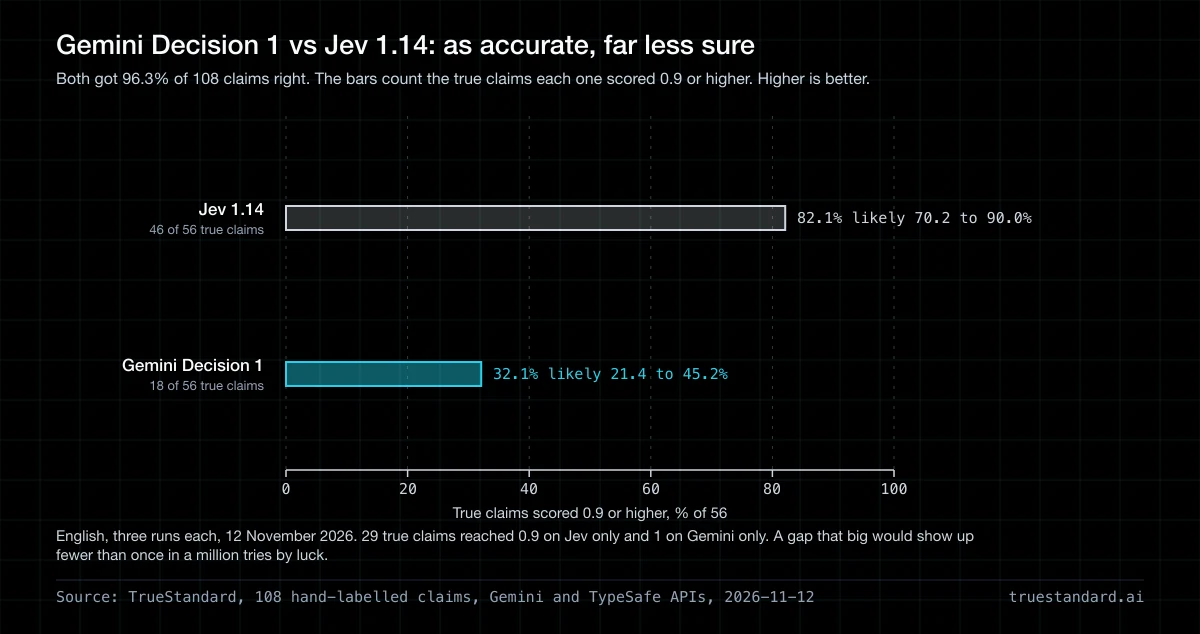
Same right answers, much less sure
On 108 claims checked against a source passage, Gemini Decision 1 and Jev 1.14 both got 96.3% right in English. The difference is in the number each one sends back. Jev scored 46 of the 56 true claims at 0.9 or higher, while Gemini scored 18 there and left 49 of its 108 answers between 0.1 and 0.9.
Once your code acts on the number, the gap shows. A rule that accepts at 0.9 would send 38 true claims to a person with Gemini, and 9 or 10 with Jev. Gemini is also the stricter of the two. It turned down more claims that add a cause the source never states, and more true claims that need a small step of reasoning.
What a decision model is
A decision model does not write text. You give it some material and a list of questions, and it sends back one number for each question, such as how likely the answer is yes. Your code then acts on that number, often with a cut-off like "accept at 0.9". So you need the answer to be right, and the number honest enough to build a rule on.
What Google claims, and what we found
Google's launch chart compares Gemini Decision 1 with Jev 1.14 on nine tests, one calibration score and price. We did not run Google's tests; we ran our own, and three of its measures have a match in ours.
Google's launch numbers beside ours, 12 November 2026.
| Measure | Google's chart | Our test |
|---|---|---|
| Accuracy, Gemini | 92.2% | 96.3% |
| Accuracy, Jev 1.14 | 90.0% | 96.3% |
| Calibration error, Gemini | 0.0250 | 0.110 |
| Calibration error, Jev 1.14 | 0.0494 | 0.079–0.086 |
| Gemini price vs Jev | 1.3 times | 1.2–6.7 times |
Google's accuracy is its JevBench public split. Its calibration error covers seven tests the models share, and its price is the total for those seven. Ours come from 108 English claims checked against a source passage, three runs each, and the cost of one call.
Google's chart puts Gemini ahead on calibration, with half of Jev's error, but on our task the order flipped. Gemini's error was higher in English and in Spanish by more than luck explains, and in Japanese and Hindi the gap was too small to call.
The tasks differ, so compare the direction rather than the size. On price the chart and our bills agree that Gemini costs more per text call. The gap is wider on our calls because Gemini bills about 49 tokens (word pieces) for each question, and Jev about 17.
What we measured
We ran three tasks on 12 November 2026, the day after launch, and ran Jev 1.14 again on the same day so the two sit side by side. Jev's numbers matched the ones we published for it in October.
Accuracy on 108 claims, in four languages
Each claim comes with a source passage, and the model says how likely it is that the passage backs the claim. Of the 108 claims, 56 are true and 52 are not, and some of the false ones add a cause, a number or a scope the source never states.
Share of 108 claims each model got right, three runs each, 12 November 2026.
| Language | Jev 1.14 | Gemini Decision 1 | Jev likely range | Gemini likely range |
|---|---|---|---|---|
| English | 96.3% | 96.3% | 90.9–98.6% | 90.9–98.6% |
| Spanish | 94.4–95.4% | 88.9% | 88.4–97.4% | 81.6–93.5% |
| Japanese | 91.7–92.6% | 98.1% | 84.9–95.6% | 93.5–99.5% |
| Hindi | 93.5–95.4% | 95.4% | 89.6–98.0% | 89.6–98.0% |
A range in a model's column is its lowest and highest run, and Gemini gave the same answer in all three runs. The likely range judges each claim on the average of its three runs.
English and Hindi are a tie, and Japanese is the one clear gap: Gemini got 7 claims right that Jev missed, and Jev got none that Gemini missed. A gap that size would show up 1.6% of the time by luck, but we tested four languages, so one result like this is weaker than it looks.
In Spanish, Gemini missed 10 claims that Jev got right and got 4 that Jev missed. A gap that size would show up 18% of the time by luck, so accuracy alone does not settle Spanish; the calibration table further down does.
How often each model is sure
Code that acts on a decision model often uses two cut-offs: accept at 0.9, refuse at 0.1, and send the rest to a person.
How many of the 56 true claims each model scored 0.9 or higher. Three runs each, 12 November 2026.
| Language | Jev 1.14 | Gemini Decision 1 |
|---|---|---|
| English | 46–47 of 56 | 18 of 56 |
| Spanish | 38 of 56 | 15 of 56 |
| Japanese | 37–38 of 56 | 24 of 56 |
| Hindi | 31–34 of 56 | 30 of 56 |
Each row is one language, and a range is the lowest and the highest of three runs.
In English, 49 of Gemini's 108 answers sat between 0.1 and 0.9, against 21 to 23 for Jev. Neither model was ever sure and wrong: no answer at 0.95 or above, or at 0.05 or below, landed on the wrong side.
Calibration error
When a model says 80%, about 80% of those answers should turn out right, and calibration error measures how far off that is. Lower is better.
Calibration error on 108 claims, ten score bands, 12 November 2026. Lower is better.
| Language | Jev 1.14 | Gemini Decision 1 | Gap | Likely gap |
|---|---|---|---|---|
| English | 0.079–0.086 | 0.110 | +0.031 | +0.001 to +0.069 |
| Spanish | 0.073–0.086 | 0.140 | +0.058 | +0.018 to +0.096 |
| Japanese | 0.078–0.094 | 0.109 | +0.027 | −0.028 to +0.058 |
| Hindi | 0.066–0.082 | 0.075 | −0.016 | −0.049 to +0.026 |
The gap is Gemini minus Jev, with each claim scored on the average of its three runs. We redrew the claims at random 5,000 times to get the likely gap. When it crosses zero, the test cannot tell the two apart.
Gemini's error was higher in English and Spanish by more than luck explains. In Japanese and Hindi it was too close to call. The error comes from doubt: in English, every answer Gemini scored between 0.7 and 0.9 was right, so those scores ran low.
Speed and cost
We timed a support-ticket task, sending first one question per call and then more, up to 1,000 questions in a single call.
Median time and cost for one call, 12 November 2026.
| Questions | Jev 1.14 time | Gemini time | Jev 1.14 cost | Gemini cost |
|---|---|---|---|---|
| 1 | 319 ms | 400 ms | $0.0000196 | $0.0000235 |
| 6 | 450 ms | 446 ms | $0.0000285 | $0.0000528 |
| 20 | 278 ms | 437 ms | $0.0000368 | $0.0001173 |
| 100 | 508 ms | 434 ms | $0.0000906 | $0.0005013 |
| 1,000 | 678 ms | 2,599 ms | $0.0007332 | $0.0049113 |
Each row is one call size. Each time is the median of five calls from one computer, network included, and three calls for 1,000 questions. Gemini's cost is its billed tokens times $0.10 per million, and Jev's is what TypeSafe billed.
Up to 100 questions the two run at about the same speed, and the lead changes from row to row. An earlier pass of the one-question test came out the other way round. At 1,000 questions, Jev was almost four times faster.
Gemini never cost less on text, because it charges 2.4 times as much per token and bills more tokens for each question.
Reading screenshots
We gave both models screenshots of AI search answers and asked three questions. Is a given brand named in the answer, which brand comes first, and is a pop-up covering the page? The pages come in three kinds: clean, dense with ads, and small grey print.
Wrong answers and cost per 1,000 screenshots, 12 November 2026.
| Pages | Jev 1.14 wrong | Gemini wrong | Jev per 1,000 | Gemini per 1,000 |
|---|---|---|---|---|
| Clean | 0 of 538 | 0 of 538 | $0.163 | $0.136 |
| Dense | 0 of 360 | 30 of 1,080 | $0.181 | $0.136 |
| Small print | 0 of 180 | 15 of 540 | $0.181 | $0.136 |
Gemini ran three times on dense and small-print pages and once on clean ones, and Jev ran once on each as the check. There were 180 clean, 120 dense and 60 small-print screenshots.
Gemini missed brands that appear only inside the reason for another pick, as in "Often compared with Altra." It said those brands were not named. It missed the same pages in every run, and Jev caught all of them.
Screenshots are the one task where Gemini cost less, because it bills a third of Jev's tokens for the same image.
How to read this
- Accuracy
- How often the answer landed on the right side of 0.5.
- Sure at 0.9
- How many true claims got a score of 0.9 or more, which is exactly what a rule like "accept at 0.9" lets through without a person.
- Calibration error
- When a model says 80%, about 80% of those answers should be right, and this number is how far off that is across ten score bands. Zero is perfect.
- Likely range
- The span that holds the true value 95 times in 100. For accuracy it comes from the Wilson method over the claims, and for a gap it comes from drawing the claims again at random 5,000 times.
- Gap
- The new model minus the one it is tested against, on the same claims. When the likely gap crosses zero, this test cannot tell the two apart.
- Run spread
- The lowest and the highest of three runs, written as a range, so a model that gives the same numbers every run shows one value.
Gemini gave the same numbers on every repeat run of the claim and screenshot tests, while Jev's numbers vary between runs.
What this data cannot tell you
- It covers three tasks. We ran three jobs: does a source passage back a claim, what does a support ticket need, and what does a screenshot show? The launch chart covers nine other tests that we did not run.
- It cannot rank vendors. A set of 108 claims can only split two models when the gap is large, and most gaps on this page sit inside the likely range, which each table says.
- Three of the four languages are translations. A model translated our Spanish, Japanese and Hindi claims, and we checked each one by translating it back. Real text written in those languages could score differently.
- A result that shows nothing still gets published. Where the two models tie, the page says they tie.
Where each model went wrong
One claim fooled both models in three of four languages. Two others split them, and each model got one right that the other missed.
False. The source says the backlog doubled after the outage, and after is not because. Jev scored it 0.63 to 0.77 in all four languages, so it missed every time. Gemini got it right in English at 0.43, then scored it 0.61 to 0.69 in the other three.
True. The source gives revenue up 12% and churn up from 4.4% to 5.1%, so both halves hold. Jev scored it 0.89, and Gemini scored it 0.30 and missed.
True. The penalty is 2% a week, capped at 10%, so five weeks and six weeks both cost 10%. Gemini scored it 0.90, and Jev scored it 0.22 and missed.
Which one fits your job
Your code acts on a cut-off, such as 0.9
Jev. In English it put 46 true claims at 0.9 or higher, against Gemini's 18. If you move to Gemini, test your cut-off again on your own data, because the same number means something else.
Unsupported claims must not get through
Gemini was stricter on claims that add a cause or a scope, getting 97.2% of the hardest English claims right against Jev's 91.7%.
Japanese text
Gemini. It got 7 Japanese claims right that Jev missed, and it missed none that Jev got.
Spanish text
Jev. In Spanish, Gemini's calibration error was 1.6 to 1.9 times Jev's, and it missed 10 claims that Jev got right.
Screenshots at volume
Gemini costs less per screenshot, but test it first on brands that appear only inside other text, which it missed a third of the time on dense pages.
Large batches of questions
Jev. It answered 1,000 questions in 0.7 seconds for $0.0007, while Gemini took 2.6 seconds and cost $0.0049.
If a model hedges, your cut-offs let different answers through, so test them before you switch. We use Jev 1.13 inside our own claim checker to test whether a cited source backs the sentence that cites it, which is why we ran this the day after launch. To check the sources in your own draft, try the free AI citation checker.
How current this is
Google released Gemini Decision 1 on 11 November 2026. We ran every test on 12 November and published the same day, one day after release.
How we ran it
Both models got the same material and the same questions, on the same day, from one computer, and each task ran three times. Code scored every answer against a label a person set before the run, and no language model graded anything. Cost is what each vendor bills: Google returns a count of tokens (word pieces), which we multiply by its list price, and TypeSafe returns a price.
Gemini Decision 1 ran on Google's Gemini API and Jev 1.14 on TypeSafe's own endpoint. Gemini got each source passage as plain text, and Jev got it as a named field. A model translated the Spanish, Japanese and Hindi claims, and we checked each one by translating it back. We did not test Google's own benchmarks, audio, video, PDF files, or any input longer than about 49,000 tokens.
The claims, the questions, every raw answer and the scoring code are kept beside the code that built this page. A public copy is being set up. Until it is live, ask and we will send the run files.
Questions about Gemini Decision 1
Is Gemini Decision 1 more accurate than Jev?
Not in English, where both got 96.3% of 108 claims right. It did better in Japanese, at 98.1% against Jev's 91.7 to 92.6%, and worse in Spanish, at 88.9% against 94.4 to 95.4%. Hindi was a tie.
Is Gemini Decision 1 better calibrated than Jev?
Google's chart says yes, but on our 108 claims it was not. Calibrated means a score of 80% turns out right about 80% of the time. Gemini's calibration error was 0.110 in English against Jev's 0.079 to 0.086, and 0.140 in Spanish against 0.073 to 0.086, both larger gaps than luck explains. In Japanese and Hindi the gap was too small to call.
How much does Gemini Decision 1 cost?
Google charges $0.10 per million input tokens and nothing for output. On our text calls that came to 1.2 to 6.7 times Jev's bill, since Jev costs $0.042 per million and bills fewer tokens for each question. On screenshots Gemini cost less, at $0.136 per 1,000 against $0.181.
Is Gemini Decision 1 faster than Jev?
About the same up to 100 questions in one call. At 1,000 questions it took 2.6 seconds, and Jev took 0.7.
Can I swap Gemini Decision 1 in for Jev?
Only after you test your cut-off again on your own data. On the same claims Gemini's scores sit much closer to the middle than Jev's, so a cut-off chosen for Jev lets different answers through when Gemini answers instead.
Does Gemini Decision 1 give the same answer every time?
In our runs, yes: every repeat run of the claim and screenshot tests returned the same numbers, while Jev's numbers varied between runs.
Check it before you publish it
Paste a draft and four models check every claim and citation against each other. You see where they disagree, which is where the errors are.
The claim checker is free. Pro is $20 a month for 250 drafts, Max $40 for 500, and Ultra $200 for 3,000.