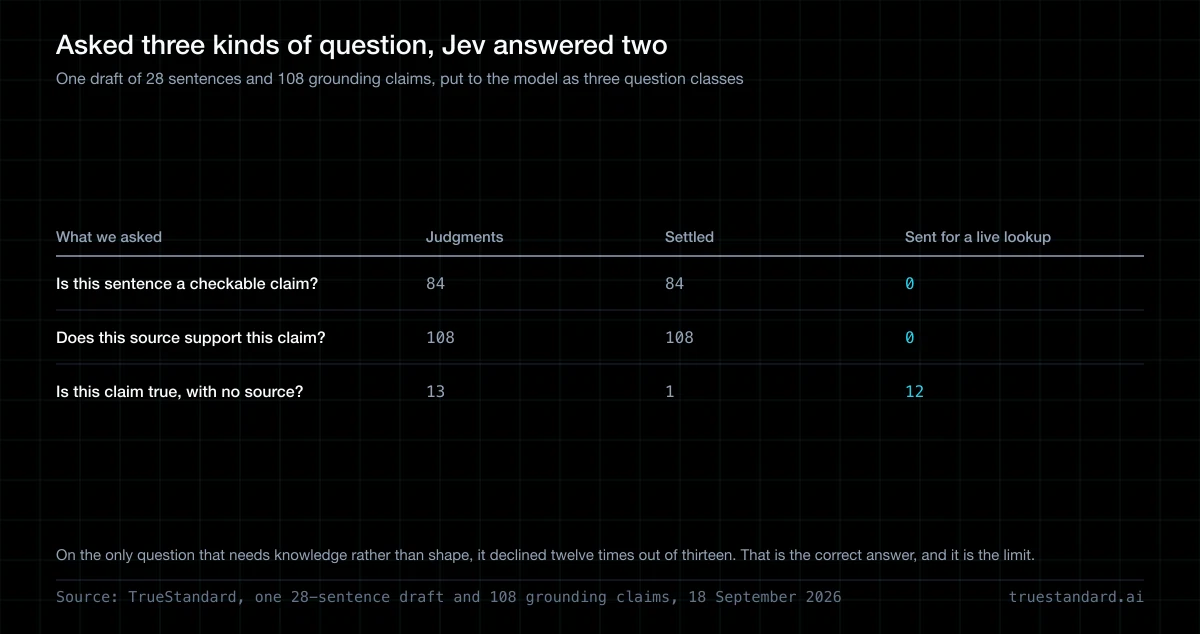
TypeSafe's Jev returns a typed answer and a probability instead of a sentence, and the coverage of its launch has been steadily promoting it into a fact-checker. We gave it thirteen factual claims with no source attached and asked it to judge whether each one was true. It settled one and flagged twelve as needing a live lookup.
That is the right answer to a question it cannot answer, and it is the reason Jev cannot replace a fact-checker. It is very good at judging the shape of a claim. Deciding whether a claim is true in the world is a different job, and it declines to do it.
The short answer
We put three kinds of question to Jev on 18 September 2026. Two of them it answered completely. The third it handed back.
Ask it something the text in front of it can settle and it settles it. Ask it something that needs a fact from the world and it reports that it needs a live lookup instead of producing a confident number.
Three questions, one refusal
| What we asked | Judgments | Settled | Sent for a live lookup |
|---|---|---|---|
| Is this sentence a checkable claim? | 84 | 84 | 0 |
| Does this source support this claim? | 108 | 108 | 0 |
| Is this claim true, with no source? | 13 | 1 | 12 |
Three separate runs on 18 September 2026. One draft of 28 sentences for the first row, 108 hand-labelled grounding claims for the second, and the 13 factual claims pulled out of that same draft for the third.
Every write-up of this launch we have read describes abstention as something you configure. None of them show the model declining on its own. It did.
Shape questions and knowledge questions
Jev takes source material and a set of questions written in advance, and returns an answer chosen from options you supplied plus a probability for each one. It writes nothing. That draws a clean line through the questions you can ask it.
A shape question can be settled from the material in front of the model. Is this sentence making a factual claim or expressing an opinion? Does this passage support this claim as stated? How urgent is this ticket? The answer is in the text, and the model's job is to read it.
A knowledge question cannot. Is this claim true? That answer lives in the world, in a source nobody has put in front of the model. A language model will answer it anyway from whatever it absorbed in training, which is where a confident fabrication comes from.
We have argued for a long time that a model checking its own work is not a check. The interesting thing about Jev is that it appears to know which of the two questions it has been handed.
What we asked it
The draft was 28 sentences of ordinary published writing, the kind our own tool gets pasted into every day. We asked Jev three things about each sentence. Is it making a claim somebody could check, is it high risk if it is wrong, and is it attributed to a source.
That is 84 judgments. They went in as one call, came back in about a second and a half, and cost $0.000143 for the batch. Jev separated 13 real factual claims from 15 opinions, transitions and hedges without a single error.
Then we took those 13 claims, stripped the sources off, and asked a different question: is this true? Nothing to read, nothing to compare against, just the claim and a request for a probability. A fact-checker has to answer that question. We wanted to see whether Jev would.
Separating a factual claim from an opinion is the judgment a verification pipeline has to make before it does anything expensive. A model costing a fraction of a cent got all 84 right. That is the half of this job a decision model is built for, and it is the half worth handing over.
What it did
Jev settled one of the thirteen. For the other twelve it returned a low probability of being able to adjudicate at all, between 0.51 and 0.82 on needing a live web lookup. That is not a confident verdict on the claim.
It did not split the difference, and it did not attach 0.9 to the claims that sounded plausible. Across twelve claims covering different subjects and different levels of difficulty it gave the same answer: this needs something I do not have.
A judgment on this question costs about $0.0000029 on Jev, against roughly $0.0027 for the same claim through our full council on the pro tier. That is about a thousandth of the price. If it had been willing to guess, the economics would have been irresistible and the output would have been worthless. It was not willing.
A cheap model that refuses the question it cannot answer is rarer and more useful than a cheap model that answers everything. That is a compliment, and we mean it as one.
What cannot hallucinate guarantees
TypeSafe says Jev cannot hallucinate. That is a statement about the shape of the output, not about whether the output is correct. The model returns a value from a list you supplied, so it cannot invent an option that was not there. It can still return the wrong one.
A developer put it plainly in the launch thread on Hacker News: "Sure, it can't emit an invalid type, but it can still emit a completely wrong valid value."
TypeSafe answered in the same thread, first pushing back on the word, then conceding the substance. The reply was that this is "likely true of all ML" and that calling it hallucination is a debate about semantics. A few comments later came the sentence that matters: "because these models are probabilistic, it's also possible to be confidently wrong."
Both sides of that exchange are right. The guarantee is real and it is narrow. You will never get a malformed answer, an invented category or a citation to a paper that does not exist. That is because the model cannot produce prose in which to invent one. You can still get the wrong department, the wrong score or the wrong verdict, with a plausible probability attached.
This is the distinction the whole category keeps collapsing. A guarantee about the form of an answer is not a guarantee about its truth, and neither one is a check. The only thing that catches a confident wrong answer is another judgment that disagrees with it. That is why we run a draft past four or five models and show you where they part company.
The nine failure modes TypeSafe publishes
TypeSafe does something most labs do not, which is publish a page of the things its model is bad at. The jaggedness page for Jev 1.13 names nine of them.
Named on TypeSafe's own jaggedness page
| Failure mode | What it means for a checker |
|---|---|
| Literal reading | It answers the question you wrote, not the one you meant. Scoping words and negations are read at face value. |
| Math and numbers | It does not count reliably, whether characters, occurrences or items in a list. |
| Date and time comparison | It reads dates as text rather than as ordered quantities. |
| Indirection | Double negatives and conditions that need a second hop degrade it. |
| Large state full of irrelevant detail | Unrelated material in the source costs accuracy. |
| Adversarial content | Text written to steer the model can move the answer. It does not treat input as hostile by default. |
| Contradictory instructions and criteria | Criteria that disagree with each other produce unpredictable answers. |
| Common-sense structural invariants | Two questions that ought to imply each other are not guaranteed to agree. |
| Generation | It does not write, so anything needing an explanation goes elsewhere. |
Read from TypeSafe's published jaggedness page for Jev 1.13 on 18 September 2026.
Four of those nine land directly on fact-checking. Dates, counts, negations and adversarial text are most of what goes wrong in a published claim. A checker that reads a date as a string is not going to catch an inverted timeline. Publishing the list is the right call, and the list is not short.
Abstention as a setting, and abstention on its own
Every page we found on this model describes abstention as something you arrange. Add a none of the above option, set a confidence band, route anything under the threshold to a person. All of that works and all of it is your design, not the model's judgment.
The difference matters because a forced choice is the default. If you hand the model four options and the true answer is none of them, it will pick the closest of the four and attach a probability to it. The model has no way to tell you the question was wrong unless you gave it one.
What we saw was not that. We asked an open question about truth and the model reported, unprompted and twelve times out of thirteen, that it could not settle it from what it had. No abstention option was configured, and we have found no published account of anyone else seeing it.
It is also the clearest possible statement of the limit. A model that tells you it needs a live lookup is telling you it is not the thing that does the lookup.
Where to put it
Put Jev on the shape questions. Which sentences in this draft are checkable claims, is this one high risk, does the passage the writer cited actually support what they wrote. It is fast, it costs a fraction of a cent, and on our triage run it was right 84 times out of 84.
Do not put it on the knowledge question. It will not take it. If you force an answer by supplying only the options you want back, you have built a machine for producing confident numbers with nothing behind them.
The two halves belong together. That is the shape our own pipeline is moving toward. A cheap typed judgment decides what is worth checking, and several models with sources in front of them decide whether it holds. We measured the accuracy half of that separately over 108 grounding claims across six domains, and the speed half against the 193x claim everyone has been arguing about.
A model that reports it does not know is rarer than it should be. It is worth building on, and it is worth being precise about what you are building on.
We have since wired the shape half into our own pipeline and measured what it did to the bill. The cost saving was zero, and the reason was more useful than the saving.
Frequently Asked Questions
Can Jev fact-check claims?
Not on its own. We gave it 13 factual claims with no source attached on 18 September 2026 and asked it to judge whether each was true. It settled one and returned a probability of between 0.51 and 0.82 on needing a live web lookup for the other twelve. It can judge whether a source supports a claim, which is a different question with the answer sitting in the text. It did that correctly 96.3 percent of the time over 108 claims.
Does Jev abstain on its own or do you configure it?
Both, and the difference matters. You can configure abstention by adding a none of the above option, or by routing anything under a confidence threshold to a person. Every write-up of the launch describes it that way. Separately, when we asked an open question about whether a claim was true, Jev reported that it needed a live lookup without being given an option to decline. That second behaviour is the one nobody else has published.
Can Jev hallucinate?
Not in the sense of writing a false sentence, because it does not write sentences. It returns a value from a list you supplied, so it cannot invent an option or cite a paper that does not exist. What zero hallucinations means is schema conformance, and TypeSafe's launch post is clear that this is a property of the design rather than an empirical result. The model can still return the wrong valid option with a confident probability attached. TypeSafe said as much in its own launch thread: because the model is probabilistic, it is possible for it to be confidently wrong.
What is Jev actually good at?
Questions the text in front of it can settle. On a 28-sentence draft we asked it 84 questions in one call, about whether each sentence made a checkable claim, whether it was high risk and whether it was attributed. It separated 13 factual claims from 15 opinions and transitions with no errors, in about a second and a half, for $0.000143. Triage, routing, scoring and grounding against a supplied source are all in that family.
Should I replace my fact-checker with Jev?
No, and you can add a grounding pass with it. A fact-checker answers whether a claim is true, which needs sources fetched from the world, and Jev declines that question. What it will do cheaply is tell you which sentences are worth checking and whether a source you already have supports the claim as written. Those are the expensive parts of a pipeline to run on full language models.
What are Jev's known failure modes?
TypeSafe publishes nine on its jaggedness page for Jev 1.13. They are literal reading, math and numbers, date and time comparison, indirection, large state full of irrelevant detail, adversarial content, contradictory instructions and criteria, common-sense structural invariants, and generation. Four of them bear directly on checking claims, because dates, counts, negations and adversarially written text are where published errors concentrate.
What happens if none of the options I give Jev are correct?
It picks the closest one and attaches a probability. The model chooses from the list you supply, so a question whose true answer is absent still comes back looking like an answer. Add an explicit none of the above option to any question where that is possible. Treat a high-confidence result on a badly framed question as a fault in the question.
What does one Jev judgment cost?
About $0.0000029 for a claim-level judgment in our runs on 18 September 2026, against roughly $0.0027 for the same claim through our full council on the pro tier. That is about a thousandth of the price, which is exactly why the refusal matters: at that cost, a model willing to guess would be very easy to over-trust.
Why is a model refusing to answer a good thing?
Because the alternative is a confident number with nothing behind it. A model that answers every question about truth from its training data will be right often enough to look reliable and wrong in ways nobody catches. A model that reports it needs a live lookup has told you exactly where its competence ends, which is the information you need to design around it.
Keep reading
Why AI Hallucinations Are Structural
DELEGATE 52, GPT-5.5, and a Purdue impossibility proof. Three April 2026 results that move 'hallucinations are structural' from take to documented fact.
When AI Cites Studies That Don't Exist
AI does not just get facts wrong. It invents whole sources: cases, studies, DOIs. Then it cites them with the same confidence it uses for real ones. Here is why it happens, and the disasters it has already caused. And here is how to catch a fake citation before your name is on it.
AI Fake-Citation Disasters: A 2026 Reference
A running list of documented cases where AI made up citations in law, academia, and media. Every entry is sourced, and it is here to be linked, cited, and updated as new cases surface.
How to Check If AI Citations Are Fake
Four checks catch a fabricated reference before your readers do, and one of them is new. Here is the change: in 2026, a DOI that resolves no longer means the citation is real.
AI Detector vs Fact Checker
One asks who wrote this. The other asks is this true. Before you publish, only one of those questions protects your name, and most teams are watching the wrong one.
The claim still has to be checked
Deciding which sentences are worth checking is the cheap half. TrueStandard runs your draft past four or five models with sources in front of them and shows you every claim they disagree on. The disagreements are where the errors are.
Start Verifying →