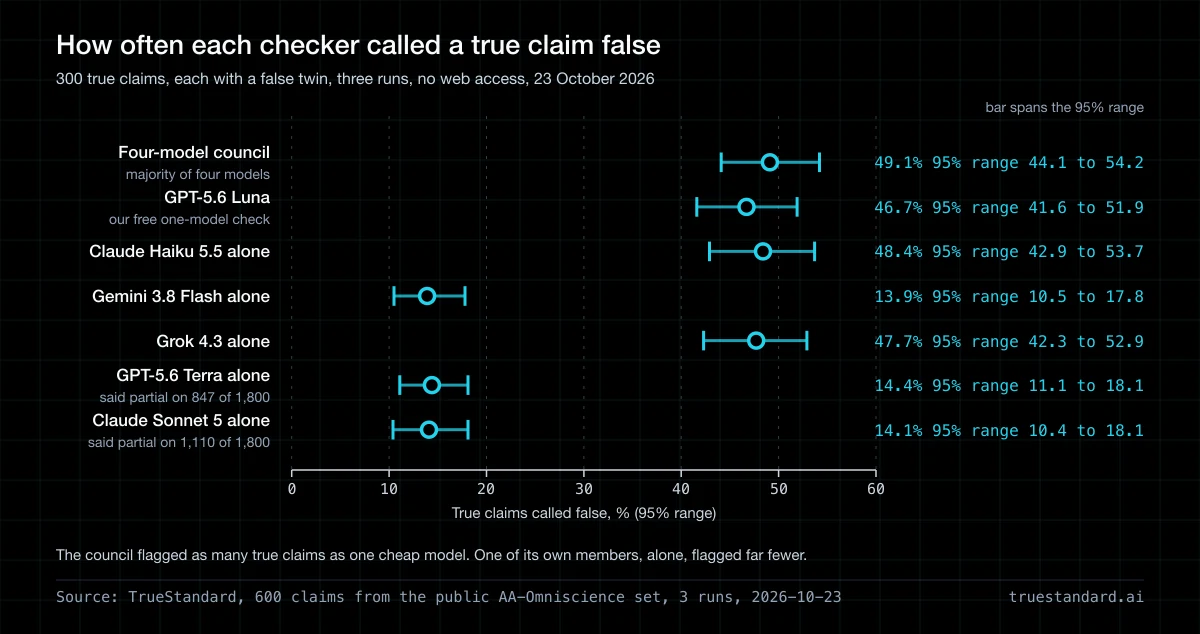
Do four AI models fact-check better than one? We tested it on our own product. We built 600 claims from 300 matched pairs. In each pair, one claim is true and its twin differs by one wrong value. Then we ran every claim through a four-model council and through six single models, three times each.
The council flagged 49.1% of the true claims as false. Our free one-model check flagged 46.7%. That gap is too small to tell apart. The council did catch more fakes: 70.3% against 57.0%. And one council member, Gemini 3.8 Flash, flagged just 13.9% of true claims when we read its vote alone.
The short answer
Four models did not cut false alarms. They caught more false claims, at 23 times the cost of one model. The best result came from one model on its own. Gemini 3.8 Flash called true claims false 13.9% of the time and caught 68.6% of the fakes.
These are hard claims. Each one names an exact year, number, name or rule from law, health, finance, science, software or the humanities. No model could look anything up. On easy claims, our checker scored near perfect in August. This test is the hard case, and the numbers are weak.
| Checker | Wrong flags | 95% range | Fakes caught | 95% range | Cost per claim |
|---|---|---|---|---|---|
| Four-model council | 49.1% | 44.1–54.2% | 70.3% | 65.6–75.0% | $0.0083 |
| GPT-5.6 Luna, our free check | 46.7% | 41.6–51.9% | 57.0% | 51.7–62.0% | $0.0004 |
| Claude Haiku 5.5 alone | 48.4% | 42.9–53.7% | 57.0% | 51.7–62.2% | $0.0004 |
| Gemini 3.8 Flash alone | 13.9% | 10.5–17.8% | 68.6% | 63.7–73.5% | $0.0072 |
| Grok 4.3 alone | 47.7% | 42.3–52.9% | 57.7% | 52.7–62.8% | $0.0009 |
| GPT-5.6 Terra alone | 14.4% | 11.1–18.1% | 27.7% | 23.0–32.3% | $0.0035 |
| Claude Sonnet 5 alone | 14.1% | 10.4–18.1% | 31.0% | 26.2–35.9% | $0.0095 |
A wrong flag is a true claim that the checker calls false. A fake caught is a false claim that the checker calls false. The 95% range comes from 4,000 resamples of the 300 claim pairs. Each checker ran three times on 23 October 2026, with no web access.
What we ran
The claims come from a public set of 600 hard quiz questions with known answers. We took 50 questions from each of six fields. For each one, a model wrote a sentence with one blank. Code put the real answer in the blank for the true claim, and a plausible wrong value for the false one.
So each pair differs by one fact. One says the Battle of Neerwinden took place on 29 July 1693. Its twin says 19 July. A checker that knows the fact passes one and flags the other. A checker that does not know has to guess, or hedge.
Every claim went through the same path a user's claim takes. The council sends one prompt to GPT-5.6 Luna, Claude Haiku 5.5, Gemini 3.8 Flash and Grok 4.3 at the same time. The majority wins, and a tie goes to the more careful verdict. Our free check sends the same prompt to GPT-5.6 Luna alone. Each council member answers on its own, so its vote is also a one-model result.
We added two larger models on their own, GPT-5.6 Terra and Claude Sonnet 5, to test the obvious objection: maybe one strong model beats four cheap ones. The total bill for the run was $41.11. This is the large version of a 24-claim test from August, written up in how often our fact checker flags a true claim.
How often a true claim gets a pass
The checker gives one of three verdicts: verified, partial or challenged. The table above counts only challenged as a flag. A careful reader treats partial as a flag too, because partial means fix this before you publish. On that reading, the numbers get much worse.
The council left 83.8% of true claims without a pass. The two large models look better in the first table for one reason: they hedge. Claude Sonnet 5 said partial on 1,110 of its 1,800 answers. A model that rarely commits makes few wrong flags, and it catches few fakes.
| Checker | True claims not cleared | 95% range | Fakes not cleared | 95% range |
|---|---|---|---|---|
| Four-model council | 83.8% | 79.9–87.4% | 97.3% | 95.6–98.8% |
| GPT-5.6 Luna, our free check | 78.6% | 74.1–82.7% | 85.5% | 81.6–89.1% |
| Claude Haiku 5.5 alone | 90.5% | 87.1–93.5% | 97.9% | 96.2–99.2% |
| Gemini 3.8 Flash alone | 26.6% | 22.1–31.6% | 84.5% | 80.4–88.3% |
| Grok 4.3 alone | 89.2% | 85.8–92.4% | 96.2% | 94.0–98.0% |
| GPT-5.6 Terra alone | 61.3% | 56.1–66.6% | 74.9% | 70.2–79.4% |
| Claude Sonnet 5 alone | 76.0% | 71.3–80.4% | 92.4% | 89.4–95.0% |
Not cleared means the checker did not call the claim true. It said partial or challenged. For a true claim, that is a miss. For a fake, that is a catch. The claims, runs and 95% range match the first table.
Can the checker tell true from false?
The pairs give a test that does not depend on where you draw the line. Take the true claim and its false twin. A checker that knows the fact gives the true one the better verdict. A checker that does not know gives both the same verdict.
The council told the twins apart in 28.2% of pairs. In 65.9%, it gave both the same verdict. Every model except one landed in the same place. Gemini 3.8 Flash told the twins apart in 70.7% of pairs.
| Checker | Told apart | Same verdict | Got backwards |
|---|---|---|---|
| Four-model council | 28.2% | 65.9% | 5.9% |
| GPT-5.6 Luna, our free check | 20.9% | 69.3% | 9.8% |
| Claude Haiku 5.5 alone | 19.2% | 73.5% | 7.3% |
| Gemini 3.8 Flash alone | 70.7% | 23.0% | 6.2% |
| Grok 4.3 alone | 16.6% | 77.4% | 6.0% |
| GPT-5.6 Terra alone | 25.0% | 66.8% | 8.2% |
| Claude Sonnet 5 alone | 26.4% | 67.8% | 5.8% |
Told apart means the true claim got the better verdict. Got backwards means the false twin got the better verdict. Each share is out of 900 pair runs, or 768 for Gemini 3.8 Flash.
One model beat the group
Gemini 3.8 Flash sits on our council. Read alone, its vote made far fewer wrong flags than the council and nearly matched it on fakes caught, 68.6% against 70.3%. It called 77.3% of all claims right. The council called 60.6% right. The council loses because the other three members flag about half of all true claims, and three votes beat one.
There are two catches. First, Gemini 3.8 Flash thinks before it answers, and the other three members do not. It costs about eight to nineteen times as much per call as the others. Second, the question set is public. A model that saw it in training would score well for the wrong reason. We cannot rule that out for any model. Gemini also timed out on 148 of 1,800 calls. We count its rate only on the calls that came back.
In this test, Gemini 3.8 Flash stood alone against the other three models 311 times. It was right on 226 of them. Our council report shows each model's verdict next to the vote, so a lone dissent like that stays in view.
How the vote changes the result
The four votes stay the same in every row below. Only the rule that turns them into one verdict changes. Our rule breaks a tie toward caution. 246 of the 1,800 council results were ties.
A stricter rule cuts wrong flags in half and misses more fakes. A looser rule catches almost every fake and flags most true claims. No rule we tried got the council near Gemini 3.8 Flash on its own.
| Council rule | Wrong flags | 95% range | Fakes caught | Right calls |
|---|---|---|---|---|
| Majority, ties go to caution (ours) | 49.1% | 44.1–54.2% | 70.3% | 60.6% |
| Majority, ties go to true | 41.2% | 36.1–46.3% | 58.6% | 58.7% |
| Flag only when 3 of 4 agree | 26.0% | 21.4–30.7% | 51.1% | 62.6% |
| Flag when any model objects | 74.4% | 69.8–78.9% | 88.8% | 57.2% |
We count the same 1,800 council results in each row. Right calls are the share of all 600 claims, true and false, where the verdict was correct. Only challenged counts as a flag here.
What four models cost
One council check cost $0.0083 per claim. One check on GPT-5.6 Luna alone cost $0.0004, so the council costs 23 times as much. For that, it caught 13.3 more fakes per 100 and made no fewer wrong flags.
Gemini 3.8 Flash alone cost $0.0072 per claim. That is close to the full council, because Gemini was $11.82 of the council's $14.99 bill.
What this test cannot tell you
- No model could search the web. These are memory checks on rare facts. On a claim with a source to read, the rates will differ.
- The claims are hard on purpose. On 30 easy claims in August, the same checker made almost no wrong flags.
- The true answers come from the public question set. If one of its answers is wrong, our label is wrong too. We read 30 pairs by hand and found one false twin that is partly true.
- We ran each checker three times on one day. For the council, about one claim in five changed its verdict between runs.
- Each model ran with our settings, not its best ones. This is not a ranking of the labs.
Check rare facts at the source
Four models are not a fix for false alarms on hard claims. They catch more fakes, and they flag about as many true claims as one cheap model. The choice of member mattered more than the number of members. So did the rule for counting votes.
So we will not tell you that a council is always safer. On a claim that turns on one rare fact, check the source yourself, whatever any checker says. Where the models split, treat the split as the result.
Want to see the split on your own draft? The AI fact checker shows each model's verdict on each claim, so you can see who disagreed and why.
Frequently Asked Questions
Do multiple AI models fact-check better than one?
Not on false alarms, in our test. On 600 hard claims, a four-model council called 49.1% of true claims false. One model alone, GPT-5.6 Luna, did so on 46.7%. The council caught more false claims: 70.3% against 57.0%. It cost 23 times as much per claim.
What is the false positive rate of an AI fact checker?
On our 600 hard claims, it ranged from 13.9% to 49.1% across the checkers we tested. A false positive here means the checker calls a true claim false. On easy claims in an earlier test, our checker made almost no such errors. The rate depends more on the claims than on the tool.
Which AI model is best at fact-checking claims?
In this test, Gemini 3.8 Flash on its own did best. It called 77.3% of claims right and flagged 13.9% of true claims. It thinks before it answers, and the other models in our council do not. The question set is public, so a model trained on it would also score well.
Why do large AI models say a claim is only partly true?
They hedge when they cannot check a rare fact from memory. Claude Sonnet 5 said partial on 1,110 of its 1,800 answers. That keeps its wrong flags low, at 14.1%. It also means it caught only 31.0% of the false claims outright.
Should I trust an AI fact checker on niche facts?
Use it to find the claims worth a second look. In our test, every checker but one gave a true claim and its false twin the same verdict at least two times in three. On a claim that turns on one exact number, date or name, open the source.
Keep reading
Why AI Hallucinations Are Structural
DELEGATE 52, GPT-5.5, and a Purdue impossibility proof. Three April 2026 results that move 'hallucinations are structural' from take to documented fact.
Can Jev Fact-Check Claims? It Declined 12 of 13
We handed TypeSafe's decision model thirteen factual claims with nothing to check them against. It refused to guess on twelve of them, which is the best thing we can say about it.
We Put Jev in Our Pipeline and Saved Nothing
The per-judgment price said we would cut the bill by a quarter. Measured against the real pipeline it saved nothing at all, and the reason is more useful than the saving would have been.
When AI Cites Studies That Don't Exist
AI does not just get facts wrong. It invents whole sources: cases, studies, DOIs. Then it cites them with the same confidence it uses for real ones. Here is why it happens, and the disasters it has already caused. And here is how to catch a fake citation before your name is on it.
TrueStandard vs Omniscient AI
Both run several models, and both show where those models agree. The difference is the moment each one is built for. Omniscient checks what you are reading. TrueStandard checks what you are about to publish.
See where the models disagree
Paste a draft and see each model's verdict on every claim, side by side.
TrueStandard is for writers who publish AI-assisted drafts. Paid plans check every claim and citation across four AI models before you hit publish.
Free: one check a day, no signup. Pro is $20 a month for 250 drafts.
Start Verifying →