You pasted a draft into Claude to tighten it. Then you read that Anthropic now marks Claude's text, and a small alarm went off. Did your own paragraphs just get branded as machine output?
Mostly no. The Claude watermark attaches to words Claude picked. Suppose you wrote the words and Claude only tidied them: there is very little for it to hold onto. The fear going around is aimed at the wrong thing, and the mechanism shows why.
What the watermark actually is
Nothing is added to your text: no hidden characters, no invisible spaces, no tag in the file. The mark lives in which words the model picked.
In plain terms
Every time a model writes, it picks the next word, from a handful of decent options. Claude now makes that pick using a secret key instead of pure chance. Do that a few hundred times and the picks form a faint pattern. Anyone holding the key can see the pattern, and everyone else sees ordinary writing.
This is a variant of SynthID-Text, the method Google DeepMind published in 2024. Anthropic says it does not change how the text reads, and that it carries no information about you, your account or your chat. It says one thing only: these word choices came from Claude.
Does it mark writing you wrote?
This is the question that sent writers, lawyers, academics and researchers into a small panic, and Anthropic answered it directly in its own explanation.
When Claude edits human text, nearly all the words are the person's, there's very little (if anything) for the watermark to attach to.
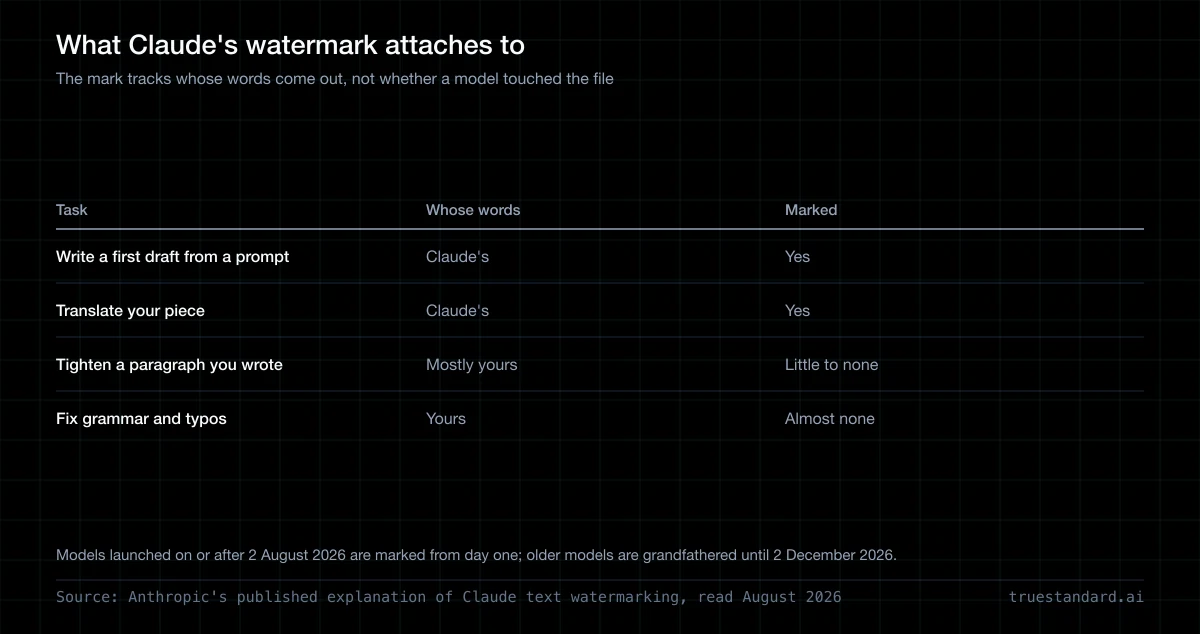
So the mark tracks authorship of the words, not whether a model touched the file. Ask Claude to fix your commas and you keep your commas, your sentences and your voice, so there is no pattern to leave behind.
Whose words come out the other end decides it.
| Ask Claude to | Whose words | Carries the mark |
|---|---|---|
| Write a first draft from a prompt | Claude's | Yes |
| Tighten a paragraph you wrote | Mostly yours | Little to none |
| Fix grammar and typos | Yours | Almost none |
| Translate your piece | Claude's | Yes |
| Write code | Claude's | Less than prose |
Notice what the mark is doing. It records where the words came from and stops there, and that is the same boundary a verification tool has to cross. TrueStandard takes your finished draft, runs four independent models over it in about a minute, and shows you every claim they disagree about.
What erases it
The mark is tougher than people assume in one direction, and weaker in another.
It survives
Copying, pasting, reformatting and saving to plain text all leave it intact. Moving the text into Word, Google Docs or an email changes nothing, because the mark is not a character in the file.
It breaks
A full rewrite erases it and heavy editing weakens it. Anything that swaps Claude's choices for yours removes the thing being measured.
It is thin to begin with
Short passages give it few choices to work with, and factual writing often has one natural phrasing per sentence. Code has the same problem.
Notice that the second list is just editing: the mark fades as your involvement rises. That is the behaviour you would want if you were designing it.
Who can read the mark today
Nobody outside Anthropic. Detection needs the secret key used to generate the text, and Anthropic holds it. Paste Claude output into any third-party checker and it is guessing from writing style, the same unreliable method it used last year.
Anthropic has said a detection API is coming, and it is still working out the details. Until it ships, text is being marked and no one can read the marks. Which makes this a strange moment to buy a tool that claims to find or remove them.
There is a quieter problem here. Even a perfect origin signal answers a question about the writer, and it never touches the claims. TrueStandard checks the second thing: paste the draft and four models read it in parallel, and every fabricated citation or disputed number comes back flagged.
Why this is happening now
Regulation, mostly. Article 50 of the EU AI Act covers providers serving the EU, and it requires them to mark AI-generated content in a machine-readable way. Anthropic applies the mark at the model level rather than by region, so it ships everywhere Claude is offered.
The rollout runs on two clocks.
| Model | Status |
|---|---|
| Models launched on or after 2 August 2026 | Marked from day one |
| Models already on the market | Grandfathered until 2 December 2026 |
One vendor doing this is not an industry standard. OpenAI built a text watermarker around 2023, reportedly an accurate one, and it has never shipped it. Its stated worries were that a rewrite defeats the mark, and that users would leave. As of today ChatGPT output carries no watermark, so plan for a patchwork rather than a wave.
What a watermark cannot tell you
A mark on a paragraph tells you the words came from Claude. It says nothing about whether the study cited in that paragraph exists. Provenance and accuracy are different measurements, and only one of them gets you corrected in public. We laid out that split in AI detector vs fact checker, and the failure it protects against is covered in why AI cites studies that do not exist.
Which is why the watermark changes less about your workflow than the headlines suggest. You are fine if you use Claude to sharpen your own prose, and the tells that make writing read as generated remain the thing readers actually notice. If you publish a draft Claude wrote, the mark is the least of it. Check the facts.
Frequently Asked Questions
Does Claude watermark text I wrote myself?
Barely, if at all. The watermark attaches to word choices Claude made, and when Claude edits or proofreads your writing, nearly every word stays yours. So there is almost nothing for the mark to attach to. A draft Claude wrote from a prompt is a different case, and it does carry the mark.
Which Claude models are watermarked?
Models launched on or after 2 August 2026 carry the mark from launch. Models already on the market when the rule took effect were given until 2 December 2026. The mark is applied at the model level, so it applies wherever Claude is offered rather than only in the EU.
How can I check if text has a Claude watermark?
You cannot, and neither can anyone else outside Anthropic. Detection requires the secret key used during generation, and Anthropic has announced a detection API but has not shipped it. Any third-party tool claiming to detect the Claude watermark today is guessing, from writing style.
Does rewriting remove the Claude watermark?
Replacing the words removes what the mark measures, so a full rewrite erases it and heavy editing weakens it. Copying, pasting and reformatting do not. Paying for a tool to do this is odd, though, because there is no public detector reading the mark in the first place.
Why did Anthropic start watermarking Claude?
Article 50 of the EU AI Act covers providers serving the EU market, and it requires them to mark AI-generated content in a machine-readable form. Anthropic applies the mark in the model's sampling behaviour rather than per region, so it ships worldwide.
Does ChatGPT watermark its text?
No. OpenAI built a text watermarking method around 2023 and has never released it. It cited the risk that rewriting defeats the mark, and the risk that users would move to competitors. Reports of invisible characters in ChatGPT output are a separate thing, and OpenAI denies they are watermarks.
Does the watermark change how Claude writes?
Anthropic says it does not affect quality, creativity or readability. The method picks among words the model already considered acceptable, so the output stays within the range it would have produced anyway. Nothing is added to the text itself.
Does a watermark mean AI content is accurate?
No. A watermark records where words came from, and it makes no claim about whether the facts, quotes or citations in those words are real. A watermarked paragraph can be entirely fabricated, and an unmarked one can be entirely correct.
Keep reading
AI Detector vs Fact Checker
One asks who wrote this. The other asks is this true. Before you publish, only one of those questions protects your name, and most teams are watching the wrong one.
GPTZero's Hallucination Detector, Explained
It catches citations that don't exist. By GPTZero's own admission, it does not check whether what you wrote is true. Here is exactly what its hallucination and source tools do. Here is where the gap is, and what closes it.
TrueStandard vs Omniscient AI
Both run several models, and both show where those models agree. The difference is the moment each one is built for. Omniscient checks what you are reading. TrueStandard checks what you are about to publish.
An Originality.AI Alternative
Originality.AI is a strong AI-detection suite. But say the job you care about is verifying claims before you publish. Fact-checking is only one of its five bundled checks, and it runs on a single model.
TrueStandard vs Parafact
Both verify claims before you publish. The real difference is what one model can miss, and whether your long-form draft fits inside the check at all.
The mark says who wrote it. We say whether it holds up.
Paste your draft, and four independent models check the claims and citations in about a minute. You get a receipt showing what they found.
Start Verifying →