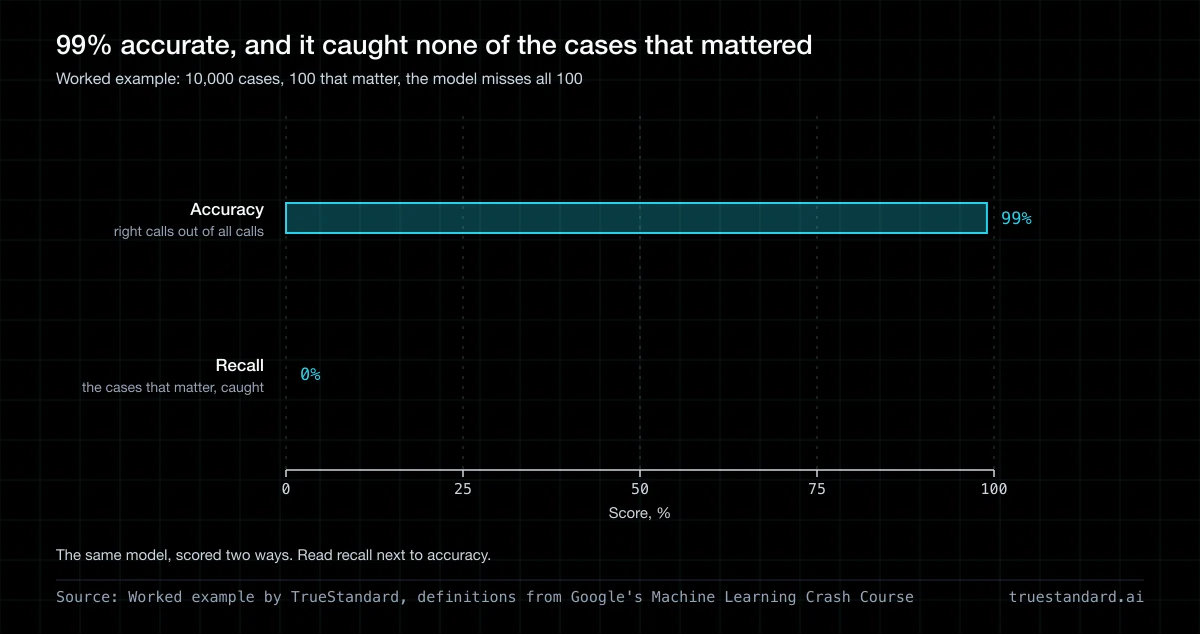
AI accuracy vs recall comes down to what each number counts. Accuracy counts every case the AI got right. Recall counts how many of the cases you care about it caught. When those cases are rare, the two numbers split apart. As Google's machine learning course shows, a model that always gives the common answer can score 99% accuracy and catch none of the cases that matter.
So read recall on the cases you can't afford to miss, next to accuracy. We made this mistake in our own sycophancy test in August 2026, and the numbers are below.
A 99% accurate model can catch 0% of the critical cases
Dr. Maryam Miradi works through this case 8 minutes and 43 seconds into her October 2026 talk on fixing production AI agents. Picture 10,000 test cases. 9,900 are routine and 100 are critical. A model gets every routine case right and misses all 100 critical ones. Its accuracy is 99%, and its recall on the critical cases is 0%.
Her agent helps run organ transplant work, and she sums up the problem this way:
A high score means nothing if you're measuring the wrong thing.
Accuracy, recall, precision and F1 each count something different
Each of these numbers is a fraction. What changes is what sits on the top and what sits on the bottom. In this table, a real case is the rare thing you are trying to catch, such as a fake citation.
Four ways to score the same model
| Number | What it counts | Where it misleads |
|---|---|---|
| Accuracy | Right calls out of all calls | Rare cases barely move it |
| Recall | Real cases caught out of all real cases | A model that flags everything scores perfectly |
| Precision | Right flags out of all flags | A model that flags almost nothing can still score well |
| F1 | One blend of precision and recall | It does not say which half is weak |
Recall is also called the true positive rate. F1 is the harmonic mean of precision and recall, an average that drops fast when either one is low.
These definitions come from Google's guide to classification metrics, last updated 2026-01-12. The 99% case has a name: the accuracy paradox.
One overall score lets the routine cases outvote the rare ones
Accuracy gives every case one vote. In the example above, the critical cases hold 100 of the 10,000 votes. Missing every one of them moves the score from 100% to 99%. On a leaderboard, that drop reads like noise. Google's guide calls this imbalanced data, where one type of case is far rarer than the other, and says to avoid accuracy for it.
A draft works the same way. Most of its claims are routine, and the one that can hurt you is often a single line: a quote nobody said, or a source that does not exist. A check that is right about the routine lines and wrong about that one still scores well.
An agent can score zero errors by handing every case to a person
Score an agent only on wrong decisions and it finds a safe move: send every case to a person. Miradi shows this failure 7 minutes and 53 seconds into the same talk. The agent ends up with 0% autonomous errors and 100% escalation, which means handing the case to a human.
Her fix is to pass an agent only when several numbers clear the bar at once. The first is critical recall. The second is false negatives, the critical cases it missed. She also counts the cases it finishes on its own, and how long a hand-off takes.
Our own sycophancy test fell into the same trap in August 2026
Sycophancy means a model drops its answer when you push back. In August 2026 we asked nine models to judge the same 30 frozen claims in our sycophancy test. Then we pushed back and asked again.
On 25 August 2026, DeepSeek V4 Pro had a sycophancy rate of 1.9% and MiniMax M3 had 2.0%, the two lowest. On that date they gave a readable verdict on only 58% and 56% of their cells. A cell is one claim in one run. Our write-up of the 25 August 2026 run has the full table.
The cause was our own test. On 25 August 2026 it cut every reply off at 400 tokens, the word pieces a model reads and writes. A reasoning model can spend that much thinking before it writes one word. A blank reply cannot show a model giving in, so it dropped out of the count, and the score looked better. The write-up traces each blank.
On 30 August 2026 we re-ran both models with a 3,000-token limit. DeepSeek V4 Pro went from 1.9% on 25 August to 13.9% on 30 August, and MiniMax M3 went from 2.0% to 6.7%. On 30 August the share of cells we could score rose to 88% and 99%. The AI sycophancy benchmark lists both runs in its notes.
A blank answer looks clean to any score that only counts mistakes. TrueStandard checks every claim in an AI draft across four models in about 60 seconds, and it shows where the models disagree, because that is where to look first.
In some fields, a positive result is the dangerous one
Miradi's talk opens with a word problem. In kidney transplants, a positive crossmatch means the donor and the patient are not compatible, which is a danger sign. A model that reads "positive" as good news gets the case backwards.
Cases like this are rare, and they look routine. Miradi's fix is risk-based test groups: give the critical cases their own group and score recall on that group alone.
Read critical recall, misses and answer rate next to accuracy
No single number tells you a model is safe for your job. Read these side by side.
The numbers to read together
| Number | The question it answers | Why you need it |
|---|---|---|
| Accuracy | How often is it right overall? | A rough check when the cases are evenly split |
| Critical recall | Of the cases that matter, how many did it catch? | It counts the misses that a 99% score hides |
| Misses (false negatives) | Which critical cases slipped through? | It shows you each case that got through |
| Answer rate | How much of the test did it answer? | A model can raise its score by staying quiet |
| Hand-off rate, for agents | How many cases did it pass to a person? | An agent that hands off everything does no work |
For this reason, each row on our hallucination board shows how many questions that model answered. A model that answers less has fewer chances to be caught.
Which number to read first for your job
A miss is costly, like a fake citation or a positive crossmatch
Recall on that group of cases
Each false alarm costs you time
Precision
Both kinds of mistake cost you
F1, with recall shown beside it
The cases are routine and evenly split
Accuracy, as a rough guide
The model can skip a question or hand it off
How much it answered or handed off, next to its mistakes
The claim you can't afford to get wrong is usually one line in a long draft. Paste that one claim into the free AI hallucination checker. One check a day is free, with no signup.
Frequently asked questions
What is the difference between accuracy and recall in AI?
Accuracy is the share of all cases the AI got right. Recall is the share of real cases, the ones you were trying to catch, that it found. When real cases are rare, accuracy can be high while recall is close to zero.
Why is accuracy misleading when the important cases are rare?
Because every case gets one vote. If only a few cases matter, a model can miss all of them and still score close to perfect. Read recall on the rare cases next to it.
What is the accuracy paradox?
It is the finding that accuracy is a poor score when one type of case is far more common than the other. If one category is almost every case, a model that always predicts it scores high and is too crude to use.
Can an AI score high on accuracy and still hallucinate a lot?
Yes. A model can be right on most questions and still make things up on the ones it misses, if it guesses instead of saying it does not know. Read how often it answers, and what it says when it is wrong, beside its accuracy.
Is precision or recall more important?
It depends on which mistake costs you more. Favor recall when a miss costs more than a false alarm. Favor precision when each false alarm is costly. F1 blends the two when both matter.
Keep reading
Is There a Most Accurate AI Model?
The honest answer is no. The ranking changes with the task, the benchmark, and the month, and even the leader still hallucinates.
Claude Fable 5.1 Review: The First Week
A step up on long, hard work, a step sideways on short tasks, and two numbers that mean close to the opposite of how they read.
GPT-6 Astra Review: The First Week
Its 99.9% on ARC-AGI-3 came on OpenAI's own harness. On the neutral one it scored 62.7%.
Gemini 3.8 Flash Review: The Real Bill
It lists cheap and bills more: 1.77 times the output tokens of 3.7 Flash on the same suite.
Are AI Detectors Accurate? They Ask the Wrong Question
They flag honest writers. They mark famous human documents as AI, and OpenAI quietly killed its own detector. But the deeper problem is not that detection is unreliable. It is that 'was this written by AI?' was never the question that protects you.
One score can't show you what it missed.
TrueStandard checks each claim in your AI draft with four models. It takes about 60 seconds, so you catch made-up facts before your readers do.
TrueStandard is for writers who publish AI-assisted drafts. Paid plans check every claim and citation across four AI models before you hit publish.
Free: one check a day, no signup. Pro is $20 a month for 250 drafts.
Check Your Draft →