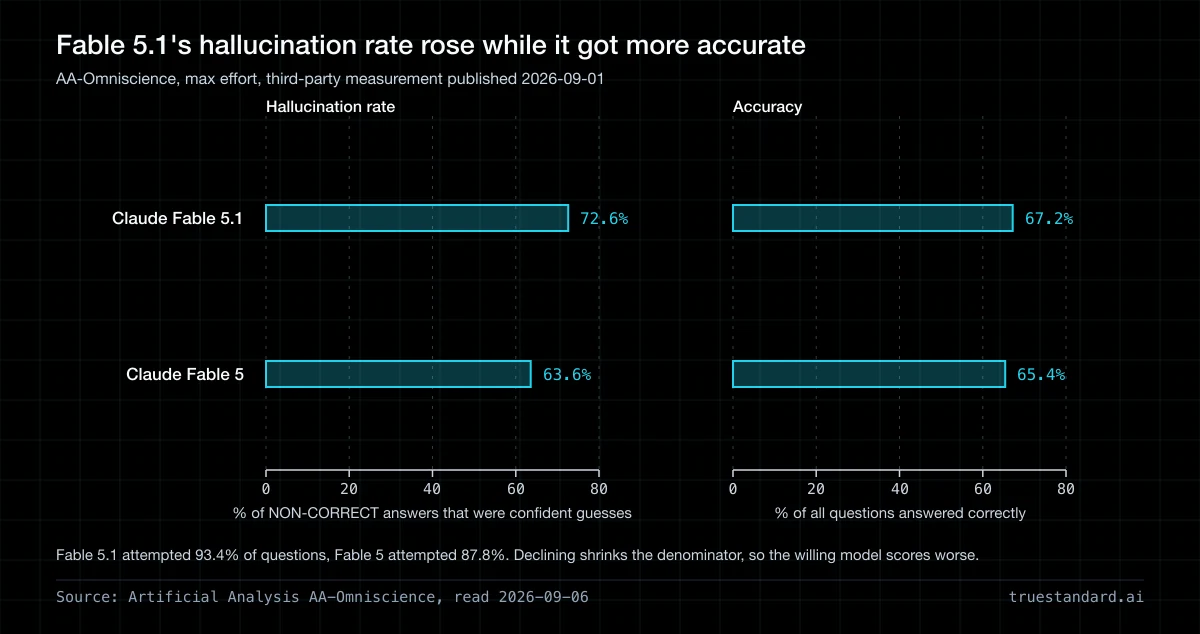
Claude Fable 5.1 is a step up on long, hard, single-shot work and a step sideways or backwards on short tasks. Its hallucination rate rose from 63.6% to 72.6%, but that metric counts only the questions it got wrong. Anthropic shipped the model on 1 September 2026, and this review covers the first seven days. We ran no benchmark on it. Each number below is traced to the source that produced it.
Its price fell and its cost rose. Where a claim below rests on one person, it says so.
The short answer
Claude Fable 5.1 costs 10 dollars per million input tokens and 50 dollars per million output, unchanged from Fable 5. It carries a one million token context window, 128,000 tokens of output, and a June 2026 knowledge cutoff. Cache reads dropped to 25 cents per million, which is 2.5% of base input, against 10% for every other current Claude model. In the Claude apps it needs the 100 dollar Max plan, and the Pro plan does not include it.
The two most quoted numbers about this model are a cost cut and a hallucination rate. Both reverse when you read the denominator under them. One says the model got cheaper when many workloads got dearer. The other says the model got worse when it got more accurate.
What shipped
Fable 5.1 arrived with a restricted sibling, Claude Mythos 5.1. Anthropic describes it as the same model with different safeguard levels, gated behind a verification programme. The specs below come from Anthropic's own docs and the model card, read on 6 September 2026.
| Specification | Fable 5.1 | Why it matters |
|---|---|---|
| API model ID | claude-fable-5-1 | A pinned snapshot despite the dateless name. No dated alias exists. |
| Input and output | $10 and $50 per million | Identical to Fable 5. |
| Cache reads | $0.25 per million | 2.5% of base input, against 10% on other current Claude models. |
| Context and output | 1,000,000 and 128,000 | The output ceiling drives the cost story further down this page. |
| Adaptive thinking | Always on, cannot be disabled | Effort runs low, medium, high, xhigh, max. The default is high. |
| Knowledge cutoff | June 2026 | Anything after that needs to be in the prompt or a tool call. |
Anthropic states that blocked requests return a standard HTTP 200 response carrying a refusal stop reason and a category. It adds that refusal rates on this model run higher than on earlier Claude models. Customers should treat refusal as a primary response path. A refusal caught before inference costs nothing. One caught partway through the answer bills for the tokens already generated.
What people built in week one
Filtering out the demos that only prove a model can make something shaped like software, six builds stand up. Each names its source so you can go and look.
A production bug that had survived five years
The hedge fund Millennium handed Fable 5.1 a crash dump for a defect that had escaped its engineers for five years. The model disassembled a closed-source vendor library into raw assembly and traced the cause. That reached us through a launch review with over two million views. It is a second-hand account of a first-hand result.
Source: Fireship on YouTube.
A racing game from one prompt, by five sub-agents
The repo turbo-kart-rush was built by five Fable 5.1 sub-agents working from a single prompt. It has procedural assets and no art pipeline. It sat at 35 stars in week one. No human sequenced the agents.
A hundred thousand line codebase review for about two dollars
One developer ran Fable 5.1 across roughly 100,000 lines that earlier Claude models had largely written. They said the review cost around two dollars and surfaced real problems. This is the cheapest useful thing anyone reported doing with the model all week.
A 74,000 line semantic layer, analysed in sixteen minutes
In a three-way head-to-head, Fable 5.1 read a real client codebase plus a meeting transcript and consulted thirteen sources. It produced a four-option comparison matrix, a 250-line design document and a migration plan. The run took sixteen minutes and eight dollars. An independent judge called it the most complete document of the three at the highest cost and slowest speed.
Source: Duke Pan on YouTube.
A walkable city block, and a house from its floor plan
One project rendered an explorable three-dimensional Union Square and drew 327 points on Hacker News. Separately, a developer handed the model the floor plan of a house they were thinking of buying. They got back a three-dimensional model they could walk through.
Sources: github.com/PhiloLabs/fable51-worlds and the floor plan, on X.
A physics platformer, one-shotted in an hour
A solo developer reported one-shotting a rope-swinging two-dimensional platformer, graphics and music and mechanics together, in about an hour. They then spent a few days polishing it. Single source.
Source: r/aigamedev.
Each one is a long, hard, single-pass task. That is the same point the tips section reaches from the other direction.
Prompting practices
Each practice below carries its source. One was measured by a third party.
| Practice | Source | Strength |
|---|---|---|
| Start at low effort and raise it only when the output forces you to | Code Rabbit measured low effort catching 61% of real problems against 57.1% at high, and running faster. | Third party measured |
| Tell it to edit only the span that changes | It defaults to rewriting entire files for small edits, which is where the extra output tokens go. | Mechanism confirmed |
| Say explicitly what it must not touch | It over-scopes, editing test files nobody asked about, on ordinary feature work. | Single source |
| Delete instructions written for older Claude models | They survive the upgrade and spend tokens solving problems 5.1 no longer has. | Single source |
| Give it one large task | On one team's client work it lost to Fable 5 on simple tasks and won the hardest by 40% on time at under half the cost. | Single source |
| Orchestrate with 5.1, implement with something cheaper | One published build had Fable at 3% of total spend, with sub-agents carrying the rest. | Single source |
The second row is the one to act on first. It is also the reason for the cost section below. A model that rewrites a whole file to change four lines emits the entire file as output tokens. Output is the expensive half of the bill at fifty dollars per million.
Four of six rows rest on one person. They are still worth trying, because the cost of testing a prompting practice is a single run. But a table that showed all six as settled would be lying about four of them. That is the same discipline we apply to model output itself. Paste a draft into TrueStandard and four frontier models from different vendors check it in parallel. Every place they disagree is shown to you.
The cost claim needs its denominator
Anthropic's launch page makes a promise. Fable 5.1 will cost an estimated 25% less than Fable 5 for typical workloads wherever usage is billed by token. For highly agentic work the saving often reaches approximately 45%. The page says where that comes from, which is the lower price on cache reads. Independent measurement then found cost per task went up. Both are true, and they measure different things.
| Who measured | What they found | What that number is about |
|---|---|---|
| Anthropic | 25% less, up to about 45% on agentic work | Per-token billing, where a cache read costs a quarter of what it did |
| Artificial Analysis | Cost per task rose about 20%, $3.14 to $3.76 | A fixed evaluation suite, where 5.1 emits roughly 1.7x the output of Fable 5 |
| Artificial Analysis | Total evaluation cost rose 56%, $5,455 to $8,523 | The same suite, whole-run total instead of per task |
Cache reads got 75% cheaper, which helps any workload that re-reads a large stable context. Long-running agents and repeated passes over one codebase pay less. Output grew about 70%, which hurts any workload that makes a lot of new text. Artificial Analysis put numbers on the tug of war. It found the cache saving worth roughly 1.40 dollars per task, while the extra output outweighed it.
So is Fable 5.1 cheaper? It depends which half of your bill is larger. The 56% figure circulating on Hacker News is real, but it is the whole-suite total. Quoting it beside Anthropic's 25% compares two different measures as though one refutes the other.
The number everyone quoted wrong
Two independent reviewers reported the same pair of numbers during launch week. The hallucination rate was 72.6% for Fable 5.1 against 63.6% for Fable 5. They framed it as the newer model guessing instead of admitting it does not know. The numbers are real. The framing drops the part that reverses the conclusion.
| Model | Correct | Hallucinated | Declined |
|---|---|---|---|
| Claude Fable 5.1 | 67% | 24% | 9% |
| Claude Fable 5 | 65% | 22% | 13% |
Artificial Analysis figures, 1 September 2026, rearranged to sum to 100. Partial answers, about 2%, sit in Declined. The 72.6% and 63.6% that circulated count hallucinations against only what the model got wrong.
The metric divides incorrect answers by everything the model did not get right. That is the incorrect answers plus the partial ones plus the times it declined. It asks a narrow question. Of the questions this model failed to answer correctly, how often did it produce a confident wrong answer instead of stepping back. Fable 5.1 attempts 93.4% of questions where Fable 5 attempted 87.8%. It is the more accurate model of the two at 67.2% against 65.4%. It answers more, gets more right, and because it declines less often the bottom of that fraction shrinks.
Take Fable 5.1's own published numbers. They show 32.8% of questions came back non-correct, and 72.6% of those were confident wrong answers. So roughly 24% of all questions got a wrong answer stated as fact, against roughly 22% for Fable 5. The gap between the two models is about two points. The gap between 72.6% and how that number reads at a glance is about fifty.
Artificial Analysis put the attempt rate in the same sentence as the rate. It said the higher attempt rate was the reason. Both reviews carried the rate and dropped the reason.
That is someone else's benchmark. We ran our own arm on the same model and asked a narrower question, whether it invents citations. Fable 5.1 invented 2 of the 144 DOIs it offered against Fable 5's 3 of 137, which is not a difference this test can separate.
We have written this mechanism before, running the other way. In our own sycophancy work, two models posted the best scores in the field by barely answering at all. An unanswered item leaves the denominator and cannot be caught being wrong. Here the sign flips. A model that answers more is punished by the same arithmetic that rewarded the quiet ones.
Of the questions Fable 5.1 does not get right, it guesses instead of declining 72.6% of the time, up from 63.6%. It also attempts more questions and answers more of them correctly. Its composite score on that benchmark lands level with Fable 5. If you need a model that says it does not know, that is a regression worth planning around. If you read the bare rate as the model getting worse, you read it backwards.
What bites
Five things surfaced often enough to plan around.
Context is now append-only
Preserved Thinking makes the context append-only. Code that edited or pruned conversation history no longer works the way it did. One developer said publicly it was enough to move their API usage elsewhere. If you trim history to control cost, this is a rewrite.
A refusal arrives as a success
Blocked requests return HTTP 200 with a refusal stop reason. A client that only checks the status code will treat a refusal as a completed answer. It then passes an empty or truncated result downstream. Anthropic says refusal rates are higher here than on earlier models, so this path will be hit.
Sessions get silently downgraded
Several users reported being moved to a weaker model mid-session with no notice, triggered by benign context. One review saw it on ordinary leukaemia and Alzheimer's questions. Another team had a game project downgraded for a whole session because a file contained the word biological. Five independent reports across two platforms, with enough people reporting no issues that it reads as inconsistent.
Sub-agent fan-out ignores soft limits
One developer had a set ceiling of roughly fifteen agents ignored. That turned 87 findings into 328 agents, of which 275 died against the session limit. Another reported 92% of a weekly quota burned by sub-agents failing and restarting with large contexts. Cap fan-out somewhere the model cannot reach.
The usage maths is contested and about to change
A proposed class action was filed in June 2026 in the Northern District of California. It alleges the Max 5x and 20x plans deliver closer to 3.5x and 6x to 8x. It is filed and unadjudicated, so it is an allegation. Separately, the temporary weekly boost expired on 13 September 2026. The permanent 25% increase that replaced it lands about 17% below the level users had, which Anthropic has itself acknowledged.
Every Claude model shipped after 2 August 2026 now carries an invisible statistical watermark for EU AI Act compliance. Anthropic says it is undetectable without its detection API. It carries no information about the user or their conversations. That sweeps in Fable 5.1 and Mythos 5.1 by release date. It changes the answer our earlier post gave on whether Claude watermarks your writing.
None of this makes Fable 5.1 a bad model. Two of the five items are the price of tighter safety machinery. The capability gain on long single-pass work is visible in every build people published. It does mean the launch post and the first week describe different products.
Frequently asked questions
What is Claude Fable 5.1?
A frontier model Anthropic shipped on 1 September 2026, available as claude-fable-5-1. It carries a one million token context window, 128,000 tokens of maximum output and a June 2026 knowledge cutoff. It costs 10 dollars per million input tokens and 50 dollars per million output. Adaptive thinking is always on and cannot be turned off. Effort levels run from low through max, with a default of high. A restricted sibling called Mythos 5.1 is the same model with different safeguards, gated behind a verification programme.
Is Claude Fable 5.1 cheaper than Fable 5?
Per token, yes, and only through one line. Input and output prices are unchanged at 10 and 50 dollars per million. Cache reads fell to 25 cents per million, which is 2.5% of base input where other current Claude models sit at 10%. Anthropic estimates 25% lower cost for typical workloads and up to about 45% for agentic work. Independent measurement on a fixed evaluation suite found cost per task rose about 20%. The model emits roughly 1.7 times the output of Fable 5. Cache-heavy workloads get cheaper and output-heavy ones get dearer.
Does Claude Fable 5.1 hallucinate more than Fable 5?
Its hallucination rate on the AA-Omniscience benchmark rose from 63.6% to 72.6%. But that metric counts only the questions the model did not answer correctly. It asks how often the model guessed instead of declining. Over the same test Fable 5.1 attempted more questions, 93.4% against 87.8%, and was more accurate, 67.2% against 65.4%. Its composite score lands level with Fable 5. The regression is real if you need a model that admits uncertainty, and the bare rate overstates it.
Is Claude Fable 5.1 good for coding?
It is strongest on long, hard, single-pass work and weaker on small edits. One team found it lost to Fable 5 on simple tasks. It won the hardest task by 40% on time at under half the cost. It also defaults to rewriting whole files for small changes. Tell it to edit only the span that changes, or you pay for the rest of the file in output tokens.
What effort level should I use with Claude Fable 5.1?
Start low and raise it only when the output forces you to, which is the opposite of the instinct. Code Rabbit measured low effort catching 61% of real problems against 57.1% at high, while running faster. The default is high, so this is a setting worth changing.
Why does Claude Fable 5.1 return an empty response?
Most likely a refusal. Blocked requests come back as HTTP 200 carrying a refusal stop reason and a category, with no error status. Anthropic states refusal rates are higher on this model than on earlier ones. Client code that only checks the status code will read that as success. Handle the refusal stop reason as a primary response path. Refusals caught before inference are not billed. Ones caught mid-answer bill for the tokens already produced.
What is Preserved Thinking in Claude Fable 5.1?
A change that makes the conversation context append-only. Code that edited or pruned history no longer behaves as it did. It is the breaking change in this release for anyone managing context by hand. At least one developer has said publicly it was enough to move their API usage off the platform.
Does Claude Fable 5.1 watermark its output?
Yes, and so does every Claude model shipped after 2 August 2026, as EU AI Act compliance. Anthropic describes it as invisible to anyone without its detection API. It has no effect on output quality and carries no information about the user, their organisation or their conversations. A detection API is in private preview for regulators, law enforcement, media and researchers.
Which Claude plan includes Fable 5.1?
In the Claude apps it requires the 100 dollar per month Max plan. The Pro plan does not include it. It is also available through the API, Amazon Bedrock, Google Cloud Vertex and Microsoft Foundry. A permanent 25% weekly limit increase took effect on 14 September 2026, replacing a temporary boost that expired the day before. That nets out about 17% below the limits users had just before.
Is Claude Fable 5.1 worth upgrading to in 2026?
If your work is long single-pass reasoning over large contexts, yes, and the week-one builds support that. If it is short iterative edits, the gain is small. The extra output tokens cost real money. If you prune context by hand, budget for a rewrite because of Preserved Thinking. If you depend on the model declining when unsure, test that yourself first. It attempts more than Fable 5 did.
Keep reading
Is There a Most Accurate AI Model?
The honest answer is no. The ranking changes with the task, the benchmark, and the month, and even the leader still hallucinates.
Gemini 3.8 Flash Review: The Real Bill
It lists cheap and bills more: 1.77 times the output tokens of 3.7 Flash on the same suite.
How Accurate Is Jev? Jev 1.14 and 1.13 Tested on 108 Claims
On 108 claims checked against their sources, Jev 1.14 matched Jev 1.13's 96.3 percent in two of three runs, and scored 91.7 percent on the hardest ones, where two cheap chat models fell to the low eighties. Its calibration was no better than theirs.
Is Jev Really 193x Faster?
We measured the same model two ways and got 1.7x and 100x. Both numbers are honest. What separates them is the thing you put on the other side.
TrueStandard vs Omniscient AI
Both run several models, and both show where those models agree. The difference is the moment each one is built for. Omniscient checks what you are reading. TrueStandard checks what you are about to publish.
What we measured on this model
Each release page carries our own fabrication data for one model version, measured against the model it replaced in the same vendor's line.
Two of this week's most repeated numbers meant the opposite of how they read.
Both survived because nobody checked them against their own source. TrueStandard runs your draft past four frontier models from different vendors at once. It shows you every place they disagree, before it ships.
TrueStandard is for writers who publish AI-assisted drafts. Paid plans check every claim and citation across four AI models before you hit publish.
Free: one check a day, no signup. Pro is $20 a month for 250 drafts.
Start Checking →