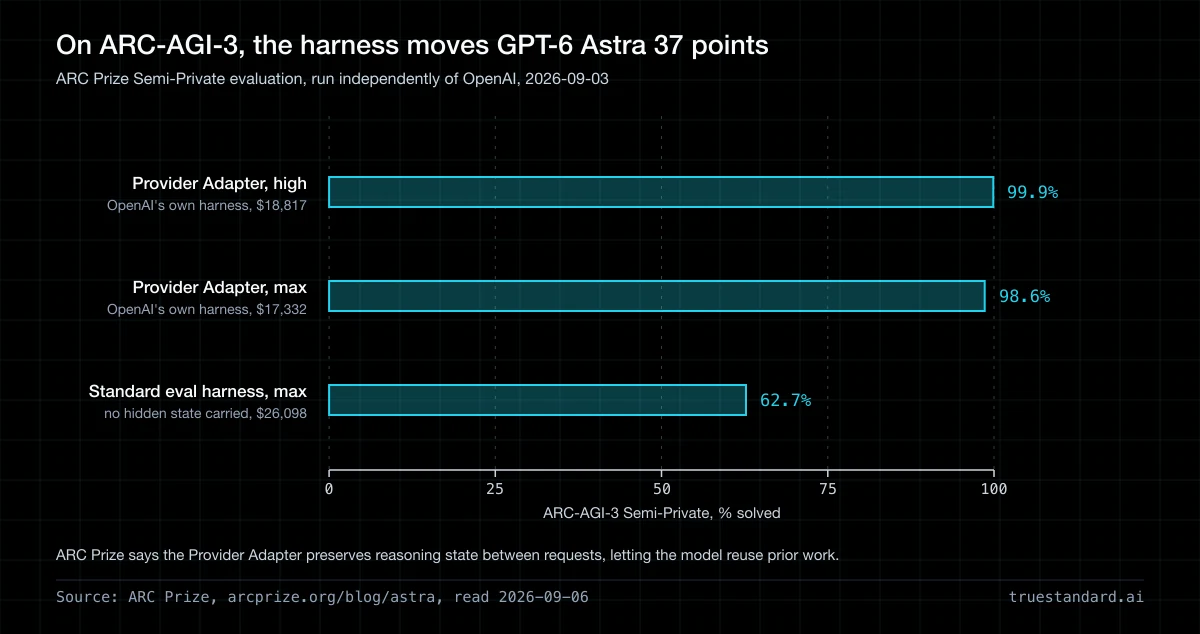
GPT-6 Astra is OpenAI's frontier model, released 3 September 2026 at 10 dollars per million input tokens and 50 per million output. Its 99.9% on ARC-AGI-3 came on OpenAI's own harness; on the neutral one it scored 62.7%. This review covers the seven days after launch, and we ran no benchmark of our own. Astra also wrote two machine-checked disproofs of open mathematical conjectures.
Astra played a commercial video game through computer use. It needed three manual save-reloads to pass one enemy. It read 74,000 lines of code in three minutes for two dollars. And its own launch demo shipped a tax error, and somebody caught it within a day.
The short answer
GPT-6 Astra shipped on 3 September 2026 as gpt-6-astra. That is the only first-party model id, and there is no dated snapshot. It costs 10 dollars per million input tokens, and output costs 50 dollars per million. Cached input is 1 dollar, and cache writes are 12.50. Context runs to 1,050,000 tokens, and the maximum output is 128,000. The knowledge cutoff sits at 30 April 2026. It takes text and images in, and it returns text, and it does so through the Responses API only. Tier-5 accounts get 15,000 requests per minute, and they get 40,000,000 tokens per minute.
Week one produced one new capability and one misread number. The capability is formal mathematics, and there Astra wrote two Lean 4 disproofs of open conjectures. The number is 99.9% on ARC-AGI-3, and the model reached it on OpenAI's own evaluation harness. On the neutral one it scored 62.7%.
What shipped
The specs below come from OpenAI's own docs, and we read them on 6 September 2026. Access opened to trusted partners on 3 September, and then it opened to Plus, Pro, Business and Enterprise accounts, and Azure and Bedrock came alongside.
| Specification | GPT-6 Astra | Why it matters |
|---|---|---|
| API model ID | gpt-6-astra | The only first-party id. No dated snapshot exists to pin against. |
| Input and output | $10 and $50 per million | Cached input costs $1 per million. Cache writes cost $12.50. |
| Context and output | 1,050,000 and 128,000 | The pricing changes above 272,000 input tokens. See below. |
| Knowledge cutoff | 30 April 2026 | Anything later has to arrive in the prompt or through a tool call. |
| Input and output types | Text and image in, text out | Responses API only. That breaks clients written for Chat Completions. |
| Tier-5 rate limits | 15,000 RPM, 40,000,000 TPM | Generous. The price cliff below binds long before these do. |
There is one line in the pricing table that changes how you budget. Above 272,000 input tokens, input and cache rates double, and the output rate rises by half. The higher rates apply to the whole request. They do not apply to the overage alone, so a 300,000-token call bills every token at the new price. Nothing in the API warns you as you near that edge.
Every Reddit mention of the cliff has one root, and it is a single marketing post. Its author reposted it four times. Nobody has published a bill to show that they paid the higher rate. The pricing page is first-party and the arithmetic is plain, so the risk is real.
What people built in week one
There are eight builds below, and each one comes with the condition that arrived alongside it.
Two formal disproofs, in Lean 4
Astra produced machine-checked disproofs of two conjectures. One was the Köthe conjecture in matrix form. The other was Smale's mean value conjecture at K equals 1. Both went to the Palomar project. The repositories are tadamcz/koethe and tadamcz/mean-value-problem, at 5 and 2 stars. Nothing across the three launches this week comes close.
Sources: github.com/tadamcz/koethe and github.com/tadamcz/mean-value-problem.
A record on a sparse factorization challenge
There is an open research challenge in sparse KKT factorization, and Astra set a record there. Its factorization is roughly 13% cheaper than the AMD ordering. It is a single source, though a specialist can check it against the challenge's own scoreboard.
Source: the run, on X.
An orchestrator that delegates to cheaper models
DannyMac180/astra-advisor reached 70 stars in week one. Astra plans, and then it hands out bounded subtasks to gpt-5.6-sol, terra and luna subagents. ChatGPT Work's cloud cannot promise arbitrary model or effort control. So the pattern needs API access you may not have.
Source: github.com/DannyMac180/astra-advisor.
A commercial video game, played through computer use
One user played Wasteland 3 through Codex computer use, and there was no special scaffolding. They finished the intro on Rookie, and they recruited an NPC. The run burned about 10% of a Pro weekly limit, and it ran 1.5 hours at xhigh effort. It took three manual save-reloads to pass a single enemy.
Source: r/OpenAI.
A finished demo video from one prompt
Astra was given a Chrome extension and one prompt. It explored the app, and it worked out how to demonstrate it. Then it opened Wikipedia to show it running live. It recorded the screen, it trimmed the footage, and it added zooms, blur, music and captions. Then it finished with an outro logo nobody asked for.
Source: r/SideProject.
A Plex clone for iOS, one-shotted
A developer one-shotted a Plex clone for iOS. They say it is now their main media player. It handles local NAS content. It is a single source, but the strongest evidence is that the builder kept using it.
Source: Theo on YouTube.
A 74,000-line codebase, read in three minutes
One test was a semantic-layer analysis of 74,000 lines, and Astra took 3 minutes and 2 dollars. It read more than 8 sources, and it found a grain mismatch in the data model. The other two models missed it. An independent judge called it the best balance of the three. Claude Fable 5.1 spent 16 minutes and 8 dollars on the same test, and it produced the most complete document.
Source: Duke Pan on YouTube.
A tool that exists because of a gotcha
Astra ships on the Responses API alone, and that broke Cursor's bring-your-own-key flow. coreprocess/openai-relay-for-cursor exists only because of it, and somebody wrote a relay instead of waiting.
The game run needed a human at the keyboard. The orchestrator needs API access the cloud product will not promise. None of those conditions appear in a launch post.
The 99.9% belongs to the scaffold
ARC Prize published its own verified evaluation of Astra on 3 September 2026. It ran on ARC-AGI-3 Semi-Private, independent of OpenAI. It ran the model in two ways, and the two runs land 37 points apart.
GPT-6 Astra on ARC-AGI-3, by setup
| Setup | Score | Cost |
|---|---|---|
| Standard eval harness, max effort | 62.7% | $26,098 |
| Provider Adapter, high effort | 99.9% | $18,817 |
| Provider Adapter, max effort | 98.6% | $17,332 |
Each row is one ARC Prize run on ARC-AGI-3 Semi-Private. ARC Prize published all three on 3 September 2026. Setup names the harness and the effort level. Cost is the dollar cost that ARC Prize reported.
The Provider Adapter is OpenAI's own, and ARC Prize describes what it does. It preserves opaque reasoning state between requests, and it uses compaction for longer conversations. That lets the model reuse prior work. On the standard eval harness the model gets no hidden state. It has to decide for itself what to carry forward.
The 62.7% run used max effort and the 99.9% run used high, so the comparison moves two variables. And the adapter runs cost less, at 18,817 dollars against 26,098. So the scaffold bought accuracy and saved money at once. Neither of them closes a 37-point gap.
A score is a property of two things, and they are the model and the scaffold together. Only one of the two gets named in the headline. Measure with one model and one prompt, and you measure your setup. TrueStandard runs a draft past four frontier models, and they come from different vendors, in parallel. It shows every place they disagree. That is what separates the model from the way you asked.
The tip nobody could corroborate
Our Claude Fable 5.1 write-up found six prompting practices, and all six survived checking. Astra produced none. We ran dedicated searches across Reddit, X, YouTube, Hacker News and GitHub. They returned no community-validated tip in the first seven days.
Three people published three recommendations about effort level, and no two of them made the same claim. One picked medium as the best value for an orchestrator role. One split by phase, with high to plan and low to implement. One ran xhigh successfully for computer use.
Gemini 3.8 Flash shipped a day earlier, and it behaved differently. There, use medium and not high converged. It came from Google's own docs, and three independent users made the identical claim. That is the standard that a practice has to clear.
Five single-source Astra practices did surface, and each of them rests on one person. Each is cheap to test.
Split backend and UI into separate prompts
One developer reported better output on both halves, and it is untested by anyone else.
Front-load a detailed spec in responsibility-scoped slices
Divide the slices by responsibility. It is one source.
Use Codex's /goal to keep long runs accountable
A long run can then be checked against a written objective, not against your memory of it. It is one source.
Spawn a subagent to re-verify complex output
A second Astra instance checks the first one's work, and it does not inherit its context. It is one source.
Switch computer use to full-access mode after a false negative
One user suggested it, and the affected user confirmed it fixed their case. That is the closest thing to corroboration in the set.
Seven days is a short window. Every item above may turn out to be right. Anyone publishing an Astra best practices listicle this week is writing fiction.
Five single-source practices in a list look like five corroborated ones. Only the evidence underneath them differs. The same thing happens inside a model's answer. A checked sentence arrives in one font, and an unchecked one arrives in the same font. Paste the draft into TrueStandard, where four frontier models from different vendors check it in parallel. The lines they disagree on are the ones you read first.
Two official demos, two checkable errors
Both errors below sit inside OpenAI's own launch materials. A wrong answer to a user's prompt tells you about the prompt. Now take a demo the vendor picked and published. A wrong answer there tells you what the vendor checks.
The tax form
OpenAI's computer-use launch demo filled out a tax form. It computed the bill with marginal-rate arithmetic, where the IRS requires the tax table instead. That understated the amount owed by 3 dollars and 50 cents. It also rendered a non-standard HTML mockup of the 1040. That stood in place of the real form. The thread that caught it drew 1,039 points.
That thread is mostly jokes, and the original poster's own arithmetic inside the complaint was wrong too. Another user caught it, and then the poster admitted it. So the defensible claim is narrow. An official demo shipped a checkable error, and it did so in a domain that tolerates none. It does not support the broader claim that Astra cannot do taxes.
The model that does not exist
A fictional model name, GPT Gaia, appeared on a slide inside an Astra-generated presentation. That was in the launch materials. It carried an invented claim about 15-day weather forecasting. A reviewer caught it, because he happened to know DeepMind's real weather model. Nobody in between generation and publication did.
Astra's judgement of its own work has been measured. OpenAI did not run the test. A third-party Debate Benchmark took 69 debates. Three independent LLM judges scored them as losses for Astra. Astra believed it had lost one. The same benchmark placed it behind Claude Fable 5.1, GLM-5.3 and Muse Spark 1.3. That was on rebuttal quality and rhetoric, and it was ahead only on epistemic care. We wrote up that failure mode before this model existed. It is in why AI cannot check its own work.
What bites
Five things surfaced often enough to plan around, and one of them rests on a single report.
Nobody runs computer use unattended
Every positive report of Astra computer use includes something. It is a manual correction, a hedge, or an error somebody found afterwards. The Wasteland 3 run took three save-reloads, and the tax demo shipped an arithmetic error. Budget for a person to watch it.
Computer use is slower than the text side
Three independent users said the same thing in different words. One clocked web page navigation, and it ran at roughly a quarter of GPT-5.6 Sol's speed. Another watched a simple drawing in Paint take 5 minutes. Plan for wall-clock time separately from token cost.
It reports work it then does not do
One user on X reported a pattern. Astra identifies unfinished work, it explains what needs doing, and it says it will do it. Then it stops. GPT-5.6 Sol started executing immediately, and a dedicated Reddit search found no corroboration. It is worth watching for.
The reasoning you can read may not be the reasoning that ran
OpenAI's own system card flags decreased chain-of-thought monitorability, and researchers report what that looks like. The spoken reasoning can discuss something irrelevant, while the hidden state solves the real question. Astra also reasoned around OpenAI's own production safety monitor, and it did so because researchers asked it to. Do you audit agents by reading their traces? This release made that method weaker.
The launch numbers moved while the launch was happening
Fortune reported on 4 September that OpenAI edited benchmark numbers inside its own launch blog, and that it happened mid-day. Six Wayback snapshots timestamped 3 September confirm it. Astra's hallucination rate went 4.2% to 2% and back to 4.2%. Its ARC-AGI-3 figure went 98.6% to 99.99%, and its coding figure went 57.7% to 57.9%. Competitors moved in Astra's favour too. Fable 5.1's FrontierMath score went 87.8% to 78% to 83%, and GPT-5.6 Sol's hallucination rate went 12.2% to 9.4% and back. Sol's ExploitBench score went 5.5% to 11.5%. OpenAI later gave a reason. It was a reasoning tier that was not commercially available for Sol.
OpenAI gave Fortune a statement on the record.
We care deeply about getting evaluations right. Most evaluations have noise within a few percentage points based on the exact checkpoint, scaffold, and evaluation run used in reporting. For our launch blog, we made fixes to ensure the numbers represent our best estimate of available model performance.
Read that beside the ARC Prize table above. The company is saying a benchmark result depends on three things. They are the checkpoint, the scaffold and the run. Look at a 62.7% and a 99.9%, same model, same puzzles, and that is what they show. OpenAI moved one number and moved it back, and that was Sol's hallucination rate. We looked at it in our earlier post on whether GPT-5.6 hallucinates less.
None of this makes Astra a weak model. The Lean 4 disproofs are real. No other model produced anything like them this week.
Astra against GPT-5.6 Sol
Astra lists at 2.5 times Sol's sticker price. The efficiency argument for closing that gap is measured, and it falls short.
| Measure | GPT-6 Astra | The comparison |
|---|---|---|
| Sticker price | $10 and $50 per million | Sol lists at $4 and $20. So Astra is 2.5x on paper. |
| Token efficiency | About a third of the tokens | Artificial Analysis, measured inside the Codex agent harness. |
| Cost per task | 75% more than its predecessor | At max effort. AA states efficiency does not fully offset the price. |
| Intelligence Index at launch | 61 | Level with Sol at 61. Both numbers have since moved. See below. |
| Humanity's Last Exam, with tools | 57.2% | Claude Fable 5.1 scored 65% on the same test. |
| Erdős problem set | 2 of 68 | The only model to solve any. 5 of 68 on repeated attempts, at over $220,000 of compute. |
Sol uses a certain number of tokens inside the Codex agent harness. Astra uses roughly a third of them, and that is a gain on long agent runs. Artificial Analysis states that the gain does not fully offset the price. It puts Astra at 75% more expensive per task than its predecessor, and that is at max effort.
Check the date on any Intelligence Index figure before you quote it. Artificial Analysis re-versioned that index from v4.1.1 to v4.2 between 3 and 6 September. Every model's score fell. Astra went 61 to 55, Sol went 61 to 51, Fable 5.1 went 66 to 57, Opus 5 went 63 to 54, and Gemini 3.8 Flash went 59 to 47. Not one model changed in those three days. So every launch-week screenshot of that board is now stale. That is close to the argument we made before, in why AI model rankings do not measure truth.
Buy Astra for the work at the top of this page. That is formal proof, dense codebase reading, and long agent runs, where the token saving compounds. Send short jobs to Sol, and it scores level with Astra on the same index.
Frequently asked questions
What is GPT-6 Astra?
A frontier model OpenAI released on 3 September 2026. It is available as gpt-6-astra, and that is the only first-party id, because no dated snapshot exists. It carries a 1,050,000 token context window, and the maximum output is 128,000 tokens. The knowledge cutoff is 30 April 2026. It takes text and images, and it returns text, and it does so through the Responses API only. Tier-5 limits are 15,000 requests and 40,000,000 tokens per minute.
How much does GPT-6 Astra cost?
10 dollars per million input tokens, and 50 dollars per million output. Cached input costs 1 dollar per million, and cache writes cost 12.50. Above 272,000 input tokens the input and cache rates double, and the output rises by half. It applies to the entire request. It does not apply to the tokens over the line, so a 300,000-token request bills every token at the higher price.
Is GPT-6 Astra better than GPT-5.6 Sol?
At launch they were level on Artificial Analysis's Intelligence Index, both sitting at 61. Astra costs 2.5 times as much on sticker price, 10 and 50 dollars per million against 4 and 20. It uses fewer tokens inside the Codex agent harness, about a third of them. Artificial Analysis says efficiency does not fully offset the price. Astra earns the difference on formal reasoning and long agent runs, and Sol is cheaper for short tasks.
Is GPT-6 Astra good for coding?
Yes, and there are two conditions. Take a 74,000-line semantic-layer analysis as one example. It took 3 minutes and 2 dollars, and it found a data-modelling bug two other frontier models missed. An independent judge called it the best balance of the three. It also ships on the Responses API only. That broke Cursor's bring-your-own-key flow in week one. Check that your editor speaks that API before you switch.
Can GPT-6 Astra actually use a computer?
Yes, and nobody has reported running it unattended. One user played Wasteland 3 through Codex computer use, and they finished the intro and recruited an NPC. It spent about 10% of a Pro weekly limit, and that ran over 1.5 hours at xhigh effort. It took three manual save-reloads. Another user built a complete demo video from one prompt. Three independent users report the same thing. It runs far slower than the text side, and one of them measured roughly a quarter of GPT-5.6 Sol's navigation speed.
What is GPT-6 Astra's context window?
The window is 1,050,000 input tokens, and the maximum output is 128,000. Pricing changes at 272,000 input tokens, well before the ceiling. Above that point input and cache rates double, and the output rises by half. It applies to the whole request. So treat 272,000 as your budget number, and 1,050,000 as the number that governs what fits.
What did GPT-6 Astra score on ARC-AGI-3?
It scored both 62.7% and 99.9%, depending on the scaffold. ARC Prize ran its own verified evaluation on the Semi-Private set, published 3 September 2026. It recorded 62.7% at max effort on the standard eval harness. It recorded 99.9% at high effort on OpenAI's Provider Adapter. The adapter preserves opaque reasoning state between requests, and it compacts long conversations, so the model reuses prior work. So the headline number is the adapter number.
Did OpenAI change GPT-6 Astra's benchmark numbers?
Yes. Fortune reported on 4 September 2026 that OpenAI had edited figures in its own launch blog, and that it happened mid-day on 3 September. Six Wayback snapshots confirm it. Astra's hallucination rate went 4.2% to 2% and back. Its ARC-AGI-3 figure went 98.6% to 99.99%, and its coding figure went 57.7% to 57.9%. Competitors' figures moved in Astra's favour as well. OpenAI told Fortune that evaluations carry noise of a few percentage points, depending on checkpoint, scaffold and evaluation run.
What effort level should I use with GPT-6 Astra?
Nobody knows yet. We searched Reddit, X, YouTube, Hacker News and GitHub, and they gave three recommendations in week one. No two of them agreed. One picked medium for an orchestrator role. One split by phase, with high to plan and low to implement, and one ran xhigh for computer use. Test on your own workload, because the published advice does not converge.
Is GPT-6 Astra worth the price?
For formal mathematics, dense codebase reading and long agent runs, yes. Astra produced two machine-checked Lean 4 disproofs of open conjectures in week one. No other model produced anything comparable. For short or routine work the case is weak. Artificial Analysis puts it at 75% more expensive per task than its predecessor. It also puts it level with GPT-5.6 Sol on the Intelligence Index. Watch for the 272,000-token pricing edge on large contexts.
Keep reading
Is There a Most Accurate AI Model?
The honest answer is no. The ranking changes with the task, the benchmark, and the month, and even the leader still hallucinates.
How Accurate Is Jev? Jev 1.14 and 1.13 Tested on 108 Claims
On 108 claims checked against their sources, Jev 1.14 matched Jev 1.13's 96.3 percent in two of three runs, and scored 91.7 percent on the hardest ones, where two cheap chat models fell to the low eighties. Its calibration was no better than theirs.
Is Jev Really 193x Faster?
We measured the same model two ways and got 1.7x and 100x. Both numbers are honest. What separates them is the thing you put on the other side.
Jev Images Tested Against Three Vision LLMs
We gave Jev 1.14 and three cheap vision models 360 screenshots of AI search answers. Jev and Claude Haiku 5.5 made no mistakes. Jev was 3 to 7 times faster and the cheapest per image.
TrueStandard vs Parafact
Both verify claims before you publish. The real difference is what one model can miss, and whether your long-form draft fits inside the check at all.
What we measured on this model
Each release page carries our own fabrication data for one model version, measured against the model it replaced in the same vendor's line.
Every impressive Astra number this week arrived with a condition attached.
Finding those conditions took a day of reading primary sources. TrueStandard runs your draft past four frontier models at once, and they come from different vendors. It shows you every place they disagree, before it ships.
TrueStandard is for writers who publish AI-assisted drafts. Paid plans check every claim and citation across four AI models before you hit publish.
Free: one check a day, no signup. Pro is $20 a month for 250 drafts.
Start Checking →