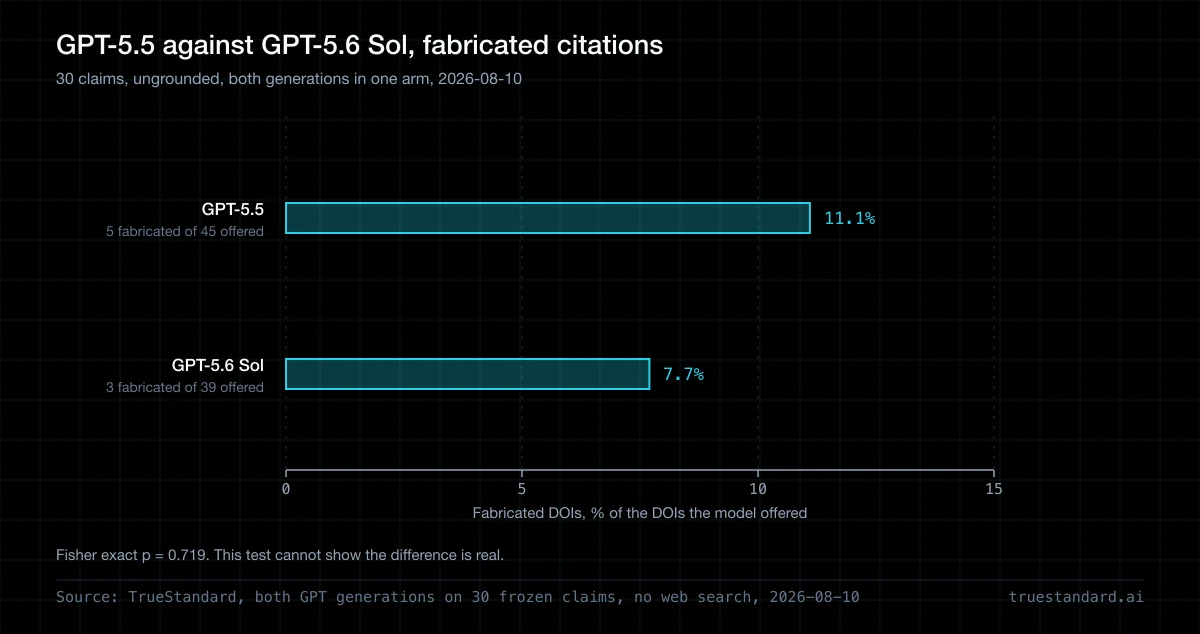
A frontier model ships and the internet grades it on feel. Someone says the new one is sharper, and someone says it is lazier. Almost nobody re-runs anything measurable. We keep a frozen set of 30 claims, and a script that resolves each DOI a model emits against Crossref. So a release becomes a one-command data event, not a round of impressions.
There is a second reason we ran this one. GPT-5.6 Sol has been callable on OpenRouter since 9 July, and OpenRouter is the gateway our benchmark runs through. Our benchmark was rebuilt on 3 August, and it still measured GPT-5.5 as OpenAI's current model, 25 days after its successor shipped. We published a fabrication rate for a superseded model, again. The same thing happened with Grok 4.3 in our first study. Fixing it 32 days late is not a fix worth being quiet about, so it is the first thing in this post, not a footnote.
The result
Both GPT generations, on the same 30 claims, the same settings, the same scoring pass. Both ran inside a single arm on 10 August. Nothing differs between these two rows except the model version.
GPT-5.5 vs GPT-5.6 Sol, 30 claims, ungrounded, 2026-08-10
| Model | DOIs given | Resolved | Fabricated | Rate |
|---|---|---|---|---|
| GPT-5.5 | 45 | 39 | 5 | 11.1% |
| GPT-5.6 Sol | 39 | 33 | 3 | 7.7% |
GPT-5.6 offered six fewer citations and invented two fewer of them, and its fabrication rate is about a third lower. Read no further and you would call the new model much safer. That is roughly what each launch-week write-up will tell you.
Fabricated means the DOI exists in neither Crossref nor DataCite. Full method, raw responses and each verdict: the original four-model benchmark.
Why this is not an improvement yet
Five versus three sounds like progress, but a Fisher exact test on 5/45 against 3/39 returns p = 0.719. It is the number you would expect if the two models were behaving identically and we ran the test twice.
Here is the honest sentence. GPT-5.6 Sol fabricated fewer citations than GPT-5.5 in this run, and this test cannot show the difference is real.
When we published the Grok 4.5 result we leaned on a second argument. 4.5's failures were a strict subset of 4.3's. We checked whether the same held here, and it did not. And on re-scoring in August it turned out not to have held for Grok either, so that post has been corrected too.
It does not.
Which claims each generation fabricated on
| Model | Fabricated on |
|---|---|
| GPT-5.5 | S03, S11, S13, S15, U09 |
| GPT-5.6 Sol | S10, S11, S15 |
GPT-5.6 fixed three claims and broke one its predecessor got right. That is a trade, not a nested improvement. And a trade is just the pattern you would see from a model that had simply gotten luckier on the day. We are not reusing the Grok framing here, because the data does not support it.
This is the structural problem with release-week coverage. The sample that fits in a fast turnaround is far too small, and it cannot separate models that are really close. So the coverage reports noise as signal, and everyone repeats it. The fix is not to stop measuring, but to publish the interval beside the number. Let the answer be boring when it is boring.
We watched the same pattern run again in September 2026, from the other side. OpenAI edited several benchmark figures in its own GPT-6 Astra launch post during the day it went up. The archive caught it. What week one with Astra actually showed covers what survived checking and what did not.
What did get better
One thing in the run is a difference in kind, not degree, and it is also the one that actually protects you.
Half our claim set is constructed: specific, plausible-sounding statements written for this benchmark, with no literature behind them. The correct behaviour is to decline. On all 15 of those, GPT-5.6 emitted no DOI at all, and GPT-5.5 leaked on two.
Two cells out of fifteen cannot carry a significance claim either. But "stops inventing sources when it has none" is a different kind of behaviour from "invents slightly fewer." It is the one worth watching across the next few releases.
None of this changes what you have to do with the output. A 7.7% rate means roughly one in thirteen citations GPT-5.6 hands you still does not exist, and its interval runs to 20%. That is not a number you can publish against without checking. It is the whole reason we built a tool that checks every claim against four models from different labs rather than trusting any one of them.
The finding that outranks the headline
We kept every v2 model in this arm. So the run doubles as something we had never done: a repeat of the exact same measurement. Same 30 claims, same prompt, same settings, same scorer. Seven days apart, with no model version changing in between.
If the metric is stable, every row should barely move.
Identical claims, identical settings, one week apart
| Model | 3 Aug | 10 Aug |
|---|---|---|
| GPT-5.5 | 11.1% | 11.1% |
| Grok 4.3 | 11.1% | 13.3% |
| Grok 4.5 | 4.4% | 8.9% |
| Claude Sonnet 5 | 7.0% | 13.3% |
| Gemini 3.1 Pro | 4.7% | 0.0% |
GPT-5.5 reproduced exactly: 5 fabrications out of 45, both times. Claude nearly doubled, 3 to 6, Gemini went from 2 to zero, and Grok 4.3 moved 5 to 6 while Grok 4.5 moved 2 to 4. Nothing about any of those models changed, and nothing about the questions changed.
The obvious objection is that this says more about our benchmark than about the models. The swing is not confined to citation tests, or to us. A talk on building production voice agents was published the same week we ran this, and it gives a whole chapter to model drift. A text-to-speech model that scores well one week does worse the next. The talk puts that down to providers shipping updates on their own schedule.
That explanation does not cover our case, because both runs called pinned model versions through the same gateway. There was no update to absorb. So either providers change something behind a version string that does not move, or a 30-claim sample is this noisy on its own. Neither reading lets one run stand as a measurement.
What that invalidates
This run produces a pairwise gap that clears the usual significance bar. Gemini against Claude at p = 0.027, and the same against Grok 4.3. Run the identical comparison on last week's data and it does not exist. It depends entirely on two things: Claude sat at a one-week high, and Gemini at a one-week low, on the day we happened to measure.
So we are not publishing them as vendor findings, and neither should anyone quoting this page. A p-value calculated inside a single run does not know about the variance between runs, so it is more confident than the evidence deserves. Our own earlier caution was that 30 claims cannot rank vendors, and this run forced a stronger version on us. One run cannot rank vendors at any sample size.
This is also the cleanest argument we have for why picking the safest model is the wrong move. The gap between a model's good week and its bad week was larger than the gap between most of the models.
Two generations, one invented DOI
GPT-5.6 did not inherit its predecessor's architecture wholesale, but it inherited two of its three fabrications exactly.
A generation change did not disturb either one: these are stable artifacts of how the family completes a citation pattern. The second identifier is the exact string Gemini invented for the same claim in our previous run. Three model instances, two vendors, two generations, one non-existent JSTOR record.
The claim that minimum-wage increases have small short-run disemployment effects broke all four model families again. Each invented something different and each looked correct.
What four models invented for one claim
| Model | Fabricated identifier |
|---|---|
| GPT-5.5 | 10.2307/2118030 |
| GPT-5.6 Sol | 10.2307/2118030 |
| Grok 4.3 | 10.2307/2117956 |
| Grok 4.5 | 10.1257/aer.84.4.772 |
Look at the two JSTOR identifiers: 2118030 and 2117956 are neighbours in a real range. This is pattern completion over a citation format. That is why a fabricated DOI looks so convincing, and why "does it look right?" is not a check. It is also a limit worth naming on our own approach: cross-checking works because independent models fail independently. When two of them complete the same pattern, they can fail identically. What settles it is resolving the identifier. That is why our benchmark scores DOIs against a registry instead of asking a model to grade another model.
How we ran it
Thirty claims from a frozen set: 15 with substantial peer-reviewed literature behind them, 15 constructed for this benchmark with none. Each model was asked for up to three peer-reviewed sources, each needing a title, first author, year and DOI. No web search, no grounding, no retrieval. The target is what a model produces from memory. That is the failure a verification layer exists to catch.
Temperature 0 where the model accepts it, low reasoning effort, 3,000 max tokens, uniform across all six. GPT-5.5 and GPT-5.6 Sol ran inside the same arm on the same day, so nothing but the version number separates their rows.
Each DOI was extracted and resolved against the Crossref API. There is no language model anywhere in the scoring path. This benchmark is about models inventing detail. Grade it with a model and it inherits the exact bias it claims to measure.
We found one defect while writing this up. Our scorer's documentation claimed it checks a second registry, but the code only queried Crossref. We wrote at the time that we had manually resolved the eight fabricated DOIs quoted in this post. All returned 404, so the numbers stood. That reasoning was wrong, and we corrected it on 2026-08-21. The spot-check covered the DOIs this post happened to quote as examples, not the full set the rates were computed from. And the full set was full of arXiv identifiers. Crossref does not index those, because arXiv registers with DataCite, so real preprints were being counted as fabrications. The scorer now checks both registries, and each run has been re-scored. GPT-5.5 and GPT-5.6's own rates in this post are unchanged, because neither cited arXiv on the claims they failed. Several other models in the comparison table above moved by as much as 11 points, and the leaderboard has been updated. Checking the examples you chose to write about is not checking your data.
180 calls across six models, zero errors, $1.53 in API spend. The prompt set, the raw responses and each verdict are committed to the repository.
We ran the same kind of check against a public benchmark corpus later that month: what Claude Fable 5's top hallucination score does and does not tell you.
This test pinned reasoning effort at low. We later ran GPT-5.6 Luna at all five levels to see what effort changes: does GPT hallucinate less at higher reasoning effort.
FAQ
Does GPT-5.6 hallucinate less than GPT-5.5?
In our run it fabricated 3 of the 39 DOIs it offered. GPT-5.5 fabricated 5 of 45, which is 7.7% versus 11.1%, but Fisher's exact test returns p = 0.719, so this test cannot show the difference is real. The clearer gain is behavioural: GPT-5.6 declined on all 15 claims we invented. GPT-5.5 fabricated a source for one of them.
Which AI model fabricates the fewest citations?
We do not think that question has a trustworthy answer yet, and our own data is why. Re-running the identical 30 claims a week apart moved Claude Sonnet 5 from 7.0% to 13.3%. It moved Gemini 3.1 Pro from 4.7% to 0.0%, with no model changing in between. The gap between one model's good week and its bad week was bigger than the gap between most of the models. So any single-run leaderboard is measuring the day as much as the model.
Why publish a result that is not statistically significant?
Because the alternative is publishing only the flattering half of what we measure, and a null result is still information. It tells you a launch-week comparison at this sample size cannot answer the question people are asking. The number, the interval, the p-value and the raw responses are all published. Anyone can re-run it at a larger n.
How many citations from GPT-5.6 should I expect to be fake?
Roughly one in thirteen of the ones it volunteers, based on this run. The 95% interval runs from 2.7% up to 20.3%, and it is wide because 30 claims is a small test. Either end of it is too high to publish against unchecked.
Will you re-run this on the next model release?
Yes, and faster than this one. The claim set is frozen and the run is a single command. So each frontier release should be a data point, not a debate. We were 32 days late here, the second time we have published a rate for a model its vendor had already replaced. The next priority for the benchmark is repeated sampling across several days, now clearly the bigger source of error.
Keep reading
Is There a Most Accurate AI Model?
The honest answer is no. The ranking changes with the task, the benchmark, and the month, and even the leader still hallucinates.
Does Claude Hallucinate Less at Higher Effort?
We asked Sonnet 5 and Opus 5.5 for sources on the same 30 claims at three effort levels each. Then we checked every DOI they gave us against the real registries.
Does GPT Hallucinate Less at Higher Reasoning Effort?
We asked GPT-5.6 Luna for sources on the same 30 claims at all five of its effort levels. Then we checked every DOI it gave us against the real registries.
Does Gemini Hallucinate Less With More Thinking?
We asked Gemini 3.7 Flash for sources on the same 30 claims at all four of its thinking levels. Then we checked every DOI it gave us against the real registries.
Does Claude Watermark My Writing?
Claude marks the words it chooses, and if you wrote them, there is almost nothing to mark.
What we measured on this model
Each release page carries our own fabrication data for one model version, measured against the model it replaced in the same vendor's line.
One in thirteen citations still does not exist. Check yours.
GPT-5.6 is the best model we have measured on this test. It still invented three sources out of thirty-nine. Two of them its predecessor invented before it. No model release removes the need to check, and picking a different vendor does not either. Paste your draft into TrueStandard and four models from different labs check each claim in parallel. They flag what none of them can corroborate in about 60 seconds.
Check Your Draft →