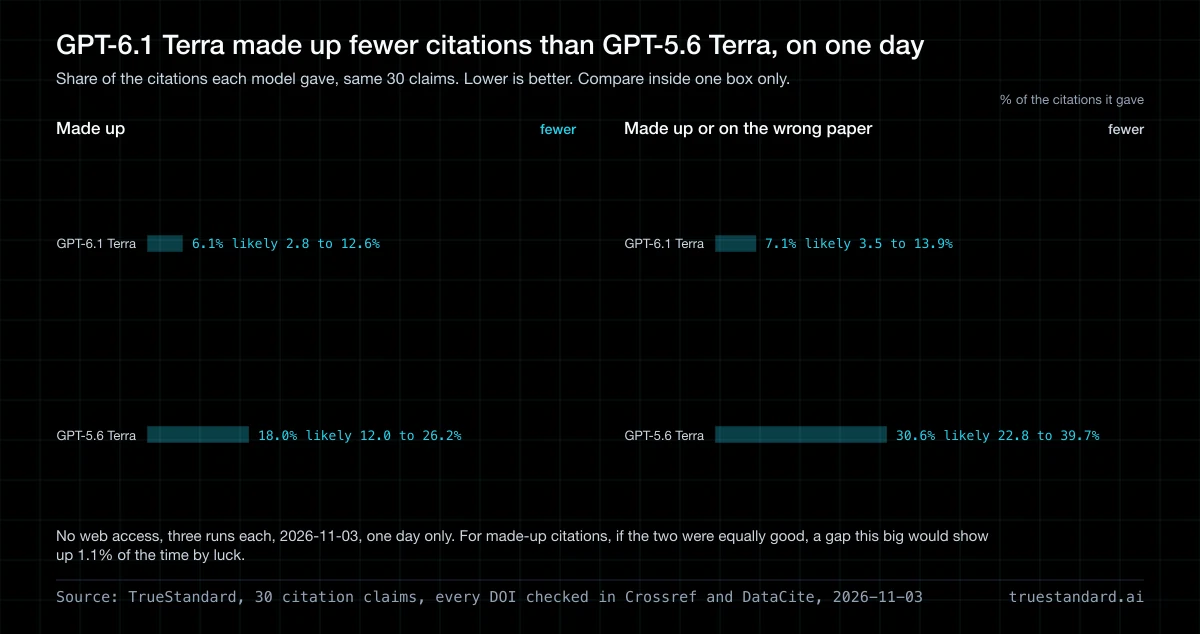
OpenAI launched GPT-6.1 Terra on 26 October 2026 and reported fewer errors on its own test. We ran it on 3 November against GPT-5.6 Terra, the model OpenAI compared it with. GPT-6.1 Terra made up 6.1 percent of the citation IDs it gave, and GPT-5.6 Terra made up 18.0 percent (p = 0.011). Those rates come from one day, on a test of citations.
OpenAI's number comes from a different test, so ours can neither confirm it nor refute it. If you publish citations from either model, check the IDs first. GPT-6.1 Terra gave one paper three fake IDs in three runs.
The short answer
On 3 November 2026, GPT-6.1 Terra made up 6 of the 99 citation IDs it gave. GPT-5.6 Terra made up 20 of 111. A citation ID, or DOI, is the permanent link a journal gives a paper, so a made-up one leads nowhere.
Citation IDs from each Terra model, three runs on 3 November 2026
| Model | Made up | Likely range | Wrong | Wrong likely range |
|---|---|---|---|---|
| GPT-6.1 Terra | 6.1% | 2.8–12.6% | 7.1% | 3.5–13.9% |
| GPT-5.6 Terra | 18.0% | 12.0–26.2% | 30.6% | 22.8–39.7% |
Made up counts IDs that no registry has issued. Wrong adds real IDs on the wrong paper. Likely range shows where the true rate most likely sits, 95 times in 100. A Fisher exact test shows how often luck alone opens a gap this wide: p = 0.011 for made up, and p = 0.000018 for wrong.
With real IDs on the wrong paper counted too, the gap widens to 7.1 percent against 30.6. GPT-6.1 Terra was lower in every run, though no single run cleared the usual bar of 0.05.
What OpenAI claimed
OpenAI says that on its internal benchmark of error-inducing prompts, the error rate at low reasoning effort fell from 53.6 percent on GPT-5.6 Terra to 16.7 percent on GPT-6.1 Terra. At maximum effort it reports 4.3 percent. We read those figures in BleepingComputer's report and a second summary, because OpenAI's own post would not open for us.
These are OpenAI's numbers, from OpenAI's test. We searched for an independent test of them and found none. The coverage we read does not list the prompts, so we could not re-run that test.
How we tested it
We gave both models the same thirty claims and asked for up to three peer-reviewed sources for each, with no web access. Fifteen claims have real research behind them. Fifteen are plausible statements we wrote ourselves, so the right answer is to decline. Both models ran at low reasoning effort, three times each, on one day.
Every ID went to Crossref and DataCite, and we re-checked each dead one at doi.org. No model graded anything. The test cost $0.89. The full table, with a control model, is on the GPT-6.1 Terra release page.
Where GPT-6.1 Terra still failed
Asked about the minimum wage, it cited Card and Krueger's 1994 study in every run. It gave that paper a different made-up ID each time: 10.2307/1803623, 10.2307/1801963 and 10.2307/2118030. No registry has issued any of them. That one paper makes up half of its six fakes.
The other three are Attention Is All You Need, given a dead ID in two runs, and a 2004 paper by C. Arden Pope, in one. Each paper is real. The model knew the paper and guessed the ID. A fake like that is hard to spot, because the title checks out and only the link fails.
It also put one real ID on the wrong paper. The entry named a 1992 paper on vancomycin resistance, and the ID belongs to a paper on the colicin E1 ion channel. GPT-5.6 Terra did that 14 times. Neither model offered a source for any of the fifteen invented claims.
Notice what asking again would do here: it gets you a fourth guess at the same paper. A registry lookup and a second model catch it. That is what TrueStandard does: paste your draft, four models from different labs check each claim and citation in about 60 seconds, and every disagreement shows up.
What this result leaves open
- This is one day. We have not repeated the test, and Grok 4.7's gap on invented IDs lost significance on its second day.
- The route changed. This test ran on OpenAI's own API. By a third-party route, GPT-5.6 Terra read 11.4 and 13.6 percent on two days in October, against 18.0 here. Route and day both differ, so we cannot say why. The gap here leans on that high reading.
- The measure differs. We count false citations on thirty claims. OpenAI counts errors on prompts built to cause them. A gap in the same direction says nothing about the size of the other.
- Both models ran at low effort with no web access. We did not test maximum effort, or either model with search turned on.
What to do with this
If you run GPT-5.6 Terra today, try GPT-6.1 Terra on your own work. This result and the price point the same way. OpenAI lists the new model at $1 per million input tokens and $5 per million output tokens, a token being a word piece, against $2 and $12.
Keep checking citations either way. At 6.1 percent, a draft with twenty citation IDs from GPT-6.1 Terra likely carries one fake.
Common questions
Does GPT-6.1 Terra hallucinate less than GPT-5.6 Terra?
On citations, on one day, yes. On 3 November 2026 it made up 6.1 percent of its IDs against 18.0 percent (p = 0.011). OpenAI also reports a drop on its own test, which measures something else. We have no second day yet.
Does this confirm OpenAI's 53.6% to 16.7% figure?
No, and it does not refute it. OpenAI's figure comes from its own test of prompts built to cause errors. Ours counts false citations on thirty fixed claims. They measure different things.
What is the GPT-6.1 Terra hallucination rate?
On our citation test, it made up 6.1 percent of the IDs it gave on 3 November 2026, likely between 2.8 and 12.6 percent. That covers citations from memory at low effort. A rate for general answers needs a different test.
Can I trust GPT-6.1 Terra's citations?
Not without a check. About one ID in sixteen was fake on our test, and it attached fake IDs to real papers, so the title alone will not warn you. Look up each DOI before you cite it.
Is GPT-6.1 Terra as good as GPT-6.1 Sol?
We cannot say. GPT-6.1 Sol did not run on this day, and we do not set rates from two different tests side by side.
Keep reading
Is There a Most Accurate AI Model?
The honest answer is no. The ranking changes with the task, the benchmark, and the month, and even the leader still hallucinates.
Why AI Is Confidently Wrong
AI is confidently wrong because a model has no internal sense of when it is wrong. In one Carnegie Mellon task, chatbots showed about 90 percent confidence at about 65 percent accuracy.
Should You Stop Using ChatGPT?
No. Keep using ChatGPT to draft, and stop trusting it unchecked. Researchers found AI made experts measurably worse on hard tasks, and it tends to agree with you when it should push back.
AI Hallucination Rates in 2026, by Model
On hard factual questions, AI hallucination rates across 26 top models run from 22 to 94 percent, per the Stanford AI Index 2026. Each number here names the benchmark it came from and what that benchmark measured.
TrueStandard vs FactCheckTool
These two tools look alike, but they solve opposite problems. One tells you if the media you read is fake. The other tells you if the draft you are about to publish is true.
What we measured on this model
Each release page carries our own fabrication data for one model version, measured against the model it replaced in the same vendor's line.
Check the IDs before your readers do
GPT-6.1 Terra gave one paper three different fake IDs in three runs. TrueStandard checks your draft's claims and citations across four models from different labs.
TrueStandard is for writers who publish AI-assisted drafts. Paid plans check every claim and citation across four AI models before you hit publish.
Free: one check a day, no signup. Pro is $20 a month for 250 drafts.
Start Verifying →