Context rot is when an AI model gets less reliable as the text you give it grows longer. That text is its context: your instructions, the chat so far, any files, and its own notes. In July 2025, Chroma tested 18 models. It found that performance "consistently degrades with increasing input length." An AI agent has it worse, because it writes much of its own context as it works. The longer it runs, the more of what it reads came from itself.
On 27 October 2026 we traced two numbers often quoted about context rot back to their papers. The 18-model study held up as stated. The other comes from Less is More, a paper on giving a model fewer tools to choose from. In it, a model failed a task with 46 tools and passed with 19. The result is real, but it is one test of one small model, and the retelling we traced it from left that out. Below are the four ways context rot hits an agent, and the fix they share: take things out, then check the result with a model that did not write it.
Four failures and one fix
- Poisoning: the agent trusts a wrong note it wrote itself.
- Distraction: the agent's long history pulls it into loops, where it repeats a failed step.
- Confusion: tools and text it does not need lead it to the wrong choice.
- Clash: old and new versions of a fact sit side by side.
- The fix: take things out of the context, then check the result with a model that did not write it.
Context rot: a longer input, a less reliable answer
Chroma's context rot report, from July 2025, tested 18 models. The tasks were simple. One was to find a single sentence in a long document. Another was to copy out a list of repeated words. Even so, the report found that "model performance consistently degrades with increasing input length." The drops were often hard to predict.
That study measured retrieval, meaning whether a model can find a fact in a long input. We covered that side, and how far some newer models have pushed it back, in long context vs RAG in 2026. It is not solved everywhere. This guide is about agents, where most of the long input is the agent's own work.
An AI agent is a model that works in a loop. It reads the task, uses a tool, reads the result, writes a note, and goes again. Each turn adds text to its context, and nothing comes out unless someone builds a step to take it out. The four ways this goes wrong have names, from Drew Breunig's June 2025 essay "How Long Contexts Fail": poisoning, distraction, confusion and clash.
What fills an agent's context window
A context window is the most text a model can read at once. In an agent that runs for a long time, it fills with six kinds of text.
The system prompt
The fixed rules the agent runs under, such as "ask before you delete a file."
Project instructions
Your task, such as "move this app to the new database," plus any project notes.
Tool definitions
A short note on each tool it may use, such as web search or run code. All of them load, even the ones this task never needs.
Message history
Every step it has taken and every reply, from the first turn on.
Tool outputs
What came back each time it searched, read a file or ran code.
Its own notes
What it wrote down, such as "the bug is in the login code," including guesses it never checked.
A person writes the first two on purpose. The other four pile up as the agent works, and each of the four failures below starts in that pile.
Context poisoning: the agent believes its own notes
Context poisoning is when a wrong fact gets into the context and the agent keeps using it as if it were true. Most often the agent wrote the wrong fact itself. It skims a file, writes down a wrong conclusion, and from then on reads that note as settled.
Google's Gemini 2.5 technical report describes a Gemini agent that plays Pokemon. The report came out in July 2025. Its name for what went wrong is "context poisoning." The agent's goals and summaries got "poisoned" with false facts about the game. That kind of error "can often take a very long time to undo," the report says. Until then, the agent chased goals it could never reach.
This is the problem from why AI can't check its own work, inside a single agent. The model that wrote the note is the one reading it back, so it has no reason to doubt it.
Drafts have the same weak spot when the chatbot that wrote a claim is the one you ask to check it. TrueStandard is built around that gap. Four models from different labs check each claim, so no model grades its own work, and the check takes about 60 seconds.
Context distraction: the history outweighs the training
Context distraction is when the agent's own history becomes a stronger guide than what the model learned in training. It stops planning the next step and copies what it did before. You see it as a loop, where the agent tries the same failed fix again and again.
The same Gemini 2.5 report saw this. Once its context grew very long, the agent "showed a tendency toward favoring repeating actions from its vast history rather than synthesizing novel plans," the report says. The report calls this anecdotal, since it is one agent in one game.
Context confusion: every extra tool is one more wrong choice
Context confusion is when text the agent does not need still shapes what it does. Tool lists are the clearest case. Every tool an agent can call adds a description to its context. Each tool the task does not need is one more way to pick wrong.
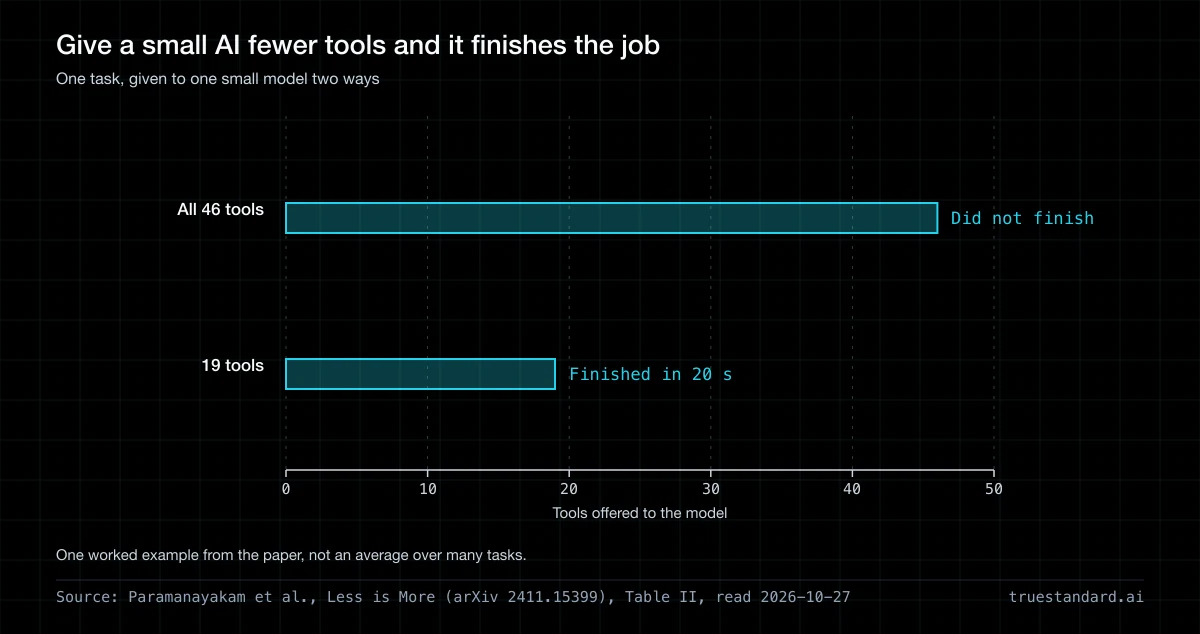
The number people quote here comes from Less is More, a paper accepted at the DATE 2025 conference. Varatheepan Paramanayakam and three colleagues posted it on November 23, 2024. They gave a small, compressed model, Llama 3.1 8B, one query from the GeoEngine test set. With all 46 tools in its context, it picked the wrong tool and failed. With 19 tools, it picked the right one and finished. Its 16K context window held all 46 tools, so space was not the problem. The authors put it down to "the large number of available options confusing the LLM."
| Tools offered | Context window | Finished the task | Time | Power |
|---|---|---|---|---|
| All 46 tools | 16K | No | 30 s | 27 W |
| 19 tools | 16K | Yes | 20 s | 26 W |
| 19 tools, smaller window | 8K | Yes | 17 s | 22 W |
From Table II of Less is More, posted November 23, 2024. The model is Llama 3.1 8B, compressed, on an Nvidia Jetson AGX Orin, a small computer that uses little power. Time is seconds to run the query. Power is watts drawn.
That result has a narrow scope: one query, on one small model, on a low-power device. The paper's main subject is saving time and power on hardware like that, so a large model on a server could behave differently. What carries over is the direction. A shorter list of the right tools got a right answer where the full list got a wrong one.
Context clash: old notes and new facts sit side by side
Context clash is when the context holds two versions of the truth and nothing says which one won. The agent wrote a plan, then learned the plan was wrong, and both are still in its context. Your correction sits next to the mistake it corrected.
A May 2025 paper from Microsoft and Salesforce researchers, LLMs Get Lost In Multi-Turn Conversation, measured something close to this. They gave models the same tasks in two ways. One way gave the whole task at once. The other gave it a piece at a time, over several turns of a chat. Over several turns, every top model they tested did worse, "with an average drop of 39% across six generation tasks."
The cause they found is the clash pattern. Models guess at the task too early and try to give a final answer too soon. Then they lean on that early guess. The guess stays in the context, and later facts have to fight it. In the authors' own words, "when LLMs take a wrong turn in a conversation, they get lost and do not recover."
The four failures side by side
Each failure starts with different text in the context. That tells you which fix to reach for first.
| Failure | What got into the context | What you see | First fix |
|---|---|---|---|
| Poisoning | A wrong note the agent wrote | It defends a fact that is false | Check the note against its source before saving it |
| Distraction | A long history of past steps | It loops on the same step | Summarize the history and start fresh from the summary |
| Confusion | Tools and text the task does not need | It picks the wrong tool | Load only the tools this task needs |
| Clash | Old and new versions of the same fact | It swings between two answers | Delete what has been replaced |
How to prevent context rot: take things out, then check from outside
Every failure above starts with something in the context that should not be there. So each fix takes something out.
Validate before you save
Before a note goes into the context, check it against the file or page it came from. If it cannot be checked, label it as a guess.
Compact the history
When the history gets long, swap it for a short summary of what is done and what comes next. Start the next stretch of work from that summary.
Curate the tools
Load only the tools this task needs. The Less is More authors built this as a step: it picks the tools for each query before the model sees the list.
Prune what was replaced
When a fact or a plan changes, delete the old version. A note saying it is out of date still leaves it there to clash.
Validation has a catch. If the model that wrote the note also checks it, you are back at poisoning, because the reader and the writer are the same. The check works when it comes from outside the agent: the source file, a test, a person, or a model from a different lab. We cover how to wire that step in which model runs your skeptic node.
An outside check works the same way for a draft. TrueStandard works beside ChatGPT and Claude: they draft, and TrueStandard checks each claim across four models from different labs. It shows where they disagree, because that is where to look first.
A bigger context window does not fix context rot
A bigger window lets the pile grow longer before it runs out of room. It does nothing about what is in the pile. A wrong note is just as wrong in a huge window as in a small one.
In Chroma's July 2025 tests, performance dropped as input grew, across all the models it tested. Some newer models hold up much better at length, as our long context guide shows. Those gains are in finding text, and finding a note does not tell the model whether the note is true.
What context rot means if you write with ChatGPT or Claude
You do not need to run an agent to hit this. A long chat is a context too. A wrong fact the chatbot gave you early on stays in the chat, and it will reuse that fact later with the same confidence. An old draft you pasted in sits next to the new one.
- Start a new chat for each new piece, and paste in only the current draft and your sources.
- When the chatbot gets a fact wrong, note the fix and start a new chat, so the wrong version is gone.
- Before you publish, check the claims with a different model from the one that wrote them.
Frequently Asked Questions
What is context rot?
Context rot is when an AI model gets less reliable as its input grows longer. A July 2025 report from Chroma found this across every model it tested, even on simple tasks. An AI agent has it worse. It fills its own context with notes, history and tool output as it works.
Is context rot solved in 2026?
No. Some newer models find facts in very long inputs far better than older ones, but the problem is not solved everywhere. Finding text is also only one part of it. An agent can still trust a wrong note, loop on its history, pick the wrong tool or mix up old and new facts, whatever the window size.
What is context poisoning in AI agents?
Context poisoning is when a wrong fact gets into an agent's context, and the agent keeps treating it as true. Most often the agent wrote the wrong fact itself. It skimmed a file and saved a wrong note. In Google's Gemini 2.5 report, a poisoned agent chased goals it could not reach, and the error took a long time to undo.
Can too many tools make an AI agent worse?
Yes. In the Less is More paper, posted in November 2024, a small compressed model, Llama 3.1 8B, failed a task when given 46 tools and finished it with 19. That is one query on one small model, so a large model may behave differently. Give an agent only the tools the task needs.
What is context clash?
Context clash is when an agent's context holds an old and a new version of the same fact. Nothing marks which one is current. In a May 2025 paper, Microsoft and Salesforce researchers gave models tasks a piece at a time over several turns. The models did worse, because they held on to their early guesses.
How do you prevent context rot?
Take things out of the context. Check notes before you save them, and swap long histories for a short summary. Load only the tools a task needs, and delete facts that have been replaced. Then check the result from outside the agent, with a source, a test, a person, or a model from another lab.
Does a bigger context window fix context rot?
No. A bigger window lets more text pile up before it runs out of room. It does not remove a wrong note, a stale plan or tools the task does not need. In Chroma's July 2025 tests, longer inputs meant less reliable answers for every model.
What are the four context failure modes?
Poisoning is a wrong fact treated as true. Distraction is a long history the agent copies instead of planning. Confusion comes from tools or text the task does not need. Clash is old and new facts side by side. The names come from Drew Breunig's June 2025 essay How Long Contexts Fail.
Keep reading
Multi-Agent vs Multi-Model AI in 2026
Multi-agent AI runs many roles of one model. Multi-model AI runs different models from different labs. Only multi-model can catch an error the first model is blind to.
Every Type of AI, Explained
From large language models to coding agents: what each type of AI does, which tools lead each group, and how to pick the right one for your work.
Karpathy's 3 AI Methods, and What They Don't Fix
Andrej Karpathy's three 2026 methods are autoresearch, the LLM Wiki and brevity constraints. Autoresearch tunes metrics, the wiki organizes memory, and brevity cuts reasoning loops. None of them checks whether a writer's claims are true.
3 AI Stress Tests from Q2 2026
In April 2026, top AI builders ran real experiments instead of demos. The results were more interesting than the demos. Here is what each test reveals, and why none of them fully answers the question writers care about.
What Is AI Slop, and How to Avoid It
AI slop is mass-produced, low-effort content made with little regard for whether it is accurate. What separates AI-assisted work from slop is whether you verified the output, and can prove it.
Check the claims your AI wrote.
TrueStandard checks every claim in an AI draft across four models in about 60 seconds, so you catch made-up facts before your readers do. One check a day is free, with no signup.
TrueStandard is for writers who publish AI-assisted drafts. Paid plans check every claim and citation across four AI models before you hit publish.
Free: one check a day, no signup. Pro is $20 a month for 250 drafts.
Check Your Draft →