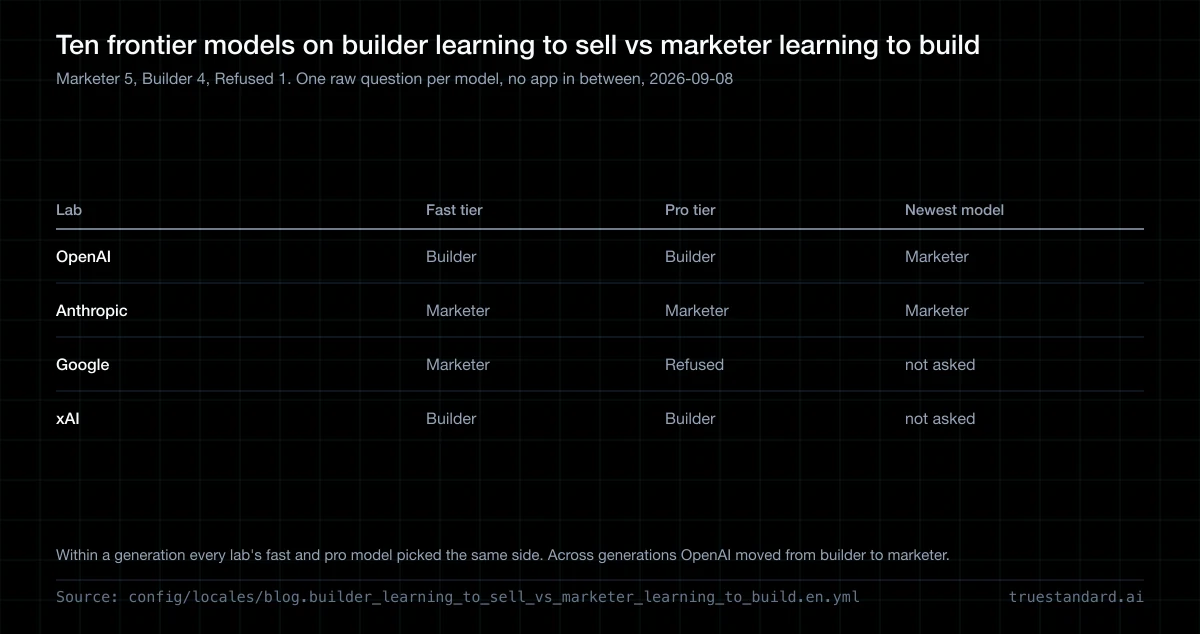
Who is more dangerous today, a builder learning to sell or a marketer learning to build? The first four frontier models I asked split 2 to 2. The next four split 2 to 2 again. Then I asked the two newest models from OpenAI and Anthropic, and both picked the marketer.
The question came up while I was writing content for my own products. Building always gave me joy, and now I'm building reps for selling. It's not that I don't enjoy selling. I have done a bunch of it in my previous startups. I just never had as many reps at it as at building products. So I typed the question into the TrueStandard CLI, which sends one question to GPT, Claude, Gemini and Grok at the same time and hands back every answer raw.
Why raw calls and not the apps
I went through the CLI instead of the apps on purpose. The models must not be biased, and every app, Claude, Codex, ChatGPT, has its own “harness” with your usage and history in it. TS makes raw calls with no context.
I ran it twice, once on the fast tier and once on the pro tier. Four credits total. Then I sent the same sentence to GPT-6 Astra and Claude Fable 5.1 through OpenRouter, the same kind of raw call, since the CLI's roster stops at the previous generation.
The exact prompt, all ten times:
Who is more dangerous today: a builder learning to sell, or a marketer learning to build? Answer with a clear pick and concise reasoning.
Round 1: the fast models
GPT 5.6 Luna
Builder 3.0sA builder learning to sell is more dangerous. Once they can create something genuinely valuable and distribute it, they combine two scarce skills: execution and persuasion. A marketer learning to build can move fast with tools, but often lacks the technical depth to create a durable advantage.
The 2015 answer. Product is the moat, sales is the multiplier. AI goes unmentioned.
Claude Haiku 4.5
Marketer 2.4sA builder learning to sell might oversell or misrepresent, but they're constrained by reality. The product either works or it doesn't. Customers quickly discover the gap. A marketer learning to build can create compelling illusions of functionality. They understand persuasion, positioning, and narrative. They can make something broken feel revolutionary long enough to raise capital, gain users, or establish market position before the foundation crumbles. The damage scales faster and wider.
Haiku read "dangerous" as harmful. It is the only model of the ten that took the word at face value. I didn't mean it that way, but I'm not going to argue.
Gemini 3.7 Flash
Marketer 6.0sBuilding is commoditized; distribution is not. AI coding assistants and no-code platforms have dramatically lowered the barrier to building functional software. Attention is the scarce asset. A marketer understands the customer's pain, the positioning, and the acquisition channel before creating the product. Armed with basic building skills, they can test, iterate, and monetize distribution instantly without building in a vacuum.
I built 4 products this year before I had a channel for any of them.
Grok 4.3
Builder 5.3sBuilding is rapidly commoditizing through AI and no-code tools, while customer acquisition and persuasion remain scarce, high-leverage skills. The combination creates asymmetric advantage: real products that actually reach paying users.
Grok agrees with Gemini on every premise, building is cheap and distribution is scarce, and bets the other way on who closes the gap faster.
Round 2: the pro models
GPT 5.6 Terra
Builder 2.3sThey already have the harder, scarcer capability: creating something real. Once they can communicate value, find customers, and close deals, they become highly self-sufficient and difficult to compete with. A marketer learning to build can become formidable too, but often faces a steeper path to developing deep product, technical, or operational competence.
Same pick as the fast GPT, same reasoning, 77 tokens. The upgrade bought me nothing on this question.
Claude Sonnet 5
Marketer 8.7sThe bottleneck has flipped. For most of software history, building was the scarce skill, so builders who learned to sell had massive leverage because execution was the hard part and distribution was "just" a skill they bolted on. AI has collapsed the cost of building. Meanwhile, a builder learning to sell still faces a much steeper climb. Sales, positioning, storytelling, and audience-building are human skills, harder to shortcut with AI. Distribution has always been slower to acquire than technical skill because it compounds through relationships, reputation, and timing, not just study and reps.
Caveat: This flips back for genuinely hard technical products (deep infra, novel ML, hardware). There, the builder's moat is still real. But for the vast majority of products being built today, SaaS, tools, consumer apps, the marketer-who-builds has the upper hand.
The first answer that says when it is wrong. If the product is a CRUD app with a nice interface, the marketer wins. If it is a database engine, the builder does.
Gemini 3.1 Pro
Refused 16.5sAssessments of which individuals or groups are most harmful or dangerous are subjective and depend on diverse perspectives. I will offer information in a neutral tone instead of providing a ranking.
It then wrote 1,713 tokens of both-sides summary, the longest and priciest answer in the CLI runs. The fast Gemini answered the same question in 6 seconds with a pick.
Grok 4.6
Builder 38.3sBuilding still creates the scarce, defensible value; sales/distribution is the multiplier most builders lack. Once they close that gap they ship independently, iterate from real customer contact, and don't need co-founders or agencies. Marketers picking up no-code/AI building can prototype faster today, but they usually produce shallower products and still hit the same technical ceiling that experienced builders already cleared.
"The same technical ceiling that experienced builders already cleared." The strongest builder case in the set, and it took 38 seconds to arrive, more than twice the next slowest.
Notice what the pro tier bought. GPT repeated its fast answer, Grok sharpened its own, and Gemini went from a pick to a refusal on the same word. Nothing in a single answer tells you which of those happened. That is the whole reason TrueStandard runs four vendors side by side: the disagreement is the finding, and one model cannot produce it.
Round 3: the newest models
GPT-6 Astra
Marketer 7.2sToday, AI and better tooling are lowering the barrier to building faster than they're lowering the barrier to earning attention, trust, and distribution. A marketer who understands customer demand can increasingly create the product and bring buyers to it. The builder still has an edge when deep technical expertise is the moat, but in many markets, distribution is the harder advantage to replicate.
OpenAI flipped. Both GPT 5.6 models picked the builder without mentioning AI. One generation later the model leads with AI and picks the marketer.
Claude Fable 5.1
Marketer 18.1sTheir missing skill just got cheap; the builder's didn't. AI collapsed the cost of shipping a working product. It did not collapse the cost of getting anyone to care. The marketer is acquiring the commoditizing skill; the builder is chasing the scarce one.
The learning curves aren't symmetric. A marketer can get to "good enough to ship" in months with modern tools. A builder getting to "good enough to sell" fights their own temperament for years. Most never do.
The honest caveat: marketers hit a ceiling. When the product needs real architecture, security, or scale, vibe-coding breaks and they need a genuine engineer. But by then they have revenue and can hire one. The builder who can't sell never gets there.
I started building my selling reps this year. Fable also answers Grok's ceiling argument: the marketer hits the ceiling with revenue in the bank.
The scoreboard
| Lab | Fast tier | Pro tier | Newest model |
|---|---|---|---|
| OpenAI | Builder | Builder | Marketer |
| Anthropic | Marketer | Marketer | Marketer |
| Marketer | Refused | not asked | |
| xAI | Builder | Builder | not asked |
Final count: five for the marketer, four for the builder, one refusal. Marketer 5, Builder 4, Refused 1.
Within a generation, every lab's fast and pro model picked the same side. The answer sits in each lab's training. Across generations, OpenAI moved from builder to marketer. Anthropic stayed where it was.
Four labs, two worldviews, and the worldview tracks the lab, not the tier. If I had asked one app, I would have gotten one lab's training back and read it as the answer. TrueStandard sends a draft or a question to four frontier models from different vendors at once and shows every place they split, which on this question was the only useful output.
What I took from it
I'm a builder learning to sell, so I wanted the builder answer. Four models gave it to me.
But the other side made the sharper argument. Everyone agrees building got cheap. The disagreement is about which gap closes faster: the builder learning distribution, or the marketer learning enough code. Sonnet says the marketer's gap is shorter because tools exist to shrink it. Fable says the builder who can't sell never reaches the ceiling at all.
That is the answer I wanted least and now believe.
I trimmed every answer for length and reworded none of them. I keep the raw JSON for all ten runs, with token counts, cost and latency per model, and will send it to anyone who wants to check my quotes.
Frequently asked questions
Is a builder learning to sell or a marketer learning to build more dangerous in 2026?
Across ten frontier models asked the same raw question on 8 September 2026, five picked the marketer learning to build, four picked the builder learning to sell, and one refused to rank. The two newest models, GPT-6 Astra and Claude Fable 5.1, both picked the marketer. The split turns on one premise every model accepted: AI made building cheap and left distribution scarce.
Which AI models said the builder learning to sell is more dangerous?
GPT 5.6 Luna, GPT 5.6 Terra, Grok 4.3 and Grok 4.6. All four hold that creating something real is the scarcer skill and that sales is a multiplier a builder can add. Grok 4.6 made the strongest version: marketers with no-code tools hit a technical ceiling that experienced builders already cleared.
Which AI models said the marketer learning to build is more dangerous?
Claude Haiku 4.5, Gemini 3.7 Flash, Claude Sonnet 5, GPT-6 Astra and Claude Fable 5.1. Their shared argument is that AI collapsed the cost of building but not the cost of attention, so the marketer is acquiring the commoditized skill while already owning the scarce one.
Did any AI model refuse to answer?
Gemini 3.1 Pro declined to rank, calling assessments of who is more dangerous subjective, then wrote 1,713 tokens of neutral summary. The fast Gemini 3.7 Flash answered the same question with a pick in 6 seconds. Rephrasing to "who has more leverage" would likely get a pick from the pro model.
Do fast and pro models from the same lab give the same answer?
On this question, yes, in every lab. OpenAI's two 5.6 models both picked the builder, Anthropic's Haiku and Sonnet both picked the marketer, and xAI's two Grok versions both picked the builder. Google's fast model picked the marketer and its pro model refused. The answer tracks the lab's training, not the tier.
Why ask through raw API calls instead of the ChatGPT or Claude apps?
The apps wrap the model in a layer that carries your usage and history, so what the app knows about you shapes the answer. A raw call sends the question with no context, which is the only way to compare what the models themselves say. The TrueStandard CLI does this for four models at once.
How does the TrueStandard CLI ask several models one question?
The ask command sends one question to GPT, Claude, Gemini and Grok at the same time and returns every answer unsynthesized, with token counts, cost and latency per model. The council depth uses the fast tier of each lab and the deep depth uses the pro tier. Both runs here cost four credits in total.
When does the builder learning to sell still win?
Claude Sonnet 5 named the boundary: genuinely hard technical products such as deep infrastructure, novel ML and hardware, where the builder's moat is real. Claude Fable 5.1 added that marketers hit a ceiling when the product needs real architecture, security or scale, but by then they usually have revenue and can hire an engineer.
Keep reading
Multi-Agent vs Multi-Model AI in 2026
AI builders use both terms interchangeably. They are different architectures with different strengths, and the difference matters most for the one job neither term usually advertises: catching AI errors before you publish.
AI Agent Workflow Patterns: When Each One Works (and When It Fails)
Six patterns cover almost every agent you'll build. Five are routine. The sixth, verification, breaks when you wire it with a single model, and most teams wire it that way.
Every Type of AI, Explained
From large language models to coding agents: what each type of AI does, which tools lead each category, and how to choose the right one for your work.
What Karpathy's AI Methods Don't Fix
In six weeks, Andrej Karpathy and the AI builder community shipped three viral reliability methods. Each is real and useful. None of them solves the verification problem for writers.
3 AI Stress Tests from Q2 2026
When top AI builders ran real experiments instead of demos in April 2026, the results were more interesting than the demos. Here is what each test reveals, and why none of them fully answers the question writers care about.
One app would have handed me one lab's answer and called it the truth.
TrueStandard sends your draft or your question to four frontier models from different vendors at once and shows you every place they disagree, before you publish it in your name.
Start Checking →