Yes. With no instructions, GPT-5.6 Terra and GPT-5.6 Luna used about 4.4 em dashes per 1,000 words. That is about one in every 230 words, and 62% of their drafts had at least one. It is less than half the rate of Claude Sonnet 5, which used 9.55.
Em dashes are not GPT's main tell, though. Lists of three are. GPT-5.6 wrote about 16 of them per 1,000 words, or five in a 300-word draft. That is about twice Claude's rate. Turning up reasoning effort changed neither.
GPT-5.6 still uses em dashes, at half Claude's rate
We asked each model for 35 short pieces in seven kinds of writing, from emails to LinkedIn posts. Each ran three times, so each row is 105 drafts of about 300 words. We called the models directly through OpenAI's API. The ChatGPT app was not involved.
Em dashes per 1,000 words, GPT-5.6 against two other models, September 2026
| Model | Em dashes per 1,000 words | 95% range | Drafts with one or more | Drafts with more than two |
|---|---|---|---|---|
| GPT-5.6 Terra | 4.35 | 3.67 to 5.14 | 62.9% | 16.2% |
| GPT-5.6 Luna | 4.43 | 3.74 to 5.24 | 61.0% | 19.0% |
| Claude Sonnet 5 | 9.55 | 8.56 to 10.65 | 92.4% | 59.0% |
| Gemini 3.8 Flash | 3.56 | 2.94 to 4.30 | 63.5% | 8.7% |
The 95% range is where the true rate likely sits. Across three runs, Terra ranged from 3.99 to 4.64 and Luna from 3.83 to 5.11. Both sit well below Sonnet 5's runs, 9.14 to 10.03, and overlap Gemini's. More than two in one draft is where our AI slop detector flags them.
At low effort, no GPT draft used more than six. Sonnet 5 went up to eight. Neither GPT model swapped the em dash for a spaced en dash ( – ) at low effort, a swap that would hide it from a simple count.
Its real tell is the list of three
GPT-5.6 reaches for three items in a row far more than any other model we tested. "Crisp, cold, and ready." "Your bag, desk, or car cup holder." It wrote about 16 of these lists per 1,000 words. Claude wrote 7 to 8, and Gemini 10 to 11.
Lists of three per 1,000 words, and drafts with too many
| Model | Lists per 1,000 words | 95% range | Drafts with too many |
|---|---|---|---|
| GPT-5.6 Terra | 16.47 | 15.11 to 17.96 | 84.8% |
| GPT-5.6 Luna | 16.07 | 14.72 to 17.54 | 87.6% |
| Gemini 3.7 Flash | 11.21 | 10.07 to 12.47 | 71.4% |
| Claude Sonnet 5 | 8.20 | 7.29 to 9.23 | 61.0% |
A 300-word draft is allowed one list of three before our detector flags it. Across both models, 181 of 210 GPT drafts went over, against 119 of 210 for Claude. A gap that size would turn up by chance less than once in a billion tries.
Stay cool, hydrated, and prepared with a water bottle that works as hard as you do.
GPT-5.6 Terra, the last line of a product description, first run
One list of three reads fine. Five in 300 words reads like a brochure. It is the tell to look for first in a GPT draft.
It uses the fewest stock AI words
Words like "seamless", "robust", "leverage" and "landscape" are the tell most people know. GPT-5.6 used them least. Only 6 of 105 drafts from each model had one, or 5.7%.
Claude drafts had one 17.1% of the time and Gemini drafts 23.9%. So if a draft is full of "seamless" and "landscape", GPT-5.6 is the least likely of the three to have written it.
No effort level changed the count
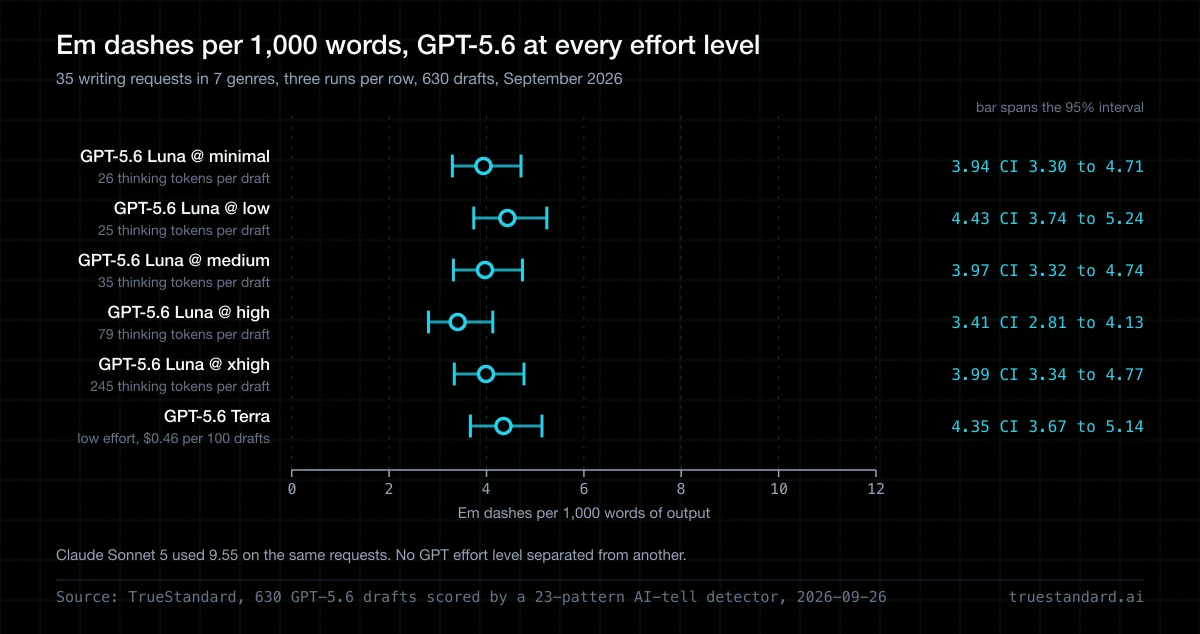
GPT-5.6 Luna lets you set how long it thinks before it writes, from minimal to xhigh. We ran all five levels on the same 35 jobs, three times each.
GPT-5.6 Luna at five effort levels, 105 drafts per level
| Effort | Em dashes per 1,000 words | All tells per 1,000 words | Thinking tokens per draft | Cost per 100 drafts |
|---|---|---|---|---|
| Minimal | 3.94 | 4.07 | 26 | $0.05 |
| Low | 4.43 | 4.33 | 25 | $0.05 |
| Medium | 3.97 | 4.33 | 35 | $0.05 |
| High | 3.41 | 3.77 | 79 | $0.06 |
| Xhigh | 3.99 | 4.06 | 245 | $0.10 |
Thinking tokens are the word pieces a model spends reasoning before it writes, as a median per draft. Every level's gap from minimal is small enough to be chance, for em dashes and for all tells. Lists of three held at 16 per 1,000 words at every level.
Xhigh thought about ten times as long as minimal and cost twice as much, and wrote the same way.
Terra costs ten times more and writes the same
GPT-5.6 Terra lists at ten times Luna's price per token. On these jobs it cost $0.46 per 100 drafts against Luna's $0.05. Its tells matched Luna's on every measure: 4.22 against 4.33 per 1,000 words, 4.35 against 4.43 em dashes.
If you pick Terra for better prose, this test gives you no reason to: on short drafts the cheaper model leaves the same tells.
Emails had almost none, LinkedIn posts the most
The kind of writing moved GPT's em dash count more than anything else. In emails, GPT-5.6 used 0.77 per 1,000 words. In LinkedIn posts it used 8.07, and in product copy 7.97, about ten times as many.
GPT-5.6 em dashes per 1,000 words by kind of writing, Terra and Luna pooled
| Kind of writing | Em dashes per 1,000 words |
|---|---|
| LinkedIn post | 8.07 |
| Product or marketing copy | 7.97 |
| Opinion piece | 4.95 |
| Blog post | 4.74 |
| How-to guide | 2.53 |
| Personal essay | 2.18 |
| 0.77 |
So an email from ChatGPT will rarely give itself away with a dash. A LinkedIn post will, about two or three times in 300 words.
How to get fewer em dashes from ChatGPT
Tell it not to. In November 2025, Tom's Guide reported that OpenAI's Sam Altman said ChatGPT now follows a custom instruction not to use them. Users still see the odd one slip through. We gave no instruction, so our counts are GPT's default.
The instruction only covers the dash. The lists of three stay. Our free AI slop detector flags all 23 tells we counted here and quotes each line, and the AI humanizer rewrites them.
None of this touches the facts. A GPT draft with no dashes and no lists can still quote a number nobody published. That is the part TrueStandard checks: paste your draft, and four models from different labs test each claim in about 60 seconds.
How we ran it
We wrote 35 plain requests, five each for seven kinds of writing. One was "Write a LinkedIn post about being laid off and looking for my next role in data analysis." Each asked for about 300 words and the text only. We set no tone, no style and no system prompt.
Each model got every request three times, on 26 September 2026, through OpenAI's API with low reasoning effort. Luna also ran at minimal, medium, high and xhigh. We gave every draft room for 32,000 tokens, or word pieces, so none was cut short. A script scored all 630 GPT drafts against the 23 patterns in our AI slop detector. No AI model graded anything.
These are short first drafts from a bare request. ChatGPT adds its own instructions and yours on top of the model, so its output can differ from ours. A flag is a pattern match. It is not a verdict. We left out GPT-6 Astra for cost.
We ran the same test on Claude and Gemini. The six-model comparison has all of them side by side.
FAQ
Does ChatGPT still use em dashes?
Yes. With no instructions, GPT-5.6 Terra and Luna used about 4.4 em dashes per 1,000 words in our September 2026 test, and 62% of their drafts had at least one. That is less than half of Claude Sonnet 5's rate of 9.55.
How do I stop ChatGPT from using em dashes?
Add "don't use em dashes" to ChatGPT's custom instructions under Personalization. OpenAI says ChatGPT now follows it, though some users still see one slip through. It will not remove GPT's other habits, like lists of three.
Who uses more em dashes, ChatGPT or Claude?
Claude. On the same 35 writing jobs, Claude Sonnet 5 used 9.55 em dashes per 1,000 words and Claude Haiku 4.5 used 6.04. GPT-5.6 Terra and Luna used about 4.4.
What is the biggest sign that ChatGPT wrote something?
Lists of three, in our test. GPT-5.6 wrote about 16 per 1,000 words, about five in a 300-word draft, twice Claude's rate. 86% of GPT drafts had more than our detector allows. It used stock words like "seamless" the least of any vendor.
Does GPT use fewer em dashes at higher reasoning effort?
No. GPT-5.6 Luna used between 3.4 and 4.4 em dashes per 1,000 words at all five effort levels, minimal to xhigh. The gaps were small enough to be chance, though xhigh thought about ten times as long.
Is GPT-5.6 the model inside ChatGPT?
ChatGPT runs OpenAI's GPT models with its own instructions, and your settings, on top. We called GPT-5.6 Terra and Luna directly with no instructions, so ChatGPT's output can differ from what we measured.
Keep reading
Multi-Agent vs Multi-Model AI in 2026
AI builders use both terms as if they meant the same thing. They are different architectures with different strengths. The difference matters most for the one job neither term sells: catching AI errors before you publish.
Long Context vs RAG in 2026
Three things just changed about how AI handles your documents. Here is what works for content teams, and why better retrieval still does not mean better truth.
AI Agent Workflow Patterns: When Each One Works (and When It Fails)
Six patterns cover almost every agent you'll build. Five are routine. The sixth, verification, breaks when you wire it with a single model, and most teams wire it that way.
Every Type of AI, Explained
From large language models to coding agents: what each type of AI does, which tools lead each group, and how to pick the right one for your work.
What Karpathy's AI Methods Don't Fix
In six weeks, Andrej Karpathy and AI builders shipped three viral reliability methods. Each is real and useful. None of them solves the checking problem for writers.
Check the claims in your GPT draft
A clean GPT draft can still cite a study that does not exist. Paste yours into TrueStandard. Four models from different labs check each claim and flag what none of them can back up, in about 60 seconds.
Check Your Draft →