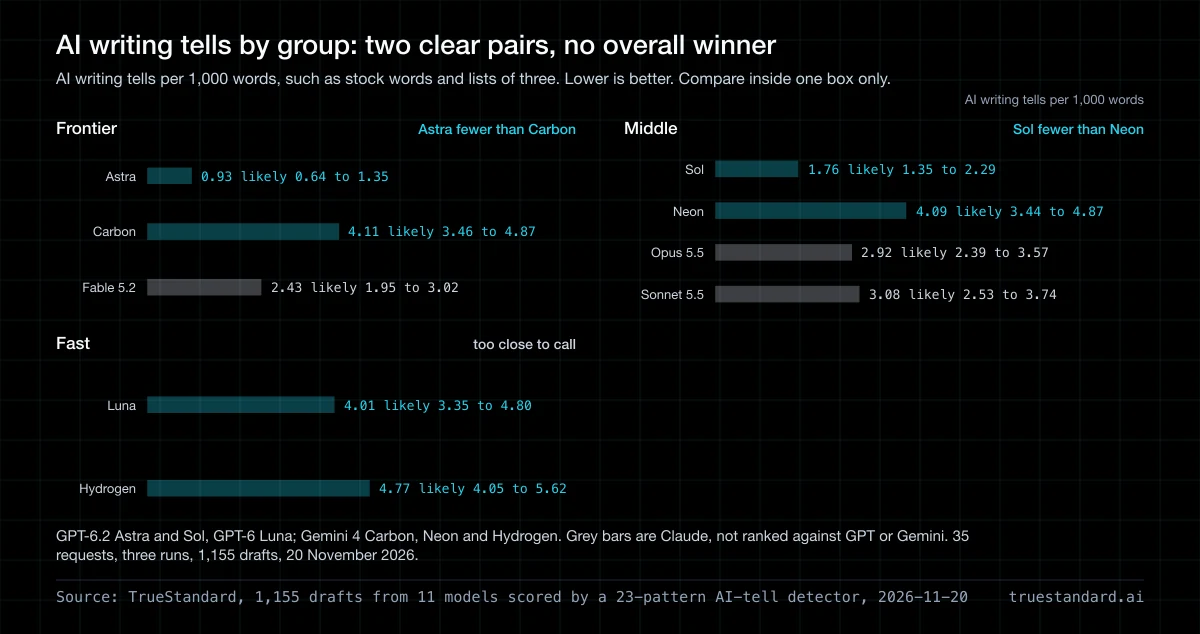
Which is the best AI model for writing? By our test, none yet. On 20 November 2026 we counted 23 AI writing tells, such as stock words and lists of three, in 1,155 drafts from 11 models. Two pairs split. GPT-6.2 Astra wrote 0.93 tells per 1,000 words and Gemini 4 Carbon 4.11. GPT-6.2 Sol wrote 1.76 and Gemini 4 Neon 4.09.
The newest Claude models almost stopped using em dashes. Claude Sonnet 5.5 wrote none in 32,831 words. Claude Sonnet 5, run the same way on the same day, wrote 11.46 per 1,000. We ran Claude through a different setup from GPT and Gemini, and a check on that setup failed. So we show Claude's rows but do not rank them against the other two labs.
No model wins overall, and two pairs split
We put the 11 models in three groups and compare them only inside a group. A model wins its group when it writes fewer tells than every group-mate. No group has a winner.
- Frontier
- GPT-6.2 Astra wrote fewer tells than Gemini 4 Carbon. Claude Fable 5.2 is shown but not ranked.
- Middle
- GPT-6.2 Sol wrote fewer tells than Gemini 4 Neon. Claude Opus 5.5 and Claude Sonnet 5.5 are too close to call, and neither is ranked against Sol or Neon.
- Fast
- GPT-6 Luna and Gemini 4 Hydrogen are too close to call.
Our rule: one model beats another only when it was lower in all three runs, and chance alone would give a gap that size less than 1 time in 20. We wrote the rule down before the first run.
Frontier: Astra wrote fewer tells than Carbon
The frontier group holds three models: GPT-6.2 Astra, Gemini 4 Carbon and Claude Fable 5.2.
Frontier models, tells per 1,000 words, 105 drafts each, 20 November 2026
| Model | Tells | Likely range | Runs 1, 2, 3 | Em dashes |
|---|---|---|---|---|
| GPT-6.2 Astra | 0.93 | 0.64–1.35 | 0.80, 0.90, 1.10 | 0.53 |
| Gemini 4 Carbon | 4.11 | 3.46–4.87 | 3.99, 4.22, 4.11 | 4.32 |
| Claude Fable 5.2 | 2.43 | 1.95–3.02 | 2.53, 2.29, 2.46 | 0.30 |
Both counts are per 1,000 words. Tells counts all 23 patterns, em dashes among them, and lower means fewer. The likely range is the 95% interval. The runs column shows each run on its own. Claude rows sit in the shaded rows at the bottom: they ran through Claude Code, so we do not rank them against the rows above.
Astra was lower than Carbon in all three runs. The gap was 3.17 tells per 1,000 words, likely 2.48 to 3.90. Chance alone would give a gap that size at most 1 time in 10,000 (p = 0.0001).
Most of the gap came from two habits. Carbon used too many lists of three in 63.8% of drafts and Astra in 21.0%. Carbon used a stock AI word like "seamless" in 21.0% of drafts. Astra used none.
Fable 5.2 wrote 2.43. Because Fable is not ranked, Astra cannot be called the group winner.
Middle: Sol wrote fewer tells than Neon
The middle group holds four models: GPT-6.2 Sol, Gemini 4 Neon, Claude Opus 5.5 and Claude Sonnet 5.5.
Middle models, tells per 1,000 words, 105 drafts each, 20 November 2026
| Model | Tells | Likely range | Runs 1, 2, 3 | Em dashes |
|---|---|---|---|---|
| GPT-6.2 Sol | 1.76 | 1.35–2.29 | 2.00, 1.16, 2.13 | 1.35 |
| Gemini 4 Neon | 4.09 | 3.44–4.87 | 4.30, 4.17, 3.81 | 4.81 |
| Claude Opus 5.5 | 2.92 | 2.39–3.57 | 2.68, 2.95, 3.13 | 0.12 |
| Claude Sonnet 5.5 | 3.08 | 2.53–3.74 | 2.78, 3.27, 3.18 | 0.00 |
Both counts are per 1,000 words. Tells counts all 23 patterns, em dashes among them, and lower means fewer. The likely range is the 95% interval. The runs column shows each run on its own. Claude rows sit in the shaded rows at the bottom: they ran through Claude Code, so we do not rank them against the rows above.
Sol was lower than Neon in all three runs. The gap was 2.33 tells per 1,000 words, likely 1.43 to 3.26 (p = 0.0001). 45 of Sol's 105 drafts had at least one tell, against 75 of Neon's.
Opus 5.5 and Sonnet 5.5 ran the same way, so they can be compared with each other. They are too close to call: 2.92 against 3.08 (p = 0.64).
Fast: Luna and Hydrogen are too close to call
The fast group holds GPT-6 Luna and Gemini 4 Hydrogen.
Fast models, tells per 1,000 words, 105 drafts each, 20 November 2026
| Model | Tells | Likely range | Runs 1, 2, 3 | Em dashes |
|---|---|---|---|---|
| GPT-6 Luna | 4.01 | 3.35–4.80 | 3.58, 4.35, 4.08 | 5.53 |
| Gemini 4 Hydrogen | 4.77 | 4.05–5.62 | 4.99, 4.72, 4.61 | 5.07 |
Both counts are per 1,000 words. Tells counts all 23 patterns, em dashes among them, and lower means fewer. The likely range is the 95% interval. The runs column shows each run on its own. Claude rows sit in the shaded rows at the bottom: they ran through Claude Code, so we do not rank them against the rows above.
Luna was lower in all three runs, but chance alone would give a gap that size about 1 time in 10 (p = 0.10). That misses our bar. Em dashes were close too: 5.53 for Luna and 5.07 for Hydrogen (p = 0.45).
Hydrogen's tell is the stock AI word: 23.8% of its drafts had one, most often "seamless" or "meticulous".
Gemini 4 Neon: praised on X, more tells in our count
On X, Siqi Chen (@blader) called Neon "by far the most human sounding, non-slop writing model". Katie Parrott (@kplikethebird) praised it too, with two caveats. She said you have to push it hard into a voice. She also said it slips into a few AI habits, like "not X, Y", that other labs have mostly trained out.
Our count backs her second caveat in general. Neon wrote 4.09 tells per 1,000 words and GPT-6.2 Sol 1.76, lower for Sol in every run. Most of Neon's extra tells came from three habits: stock AI words in 12.4% of drafts, too many lists of three in 61.9%, and 4.81 em dashes per 1,000 words. The "not X, Y" pattern itself was rare. Our "it is not X, it is Y" check fired in 3 of Neon's 105 drafts. Endings like "X, not Y" came to 0.36 per 1,000 words, against 0.51 for Sol.
Our count cannot test the first claim. Sounding human comes down to voice, rhythm and clarity, and a pattern count measures none of them. Neon can read well to people and still trip more of our patterns.
Neon is careful with sources, which is a separate skill. On 20 November 2026 we asked it 100 hard questions with no web access. It made up 0.4% of the citation IDs it gave, and it gave a real source on 76% of the questions. Our Gemini 4 Neon page has the citation test we ran the day before.
The newer Claude models dropped the em dash
Claude's three newer models wrote almost no em dashes. Claude Sonnet 5 ran the same way on the same day, as a check, and wrote 11.46 per 1,000 words.
Claude em dashes per 1,000 words, 105 drafts each, through Claude Code, 20 November 2026
| Model | Em dashes | Likely range | Runs 1, 2, 3 |
|---|---|---|---|
| Claude Sonnet 5 | 11.46 | 10.34–12.69 | 11.41, 11.60, 11.36 |
| Claude Fable 5.2 | 0.30 | 0.16–0.56 | 0.09, 0.37, 0.46 |
| Claude Opus 5.5 | 0.12 | 0.05–0.32 | 0.00, 0.00, 0.37 |
| Claude Sonnet 5.5 | 0.00 | 0.00–0.12 | 0.00, 0.00, 0.00 |
All four ran through Claude Code on the same day, so these rows compare with each other. The likely range is the 95% interval.
Each newer model was lower than Sonnet 5 in every run. Chance alone would give gaps that size about 1 time in 10,000 or less (p = 0.0001 each). Sonnet 5.5 wrote no em dash in 32,831 words.
They did not swap in another dash. Spaced hyphens stayed at zero, and spaced en dashes at 0.12 to 0.43 per 1,000 words, against 0.48 for Sonnet 5. They did add more headings: 54 to 59 of their 105 drafts had one, against 30 for Sonnet 5.
These counts come from Claude Code on a Claude subscription. We did not test the Claude API or the Claude app. Run this way, Sonnet 5 wrote more em dashes than in our September test: 11.46 against 9.55 per 1,000 words. So do not set these figures beside our earlier tables. The drop holds within one day and one setup.
A public test on GitHub found 0.05 em dashes per 1,000 words for Opus 5.5, close to our 0.12. Our Claude em dash post has the September counts.
What fewer tells means, and what it does not
A tell is a pattern match: a stock word like "seamless", a third em dash in one draft, too many lists of three. Fewer tells means a draft trips fewer of the patterns readers have learned to spot. It does not tell you whether the draft is clear, accurate or in your voice.
In one run, GPT-6.2 Astra's LinkedIn post about a first year in freelance design opened with a story the model made up. Our count scored that draft at zero tells. Nothing in the test checks for an invented story.
We also have no human baseline. We did not count tells in writing by people, so we cannot say how many a good human writer leaves.
A draft with no tells can still state a fact nobody checked. That is the part TrueStandard checks: paste your draft, and four models from different labs test each claim in about 60 seconds.
Neon and Hydrogen thought before they wrote
We set every model to low reasoning effort. At that setting, Gemini 4 Neon spent about 996 tokens (word pieces) thinking before each draft, and Gemini 4 Hydrogen about 920. Carbon, Astra and Sol spent none, and GPT-6 Luna 25. So low was not the same thinking budget for every model.
Neon still wrote more tells than Sol. We cannot say how Neon or Hydrogen would score with thinking off, or the others with it on. The thinking was also most of Neon's cost: $2.19 for 105 drafts, against $0.38 for Sol.
How we ran it
We used 35 plain writing requests, five each for seven kinds of writing: blog posts, emails, product copy, opinion pieces, personal essays, LinkedIn posts and how-to guides. Each asked for about 300 words and the text only. We set no tone and no style.
Every model got every request three times on 20 November 2026, 1,155 drafts in all, with no errors. GPT ran on OpenAI's API and Gemini on Google's. Claude ran through Claude Code on a Claude subscription, with a one-line system prompt. Claude Code adds some setup text of its own.
A script scored each draft against the 23 patterns in our AI slop detector. It is plain pattern matching, and no AI model graded anything. We compare models only inside their group.
Before the first run, we also wrote down a check for each setup: one model we had tested before, run again. The GPT and Gemini checks matched their October counts. The Claude check, Sonnet 5, wrote more em dashes than in September. That is why Claude's rows are not ranked against the others.
This is one day and one task: short first drafts from a plain request. A style guide, a longer piece or a chat app could change the counts.
Our em dash comparison has the September and October tests. Our free AI slop detector runs the same 23 checks on your own draft.
FAQ
What is the best AI model for writing?
No model won overall in our 20 November 2026 test. Inside its group, GPT-6.2 Astra wrote fewer AI tells than Gemini 4 Carbon, and GPT-6.2 Sol fewer than Gemini 4 Neon. We do not rank Claude against GPT or Gemini, and the test does not judge clarity, accuracy or voice.
Is Gemini 4 Neon good at writing?
Some people on X call it the most human-sounding model, and our test cannot measure that. It counts patterns. Neon wrote 4.09 tells per 1,000 words against 1.76 for GPT-6.2 Sol, and Sol was lower in every run.
Does Claude still use em dashes?
The newest models barely do. Run through Claude Code on 20 November 2026, Claude Fable 5.2 wrote 0.30 per 1,000 words, Opus 5.5 0.12 and Sonnet 5.5 none. Claude Sonnet 5, run the same way, wrote 11.46. We did not test the Claude API or the Claude app.
Is ChatGPT or Gemini better for writing?
In two of our three groups, the GPT model wrote fewer tells: Astra against Carbon, and Sol against Neon. In the fast group, GPT-6 Luna and Gemini 4 Hydrogen were too close to call. We tested the models through their APIs, not the ChatGPT or Gemini apps.
Does fewer AI tells mean better writing?
No. A tell is a pattern match, like a stock word or a third em dash. A draft with none can still be unclear or wrong. One draft our count scored at zero opened with a story the model made up.
Keep reading
Multi-Agent vs Multi-Model AI in 2026
Multi-agent AI runs many roles of one model. Multi-model AI runs different models from different labs. Only multi-model can catch an error the first model is blind to.
What Is Context Rot?
An agent gets less reliable as notes, history and tools pile up. Here are four ways it fails.
AI Agent Workflow Patterns: When Each One Works (and When It Fails)
Six patterns cover almost every agent you'll build. Five are routine. The sixth, verification, breaks when you wire it with a single model, and most teams wire it that way.
Every Type of AI, Explained
From large language models to coding agents: what each type of AI does, which tools lead each group, and how to pick the right one for your work.
Karpathy's 3 AI Methods, and What They Don't Fix
Andrej Karpathy's three 2026 methods are autoresearch, the LLM Wiki and brevity constraints. Autoresearch tunes metrics, the wiki organizes memory, and brevity cuts reasoning loops. None of them checks whether a writer's claims are true.
Check the facts in your AI draft
A draft can pass every style check and still cite a study that does not exist. Paste yours into TrueStandard. Four models from different labs check each claim and flag what none of them can back up, in about 60 seconds.
TrueStandard is for writers who publish AI-assisted drafts. Paid plans check every claim and citation across four AI models before you hit publish.
Free: one check a day, no signup. Pro is $20 a month for 250 drafts.
Check Your Draft →