Every ChatGPT vs Claude vs Gemini comparison reaches a verdict on accuracy. Almost none of them measured anything. Ask Google which of the three is most accurate and its own summary answers Claude, drawn from pages that ran no test. We run a citation-fabrication benchmark across all three, so we can tell you what turns up when somebody does measure it.
On the run we finished on 10 August, the model the consensus calls the most accurate produced the most fake sources of the three. A week earlier it sat in the middle, on the same claims and the same prompt. Both numbers are ours and both are real.
The short answer
All three plans cost about twenty dollars, and what the reviews agree on is roughly right. The accuracy ranking they add on top is the one thing nobody tested.
The three plans, and the one column that is actually measured
| Plan | What the reviews agree it is for | Model we tested | Fabricated sources, 10 Aug |
|---|---|---|---|
| Google AI Pro | Google Workspace, video, the widest bundle | Gemini 3.1 Pro | 0.0% (0 of 41) |
| ChatGPT Plus | Generalist daily driver, images, breadth | GPT-5.6 Sol | 7.7% (3 of 39) |
| Claude Pro | Writing, coding, long documents | Claude Sonnet 5 | 13.3% (6 of 45) |
Do not buy on that last column. It is the most honest number on this page, and it still cannot rank these three. We ran the identical test seven days earlier, and Claude came out at 7.0% and Gemini at 4.7%. Claude nearly doubled and Gemini went to zero, with no model release in between.
That movement is worth more to you than the ranking. It tells you what a twenty dollar decision can and cannot be made on.
Every review picks an accuracy winner
Pull the first page of results for this question and you get comparison posts from a dozen sites. Most are careful and useful on the things you can see. They agree on the shape: ChatGPT for breadth, Claude for writing and code, Gemini for anything that touches Google.
Then each one reaches an accuracy verdict. Claude wins for accuracy. Claude handles ambiguity better and produces outputs that are easier to trust. Claude is the most reliable for multi-step reasoning. Read four of these pages and you meet the same claim four times. Four ways of phrasing it, sourced to nothing.
We fetched the two closest ranking pages to check. One is a 4,000-word piece that runs real prompts through all three models and screenshots the answers. Its accuracy section is a general warning that chatbots hallucinate. The other says up front that the author paid for all three and ran the same work through each. Then it reaches a buying recommendation with no accuracy measurement anywhere in it.
The pattern holds off the search page too. Take a plan review that landed this month, 34,000 views in five days. It tells its audience that one model tends to stay closest to the facts on long answers, and invents less when a question gets complicated. No test, no number, no source. In the comments underneath, one viewer said they had cancelled a subscription that day on the strength of it.
The reviewers are not being sloppy. Usage limits, connectors, storage and video are all things a careful person can check in a month with three subscriptions open. Fabrication rate is not. It needs a frozen claim set, a registry lookup, and a scoring pass that no model is allowed anywhere near. None of that fits in a review cycle.
So the accuracy leg is the one you cannot outsource to a reviewer. You can borrow somebody else's judgment on whether the video generator is any good. You cannot borrow their judgment on whether the thing you are about to publish is true. TrueStandard runs your draft past four models from different labs at once. It surfaces every claim they cannot agree on, in about 60 seconds.
What we measured on all three
Our benchmark asks a model for peer-reviewed sources on 30 frozen claims. Half have real literature behind them, and half were constructed for the test with none. Every DOI that comes back gets resolved against Crossref and DataCite, the two registries that issue them. A DOI that exists in neither is scored fabricated. No language model touches the scoring path, because a test about models inventing detail cannot be graded by a model.
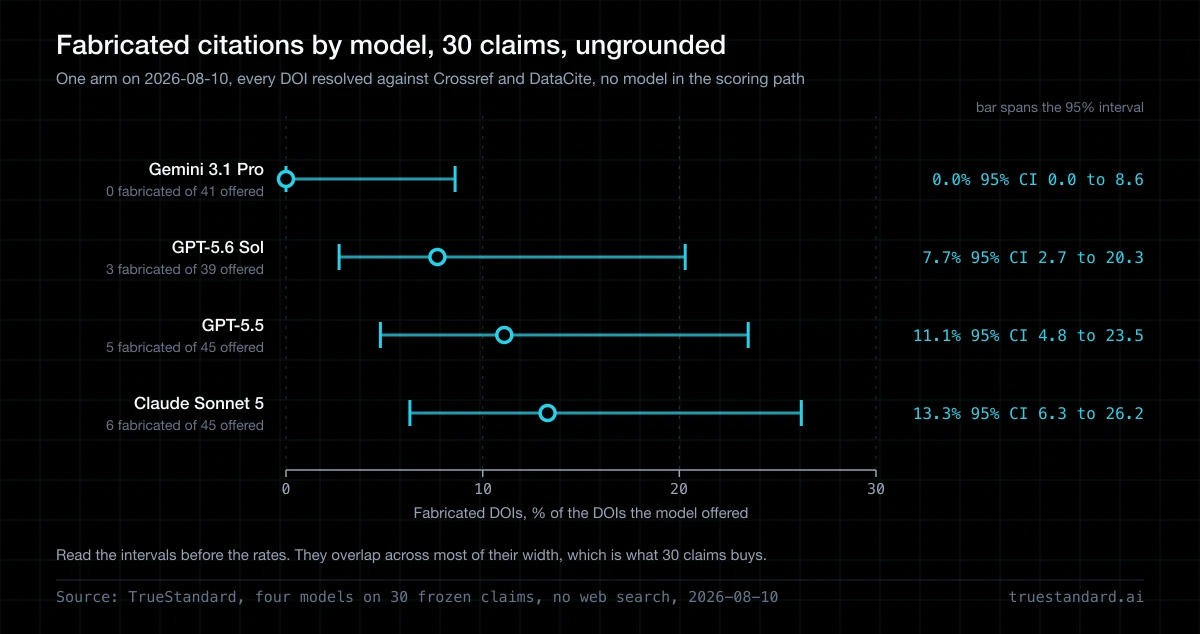
Fabricated citations by model, 30 claims, ungrounded, 2026-08-10
| Model | Sources given | Fabricated | Rate | 95% interval |
|---|---|---|---|---|
| Gemini 3.1 Pro | 41 | 0 | 0.0% | 0.0 - 8.6% |
| GPT-5.6 Sol | 39 | 3 | 7.7% | 2.7 - 20.3% |
| GPT-5.5 | 45 | 5 | 11.1% | 4.8 - 23.5% |
| Claude Sonnet 5 | 45 | 6 | 13.3% | 6.3 - 26.2% |
Read the intervals before the rates. Gemini's runs from 0.0% to 8.6%, and GPT-5.6's from 2.7% to 20.3%. Those two ranges overlap across most of their width, on 30 claims. That is what a small sample buys you. The gap you can see in the middle column is thinner than it looks.
The shape of the failures matters more than the count. In our first run, all 21 fabrications landed on claims that have genuine published literature behind them. Not one landed on a claim we invented. Partial knowledge is the danger zone. The model knows the topic and roughly which paper answers it, then invents the identifier. Claude gave us a handwashing citation with the right journal, right year and right author, and a DOI that does not exist. Nothing about it looks wrong until you resolve it.
The full study covers all four original models, every claim and every individual verdict. It is written up in our four-model citation benchmark. For the published academic numbers instead of ours, see the 2026 hallucination-rate reference.
Corrected, 17 September 2026: this page first reported Claude at 24.4% and 14.0%, Gemini at 2.4% and 11.6%, and two significant gaps in the 10 August run. Those figures came from a scorer that checked Crossref alone. arXiv registers its DOIs with DataCite, so real preprints were counted as fabrications. Re-scored against both registries, Claude is 13.3% and 7.0%, Gemini 0.0% and 4.7%. And one gap clears the bar instead of two. Claude still came out highest on 10 August. The week-to-week movement is still the point of the page.
The same test, one week apart
On 10 August we kept every model from the previous run in the same arm. That turned the run into something we had not done before: an exact repeat. Same 30 claims, same prompt, same settings, same scorer. Seven days later, with no model version changing in between.
If the measurement is stable, every row should barely move.
Identical claims, identical settings, one week apart
| Model | 3 Aug | 10 Aug |
|---|---|---|
| GPT-5.5 | 8.9% | 11.1% |
| Claude Sonnet 5 | 7.0% | 13.3% |
| Gemini 3.1 Pro | 4.7% | 0.0% |
GPT-5.5 went from four fabrications out of forty-five to five. Grok 4.3, also in both runs, went from five to six. The pipeline is deterministic and the questions did not change, so the movement belongs to the models. And it was uneven.
Claude nearly doubled, from three fabrications to six, and Gemini went from two to none. On 3 August the three were separated by about four points, and you could not tell them apart. On 10 August they were separated by thirteen, and Gemini looked untouchable.
What that invalidates
Our 10 August run produced a pairwise gap that clears the usual significance bar. That is Gemini against Claude, at p = 0.027. Run the identical comparison on the 3 August data and it returns p = 1.0. It depends on Claude sitting at a one-week high and Gemini at a one-week low, on the day we happened to measure. A p-value computed inside a single run knows nothing about the variance between runs, so it is more confident than the evidence deserves.
So we will not publish that as a vendor finding, and nobody quoting this page should either. Our earlier caution was that 30 claims cannot rank vendors, and this run forced a harder version on us. One run cannot rank vendors at any sample size. Ranking needs repeated sampling across days, and two data points is where we are.
Here is the practical reading for a subscriber. The gap between one model's good week and its bad week was larger than the gap between most of the models. Picking the safest vendor is not a strategy when the safest vendor is a coin that lands differently on Monday. Running the same claim past several models at once is what TrueStandard does instead. A claim several independent labs corroborate is standing on something firmer than one vendor's Tuesday.
ChatGPT Plus
$20 / monthWhat it is bought for
The generalist, with image generation that has the strongest text-inside-the-image handling of the three. The deepest third-party integrations, a cloud coding agent, and the clearest usage allowance on the market. OpenAI publishes an actual message count and an actual reset window. The other two weigh how heavy your requests are and leave you guessing.
What we measured
GPT-5.6 Sol fabricated 3 of the 39 sources it offered, a rate of 7.7%. Its interval runs to 20.3%, and its predecessor GPT-5.5 sat at 11.1% in the same arm. The point estimate fell by about a third, but a Fisher exact test returns p = 0.719, so this test cannot show the drop is real.
One thing did change in kind, not degree. On the 15 claims we invented, GPT-5.6 emitted no source at all. Those are the ones with no literature behind them. Fifteen out of fifteen declined, where GPT-5.5 had leaked on two. A model that says nothing when it has nothing is doing the thing that protects you. That behaviour is worth more than a point or two off a rate.
Best for
Anyone who wants one assistant that does most things well and would rather know exactly when they will hit the ceiling. It is also the least surprising of the three, which counts for more than people admit.
The full generational comparison, including why we published a null result, is in our GPT-5.6 write-up. For ChatGPT accuracy on its own terms, see how accurate ChatGPT actually is.
Claude Pro
$20 / monthWhat it is bought for
Writing and code, mostly: its prose reads less like a machine than the other two. It can take a sample of your writing and match the tone. It keeps projects as saved workspaces, so the context survives between sessions. On the coding benchmarks it leads, and its desktop agent works on the ordinary files sitting on your own machine, not only on a code repository.
What we measured
Claude Sonnet 5 fabricated 6 of the 45 sources it offered on 10 August. That is a rate of 13.3%, the highest of the three plans. On 3 August, same test, it was 7.0%. In our first run it was 26.5%, under a prompt that told the model declining was acceptable. Across every version of this test we have run, Claude's number has never been the lowest. It has never been in the same place twice.
The caveat that matters
We tested Sonnet 5. Claude Pro's headline model is Opus 4.8, which we have not put through this benchmark. So this is not a measurement of the model most Claude Pro subscribers open by default. We are not going to pretend otherwise. Here is what it does show: the whole first page of Google calls this vendor the most accurate. On the one axis anybody has actually measured, it came out highest of the three in two of our three runs, and never lowest.
Best for
People whose output is words or code, who will read every line before it goes anywhere. The tighter usage ceiling is the real trade, not the fabrication rate. You should be checking sources whichever of the three you pay for.
Google AI Pro
About $20 / monthWhat it is bought for
You are buying a bundle more than an assistant. It is the only one of the three that generates video. Its image editing is level with ChatGPT's on photo work, and it drops into Gmail, Docs and Sheets, where the work already happens. On top of the assistant you get cloud storage, higher research-tool limits and a set of perks unrelated to chat. That is why it wins the value argument on every comparison page without much of a fight.
What we measured
Gemini 3.1 Pro fabricated none of the 41 sources it offered on 10 August. Read the interval anyway: 0.0% to 8.6%. None out of 41 does not mean a rate of zero. And read the week before, where the identical test put it at 4.7%, two fabrications.
So here is the honest sentence about Gemini: it had an exceptional week on a small test. We cannot tell you yet whether that is the model or the day. Anyone quoting zero as Gemini's fabrication rate is quoting one Monday.
Best for
Anyone already living inside Google Workspace, and anyone who wants the most tool per dollar. It is also the one least likely to cut you off mid-afternoon. For heavy users that decides more than any benchmark does.
Your plan does not pin your model
There is a structural reason the accuracy column on every comparison page goes stale faster than the rest of the table. You are not buying a model. You are buying a subscription that points at whichever model the vendor has decided to serve this week.
GPT-5.6 Sol became callable on 9 July, and our own benchmark was rebuilt on 3 August. It still measured GPT-5.5 as OpenAI's current model, 25 days after its successor shipped. We published a fabrication rate for a model that had already been replaced. It was the second time we had done it. In the comments under that plan review, somebody asked whether ChatGPT was not already on 5.6. They were right. The video was out of date on the day it went up.
So even a correctly measured accuracy number is attached to a model your subscription can swap out from under you. No email, in the middle of a billing cycle. Our GPT rows are a case in point: two generations of the same family, four points apart. Both of them inherited the same two invented identifiers verbatim.
A generation change did not disturb either fabrication. Both are stable artifacts of how that family completes a citation pattern. One of them is a JSTOR identifier, which Gemini invented independently for the same claim in an earlier run. Three model instances, two vendors, two generations, one record that has never existed.
Which sets a limit on cross-checking too. Comparing models works because independent models fail independently, but two models completing the same pattern can fail identically. That is why our benchmark resolves identifiers against a registry instead of asking one model to grade another. It is why TrueStandard shows you the disagreements instead of one confident verdict. A claim four labs agree on is a stronger bet. It is still a bet, and you should be able to see the seams.
How to choose without an accuracy verdict
Take the accuracy column out of the decision. It is not stable enough to buy on, and it will have moved before your second invoice. What is left is workflow, ceilings and what else comes in the box. You can check all of that yourself in a week.
Which twenty dollars, by what you actually do
| If you | Buy | Because |
|---|---|---|
| Live in Gmail, Docs and Drive | Google AI Pro | The integration is native and the bundle is the widest of the three at the same price |
| Want one assistant for everything | ChatGPT Plus | Strongest image work, deepest integrations, and the only published usage numbers you can plan around |
| Write or ship code for a living | Claude Pro | The prose reads most naturally, it leads on coding, and its desktop agent works on your own files |
| Need video | Google AI Pro | It is the only one of the three that generates video at all |
| Use AI hard, all day | Google AI Pro | Compute-weighted limits are the most forgiving; Claude runs out fastest and drops you to nothing |
| Publish anything with sources in it | Any of them, then check | The best rate we have measured on any model still means one fake source in roughly forty |
The part that does not change with the plan
Whichever you pick, the number that should govern how you work is the one at the top of the range, not the middle. Gemini's interval runs to 8.6%, GPT-5.6's to 20.3%, and Claude's to 26.2%. Those are the numbers to plan against. None of them is low enough to publish a sourced claim without resolving it.
We wrote up the conceptual version of this argument, not the buying version. It is whether a most accurate AI model exists at all. There is also why picking the model that hallucinates least is the wrong move.
Buy the one that fits your week. Then treat every source it hands you as unverified. On the only axis that has been measured, the leader changed between two Mondays.
FAQ
Which is most accurate, ChatGPT, Claude or Gemini?
On our 10 August run, Gemini 3.1 Pro fabricated none of its citations. GPT-5.6 Sol came in at 7.7% and Claude Sonnet 5 at 13.3%. We do not think that is a ranking. The identical test seven days earlier put Claude at 7.0% and Gemini at 4.7%, with no model version changing in between. Here is the honest answer: the three are close enough, and the measurement noisy enough, that one run cannot be trusted to separate them.
Is Claude really the most accurate AI model?
That claim is repeated across most comparison pages, and we have not found a measurement behind it. We test one axis: whether the sources a model gives you exist. On that axis Claude Sonnet 5 has come out highest of the three in two of our three runs, and never lowest. It scored 26.5% under our first prompt, then 7.0% and 13.3% under the current one. Claude Pro's default model is Opus 4.8, which we have not benchmarked. So this is not a verdict on the model most subscribers use. It does mean the consensus is running on reputation, not data.
Which $20 AI plan is worth it?
Google AI Pro for the widest bundle and the most forgiving usage limits. ChatGPT Plus for a predictable generalist with the best image tools. Claude Pro if your day is writing or code. Do not let a claimed accuracy advantage break the tie. That number moves ten points week to week on the same test.
How often does ChatGPT make up sources?
In our latest run GPT-5.6 Sol invented 3 of the 39 sources it volunteered, about one in thirteen. The 95% interval runs from 2.7% to 20.3%. Its predecessor GPT-5.5 invented 5 of 45. Every fabrication landed on a topic with real published literature behind it. That is what makes them hard to spot: right journal, right author, right year, identifier that resolves to nothing.
Why do accuracy rankings between AI models keep changing?
Partly because vendors ship new models every few weeks, and partly because the tests are small. We re-ran 30 identical claims a week apart with nothing changed. Two of five models moved about ten points. At that sample size, run-to-run variance is larger than the gap between most of the models. So a leaderboard built on one run is measuring the day as much as the model.
Does paying for a plan get you a more accurate model?
It gets you a bigger model and a higher usage ceiling, not a factual guarantee. Every model in our benchmark was a current paid-tier frontier model. The best of them still invented a source. The gains from paid tiers show up in reasoning depth, context length and usage ceilings. None of them decides whether a citation exists.
Can I trust an AI comparison that did not run a test?
On the things you can see, usually yes. Usage limits, connectors, storage, video and the feel of the writing are all checkable by one person with three subscriptions. Accuracy is not. It needs a claim set that never changes and a scoring pass with no model anywhere in the loop. When a comparison asserts an accuracy winner with no method attached, treat that line as an impression, not a finding.
What should I do about fake citations regardless of which plan I buy?
Resolve every identifier before you publish. A DOI that does not open is the fastest tell, and it catches the failure mode that looks most convincing. For anything longer than a paragraph, run the draft past several models from different labs, then read what they disagree on. Independent models tend to fail on different claims.
Keep reading
Is There a Most Accurate AI Model?
The honest answer is no. The ranking changes with the task, the benchmark, and the month, and even the leader still hallucinates.
Every AI Tier List Measures the Same Six Things. Truth Isn't One.
A developer who built a $200k business on AI ranked 11 companies and 17 models across six categories. It is a good ranking. But in 27 minutes the words hallucination, accurate and sycophancy never come up. And one model gets marked down, in so many words, for checking its work. So we ran the missing column ourselves: nine models, both failure modes, three times each. It separates, and it does not agree with any capability ranking.
The Same Model Fabricated at 10.9% and 30.9%
Take one generation of models: published hallucination rates for it run from under 2 percent to over 60. The standard explanation is that different labs test different things, and that is true. Almost nobody has tested it directly, so we did. One model, one prompt, one scorer, three runs a side, and only the questions changed.
A Quiet Model Wins Your Benchmark
Two models posted the lowest sycophancy scores in our field, and both had stopped answering. The scorer could not tell the difference.
GPTZero's Hallucination Detector, Explained
It catches citations that don't exist. By GPTZero's own admission, it does not check whether what you wrote is true. Here is exactly what its hallucination and source tools do. Here is where the gap is, and what closes it.
What we measured on this model
Each release page carries our own fabrication data for one model version, measured against the model it replaced in the same vendor's line.
The leader changed between two Mondays. Check the sources anyway.
The lowest fabrication rate we have ever measured on any model still means about one invented source in forty. And the model that posted it was middle of the pack the week before. No subscription solves this, and switching vendors does not either. Paste your draft into TrueStandard, and four models from different labs check every claim in parallel. They flag what none of them can corroborate in about 60 seconds.
Check Your Draft →